

History is replete with seemingly unexpected and catastrophic appearance of events that nobody saw coming. In the old days, we had biblical prophets who sounded clarion alarms. Now, we are past the age of prophecy. As in historical watersheds, we suddenly find ourselves congealed in the volcanic ash of a modern Vesuvius eruption. That leads us to scratch our heads, wondering how in the world we came to this point of rare earth element (REE) supply fears. Where were all the environmentalists who are aware of how rare earths are used in clean energy? Where were the technology companies whose profitable patents are dependent upon? Did not the most scholarly minds at our most eminent universities hear the honking of the black swans? I guess not. Our academicians, business leaders and legislators were enjoying their own Rip Van Winkle reveries, while China was wide awake co-opting the REE arena to control over 97% of the world's supply.
It is easy to accuse China of using rare earth quotas as a form of tactical diplomacy. However, the fault lies not in the stars but in ourselves. We closed our REE production facilities years ago—in effect, forfeiting the very means of manufacture to a competitor giant who no longer is sleeping. Now the country can claim that it is setting up quotas to prioritize its own domestic needs. In reality, highly profitable technologies are dependent upon these 17 unique elements and China is trying to get a larger share of the mobile, computer and green technologies, especially as it begins preparing for an economic slowdown from hawkish monetary policies.
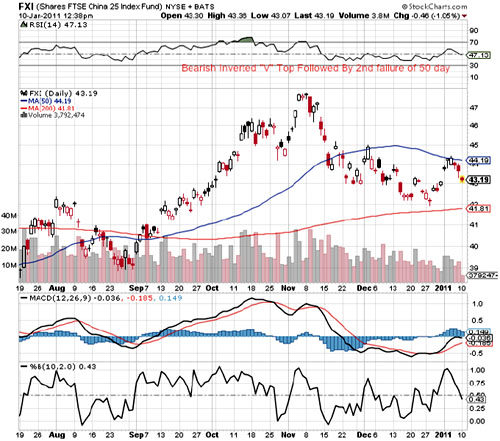
Since November, China has shown an inverted V top and is now failing at the 50-day moving average for the second time in danger of crashing through the 200-day moving average. Wars are no longer fought on battlefields—they are fought in boardrooms. Now China wants to take advantage of its +20 years of being the sole provider of heavy rare earth elements (HREEs) and monopolize a commodity for which demand is growing rapidly.
China, at one point, looked abroad for REE projects and it may start doing so again. Recent legislation in the U.S. may bring more of a domestic awareness, but it is very late. Many of these mines outside China are years away from development, especially the critical HREEs for which there is no separation facility outside of China.
The United States, for all its vaunted scientific know-how with all its battalions of university savants, left the heavy lifting to China long ago. It reminds me of Rome, which invited the Visigoths to enter the gates.
We are akin to a nation of Sonny Liston's who never saw Ali's knockout punch coming. It may be hindsight to accuse our politicians and leaders of malfeasance, not understanding the vital need for these elements by our industrial giants in the latest cutting-edge technologies like Apple—for its IPhones and IPads; GE for its wind turbines; GM for its hybrid cars; and numerous applications, such as night-vision goggles, in the U.S. defense industry. Meanwhile, our nation careens along blindly in search of a way out of this morass. Sadly, we re-enter a race that once was ours to win as the major developers of REE technology decades ago. And now, we find ourselves four to five years behind.
Out of a field of many contestants in the rare earth sector, perhaps one or two are close to the finish line of producing outside China. Investing in REE mining is completely different than investing in gold or silver. Rare earths become quite costly during the separation process and very few projects may be economically viable. Although the mania phase is upon us and investors get caught up with all the speculative rare earths promising a dream, I would stick only to the ones that are advanced and at least have an NI 43-101-compliant prefeasibility study.
In late December, I came out with a rare earths report when I saw signs of an immediate quota cut. Notice the huge volume coming in to rare earths stocks immediately after the export quota reduction. I would wait for a secondary buy point for long-term investors.
Jeb Handwerger
Editor, Gold Stock Trades
It is easy to accuse China of using rare earth quotas as a form of tactical diplomacy. However, the fault lies not in the stars but in ourselves. We closed our REE production facilities years ago—in effect, forfeiting the very means of manufacture to a competitor giant who no longer is sleeping. Now the country can claim that it is setting up quotas to prioritize its own domestic needs. In reality, highly profitable technologies are dependent upon these 17 unique elements and China is trying to get a larger share of the mobile, computer and green technologies, especially as it begins preparing for an economic slowdown from hawkish monetary policies.
Since November, China has shown an inverted V top and is now failing at the 50-day moving average for the second time in danger of crashing through the 200-day moving average. Wars are no longer fought on battlefields—they are fought in boardrooms. Now China wants to take advantage of its +20 years of being the sole provider of heavy rare earth elements (HREEs) and monopolize a commodity for which demand is growing rapidly.
China, at one point, looked abroad for REE projects and it may start doing so again. Recent legislation in the U.S. may bring more of a domestic awareness, but it is very late. Many of these mines outside China are years away from development, especially the critical HREEs for which there is no separation facility outside of China.
The United States, for all its vaunted scientific know-how with all its battalions of university savants, left the heavy lifting to China long ago. It reminds me of Rome, which invited the Visigoths to enter the gates.
We are akin to a nation of Sonny Liston's who never saw Ali's knockout punch coming. It may be hindsight to accuse our politicians and leaders of malfeasance, not understanding the vital need for these elements by our industrial giants in the latest cutting-edge technologies like Apple—for its IPhones and IPads; GE for its wind turbines; GM for its hybrid cars; and numerous applications, such as night-vision goggles, in the U.S. defense industry. Meanwhile, our nation careens along blindly in search of a way out of this morass. Sadly, we re-enter a race that once was ours to win as the major developers of REE technology decades ago. And now, we find ourselves four to five years behind.
Out of a field of many contestants in the rare earth sector, perhaps one or two are close to the finish line of producing outside China. Investing in REE mining is completely different than investing in gold or silver. Rare earths become quite costly during the separation process and very few projects may be economically viable. Although the mania phase is upon us and investors get caught up with all the speculative rare earths promising a dream, I would stick only to the ones that are advanced and at least have an NI 43-101-compliant prefeasibility study.
In late December, I came out with a rare earths report when I saw signs of an immediate quota cut. Notice the huge volume coming in to rare earths stocks immediately after the export quota reduction. I would wait for a secondary buy point for long-term investors.
Jeb Handwerger
Editor, Gold Stock Trades