


John le Carré (the pen name of David John Moore Cornwell, 1931–2020) was a renowned British author who redefined the espionage thriller. Drawing on his own background as a real-life British intelligence officer, he became famous for portraying espionage as a grim, morally ambiguous world rather than a glamorous James Bond-style adventure. After studying German at the University of Bern and Oxford, he taught briefly at Eton College before joining Britain's security service (MI5) in 1958 and transferring to the foreign intelligence service (MI6) in 1960.
While working under diplomatic cover in West Germany, he wrote his first novels. Because British intelligence officers were forbidden from publishing under their real names, he adopted the pseudonym John le Carré. His intelligence career ended in 1964 after British double agent Kim Philby betrayed the identities of numerous British spies—including Cornwell—to the Soviet Union.
This week, the U.S. capital markets were blindsided by a revelation right out of a John le Carré novel. The CEO of the most valuable public company in the world— Nvidia Corp. (NVDA:NASDAQ)—was forced by the Board of Directors to step down and on Thursday, Jensen Huang resigned his position as CEO sending the shares of the company he co-founded (alongside electrical engineers Chris Malachowsky and Curtis Priem) in April 1993 careening into a downward spiral culminating in a Friday resting point at around $160 per share, officially in "bear market" territory while lopping off over US$1.8 trillion (with a "t") in market cap. Jensen himself has seen his personal net worth, estimated to have been at over US$200 billion at the peak, pared by around US$65 billion all in the name of love and lust, proving once again that while testosterone is the primary male sex hormone that creates strong, aggressive leaders, it is also the Achilles' Heel in many powerful male figures in history. Examples of other fallen leaders include Jeff Zucker (2022), the president of CNN, Steve Easterbrook (2019), CEO of McDonald's, Brian Krzanich (2018), CEO of Intel, and Harry Stonecipher (2005), CEO of Boeing, all of whom were caught literally with their pants down.
Other notables include President Bill Clinton and the Monica Lewinsky Affair, as well as Gary Hart, a presidential candidate in the 1988 race until busted in May of 1987. It seems that for women, positions of power in males act as a sexual pheromone, a chemical substance produced and released into the environment by an animal or insect that triggers a specific sexual behavioral or physiological response in other members of the same species.
The lady in charge of the skullduggery this past week is Alice Huang (also known by her Chinese name, Huang Le, and no relation to Jensen Huang), who is the Chinese businesswoman at the center of the scandal. U.S. intelligence officials have identified her as a suspected Chinese intelligence asset who used her relationship with the Nvidia CEO to access restricted American AI chips. Now we have seen this countless times over the past few decades in an espionage caper known as the "honeytrap". The Soviet KGB and East German Stasi turned sexual espionage into an institutional science. The KGB trained female operatives known as "Swallows" or "Mozhno girls" to compromise foreign diplomats for blackmail, while East German spymaster Markus Wolf deployed dozens of male "Romeo spies" to romance and recruit lonely West German government secretaries.
In fact, the earliest historical record comes from the Bible, where early recorded examples include the biblical story of Samson and Delilah—where the Philistines bribed Delilah to seduce Samson and learn the secret of his strength—as well as ancient Chinese military treatises like Sun Tzu's The Art of War, which discussed using "beauty traps" to distract and compromise enemy leaders.
While prostitution as a profession dates back to Mesopotamia 2400 BCE, the allure of sexual intrigue has been the damnation of dunces and geniuses alike. If someone had asked me nine months ago to pinpoint the one event that would put an end to the messianic bull market called "the AI buildout", I would never have thought that it would boil down to the one vulnerability that weakens men the world over. It matters not what you possess in money, power, intellect, or willpower, when it comes to "matters of the crotch"; men are walking, talking, squawking bull's-eyes.
The mainstream media has been led to believe that Jensen Huang was forced to resign due to his "romantic affair" with Alice Huang, but as the days wore on this week, more information has started to bubble to the surface regarding U.S. National Security breaches, and unsurprisingly, all trails are leading back to the one place we would all expect—the White House!
It seems that this Congressional Hearing scheduled for next week is going to be probing a company run by Ms. Huang called Megaspeed International, where she acquired control in early 2023 as "controlling shareholder" and top executive of this cloud-computing and data center firm based in Singapore.
The plot began to thicken when it was learned that shortly after Megaspeed was established in Singapore, Nvidia named the firm a "preferred cloud partner". According to reporting from CNBC and Bloomberg, Megaspeed purchased at least $7.5 billion worth of advanced Nvidia AI hardware and allegedly funneled restricted chips into Chinese data centers in violation of U.S. export controls.
Eventually, the U.S. intelligence agencies placed Alice Huang under electronic surveillance and concluded she was working as a Chinese spy. In February 2026, Singaporean authorities barred her from re-entering the country following an investigation into suspicious server transactions and misleading statements regarding her role at Megaspeed. She is believed to have returned to Beijing, while the Chinese government has denied any espionage involvement.
Here is where the heat gets turned up.
As head of the Commerce Department, Howard Lutnick oversees U.S. export controls and the federal "Entity List" trade blacklist. Reports from the New York Times and Bloomberg state that Lutnick repeatedly stalled placing Megaspeed on the blacklist and that an internal Commerce Department probe into Megaspeed was halted after Nvidia intervened. Lutnick is the dude that allegedly (according to geopolitical analyst Peter Zeihan) set up a White House operation whereby those with interest can bribe him in order to seek relief from the Trump tariffs. As hard to fathom as that is, it would not be even slightly possible for such payments to go unnoticed by the most avaricious president in the history of the Union.
Steam was rising from the podium today, where Treasury Secretary Bessent was critical of the Commerce Department and has reportedly clashed with Lutnick over the lax enforcement. Reuters further reports that White House officials are actively discussing Lutnick's future in the administration ahead of upcoming congressional hearings.
From where I sit, this is rapidly moving to a case of "What did they know and when did they know it" type of scandal, much like the Iran-Contra Affair during the Reagan Administration. If Trump knew that Lutnick was favoring his pal Jensen Huang in allowing the Megaspeed purchase of advanced Nvidia chips, then the presidency will be "at risk".
With reports out of Reuters that "White House officials are actively discussing Lutnick's future in the administration ahead of upcoming congressional hearings", it appears that "damage control" has already started and that Mr. Lutnick is about to be summarily thrown "under the bus" in order to sterilize the Oval Office.
In sum, the frailties of the human male have once again led to gaping chasms of lost common sense. Jensen Huang must have felt pretty much "protected" in his personal life to have been photographed with a beautiful, sexy Chinese spy, but also to have a second affair with an Nvidia subordinate where certain "affectionate behaviors" were actually caught on film; this second affair served as the final straw. While Silicon Valley leaders initially rallied behind Huang after his Sunday apology regarding Alice Huang, the revelation of relationships with direct NVDA subordinates violated corporate governance standards and proved to be the tipping point that forced his exit.
So now that the entrepreneur who is the mastermind behind all of this convoluted mass of circular financing—"vendor" financing, actually—has been shunted to the trash heap of "rich geniuses no longer wanted", there is a mountain of debt owed to NVDA by a tight network of AI model developers, specialized cloud providers ("neoclouds"), and data center operators who all take Nvidia's cash and turn right around and buy Nvidia chips. That, in itself, evokes huge "Conflict of Interest" implications, but for old-timers like me, it reeks of a Charles Ponzi-style type of self-gratifying circle-jerk designed to keep the retail lemmings all running blindly into the maelstrom in order to keep the AI Trade thriving.
Total madness…
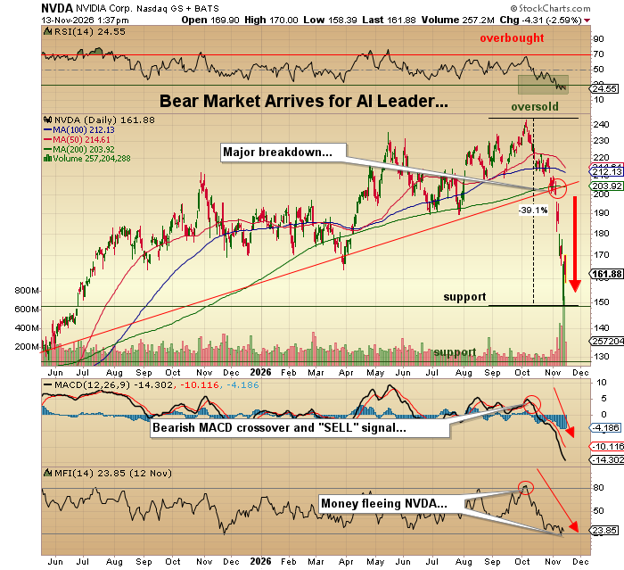
The chart shown above goes back eighteen months and, as of the close today, will clearly be heavily ensconced in a pretty angry bear market, down nearly 40% at the Thursday opening low. Unfortunately, the problem with getting immediately and overly bearish lies in the momentum indicators such as RSI and MACD, which are both deeply oversold, suggesting that in a fraction of a second, there could be a rally back to the $200 level without a lot of trouble.
The real issue lies in the longer-term trend of the "AI buildout" trade, which has as its poster child the Philadelphia Semiconductor Index ($SOX:US), which started its multi-year ascent back in the early fall of 2022 from a level of 2,089. It peaked on June 22 of this year at 14,655, representing a gain of 600% in that four-year expanse.
During that period, approximately four hundred (400) new ETF's tracking technology issues the world over were introduced to the investing public. While many are still posting positive returns year-to-date, some are down precipitously, such as the Direxion Daily Semiconductor Bull 3X ETF (SOXL:US), down 80.8% from the June peak yet still up 55% for the year.
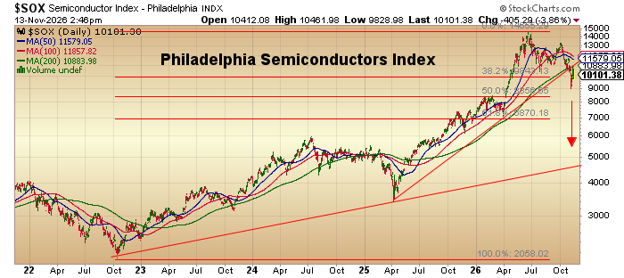
While the semiconductors are still showing positive performance for 2026, if their leader—Nvidia Corp.—has actually entered into a multi-year bear market and is about to give back, say, 50% of the gains, then the 50% Fibonacci retracement would take the $SOX:US back to 8,358 from the peak at 14,655, which is yet another 17% decline before the bear finishes feasting.
The purpose of this entire exercise concerning Jensen Huang and Nvidia is to try to determine how and why a bull market deemed "unstoppable" by the CNBC crowd was allowed to flourish as long as it did. As a metals specialist ( as opposed to a metals "guru"), I need to know/figure out how generalist portfolio managers can be convinced to reallocate their overweight technology positions into the metals space, and there is no better way than to have a hungry bear arrive on the scene.
As I have written countless times over the years, "money flows to where it is best treated," which is a form of quasi-plagiarism of former Citicorp Chairman Walter Wriston's "Capital goes where it is welcome and stays where it is well treated," with no truer statements ever having been made. Capital has been flowing into the technology space for decades because that is where it truly has been "well treated" by entrepreneurial wizards like Huang, Musk, Jobs, Bezos, et al who have enriched millions of people the world over with their wealth and creativity. However, what I want to see is capital flowing to those businesses responsible for delivering the raw materials required for technological innovation to succeed.
In the past few weeks, the one metal victimized by the sell-off in the "AI trade" has been copper. The CNBC crowd would have you all believe that it was demand, both current and future, that was encouraging users of copper to begin stockpiling the red metal on the assumption that the trillions of CAPEX dollars being spent on the build-out would be the primary driver for copper prices well into the indeterminate future.
When I hear commentators rambling on and on about how the recent Democratic midterm election sweep will slow the development of the data centers and therefore demand for copper, I want to take a ball-and-chain hammer to the TV screen. The bullish copper narrative is, at its very heart, a supply story and not an AI demand story.
If there were no data centers being constructed, the global transition to Electrification is many times as impactful as are the data center buildouts—but that is not the copper story. Decades of capital earmarked for new potential copper mines have been mistreated pitiably resulting in its flow away from mining and exploration and that has caused a dramatic reduction of replacement of supply where older mines are shutting down or rendered subeconomic by poorer ore grades and cost increases.
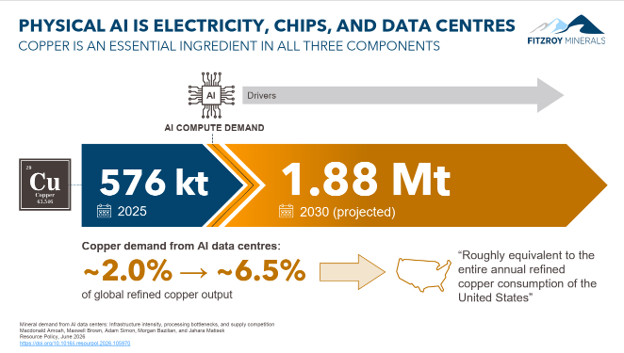
To listen to the clowns on the Cartoon Network, one might assume that AI would constitute 20-30% of global copper demand, but as seen in the graphic shown above, it is a mere 2% today, growing to 6.5% within two years. So, even at 6.5% of total global demand, how does a reduction in the pace of (as opposed to a moratorium on) data center buildouts cause a 12.74% correction in the Comex copper price?
Surely, the strong U.S. dollar has spooked the algobots into selling/shorting metals not for anything fundamental but more so because the Millennial or Gen-Ex programmers were told to factor in the "strong dollar effect" into the desired response algorithm. As I have said countless times since first turning bullish in 2022, there is no economic backdrop that I can conjure up that changes the outlook for copper. Demand for copper needs only stay "flat" in order to see supply deficits affect prices.
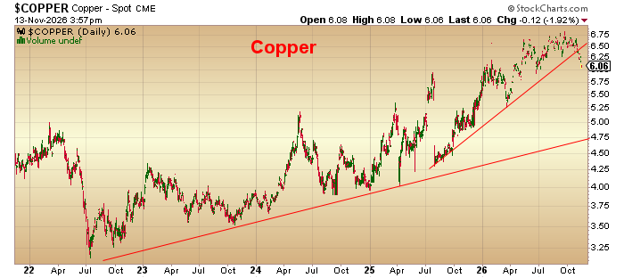
So, in earnest, I plead with those who provide commentary in podcasts or on international broadcasts like "Squawk Box" to stop trying to convince listeners that "EVERYTHING IS AWESOME" regarding this alleged "fading copper demand". For those invested in copper, everything is indeed "AWESOME," but for consumers of the red metal, not so much.
Shifting gears to the junior developers and explorers, all you need to see is this chart of the S&P/TXS Venture Exchange, which has been traveling straight south with four major bounces since the late-January top. The last bounce was the killer after the much-vaunted July bounce in gold and silver failed miserably, but not before befuddling the entire world by breaking out above all moving average resistance levels. Once the rally ended in late August, it was as if the air came completely out of the tires for the juniors. The index has lost 21.7% since that gold rally ended, with many of the issues losing 50% or more since summer alone.
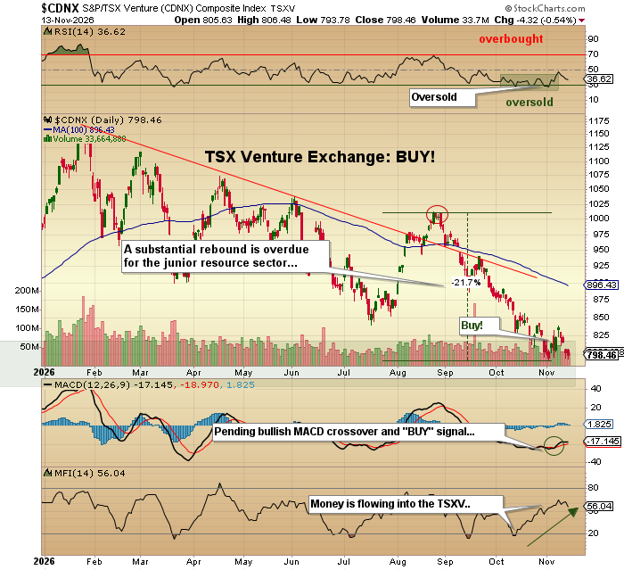
Of interest here are the MACD and Money Flow Indicators, which have made the transition to "bullish" despite sideways price action in the TSXV.
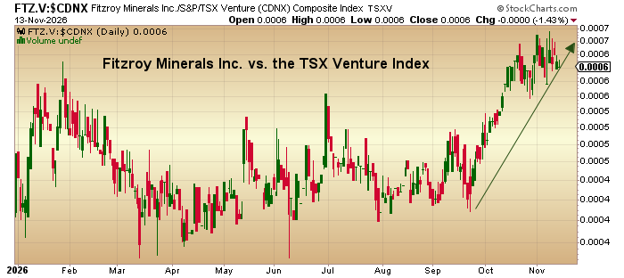
So, when you see a particular issue fight the tendency for lower prices, you are reminded of athletics where a team on a prolonged losing streak falls into that horrible habit of "mailing in the two points," which translates into players "going through the motions" in order to rationalize the losses. One of my favorite companies is doing the opposite; it has spat in the eye of the bear market behemoth and decided to embark upon a journey to full-scale heap leach copper production by 2028, getting there by setting milestones and passing them on schedule. The chart shown below measures the performance of my top-ranked Fitzroy Minerals Inc. (FTZ:TSX.V; FTZFF:OTCQX; C3Y:FSE) against the S&P/TSX Venture Composite Index on a year-to-date basis.
Since the lows in late September, the shares have drastically outperformed the index and, in fact, outperformed many of the other issues that dominate the podcast community and which are actively promoted by the rockstar "influencers" that love to see their names in print or their faces on a computer monitor or tablet.
Here are a few charts of popular names for comparison purposes only:
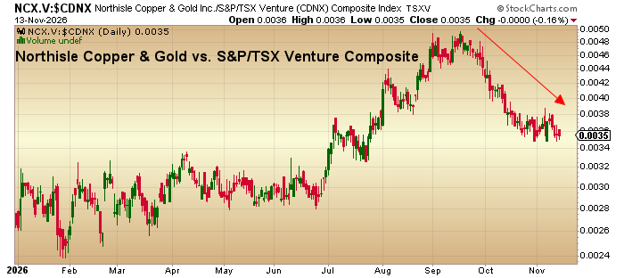
Northisle Copper and Gold Inc. (NCX:TSXV; NTCPF:OTCPK)
Straight south since the start of autumn.
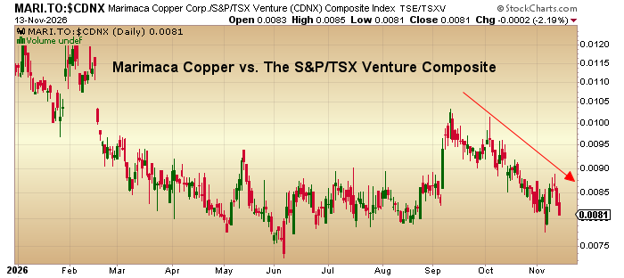
Marimaca Copper Corp. (MARI:TSX; MARIF:OTCQX; MC2:ASX)
Straight south since mid-September.
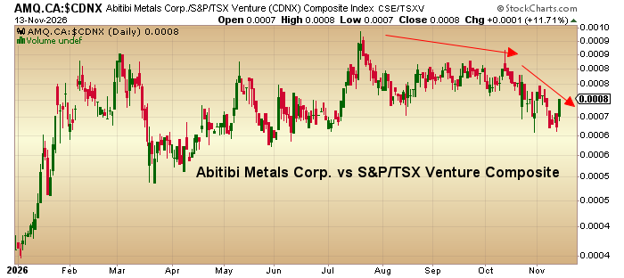
Abitibi Metals Corp. (AMQ:CSE ; AMQFF:OTCMKTS; FW0:FRA)
Not even Frank Guistra could stave off the onslaught of the TSXV "ursa major"…
One rule for trading juniors remains constant: "Stocks that fail to go down when all around them are taking gas are stocks that should be bought."
The Fed
As far as the balance of 2026 is concerned, the "consensus view" is that the Fed will eventually cave in and drop rates, triggering a dollar crash and resumption of the metal mania that ended
last January. That is recency bias of the highest order, as everyone assumes that those in charge care more about stocks than they do the bond market. Since the Crash of '87, policymakers have favored stocks over bonds 100% of the time, citing the "asymmetrical wealth effect" as the governing narrative.
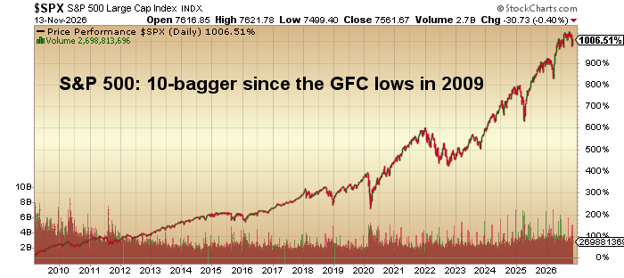
All one needs to do is take one look at the S&P 500 since March 9, 2009, and then realize the significance of the Democratic victory on November 3, and one gets the distinct sense that there has been a "Shift in the Force". If policymakers are going to be forced to pay closer attention to Joe Sixpack and less attention to Wall Street, then that cannot be favorable for stocks.
Furthermore, if making American "stuff" more affordable means increasing the purchasing power of one's paycheque, that reeks of deflation, and the last time there was a deflationary collapse not buttressed by immediate government policy action was the Great Financial Crisis of 2008. The last time prior to 2008 when there was NO government action until 1933 was the Great Depression of the Dust Bowl 1930s. In both instances, the purchasing power of cash increased due to crashing asset prices and fear of collapse of the financial system.
The wealth created since the lows of 2009 is nothing short of obscene if you are not a member of the elite classes that own stocks or real estate. With both chambers of government having shifted decisively away from the right, the big question to be answered is whether the shift is "centrist" or "socialist". If it is the latter, the charts like the one shown here will be a mythical chapter in a book or novel that reflects back upon the Millennial version of the "Roaring 2020's". One hundred years ago, Wall Street went through a decade of stock market largesse from 1920-1930 in what was the original "Roaring Twenties," only to be followed by an ominous decade of hardship called "The Dirty Thirties"…
Food for thought…
| Want to be the first to know about interesting Artificial Intelligence, Technology and Copper investment ideas? Sign up to receive the FREE Streetwise Reports' newsletter. | Subscribe |
Important Disclosures:
- As of the date of this article, officers, contractors, shareholders, and/or employees of Streetwise Reports LLC (including members of their household) own securities of Nvidia Corp. and Fitzroy Minerals Inc.
- Michael Ballanger: I, or members of my immediate household or family, own securities of: Fitzroy Minerals Inc. My company has a financial relationship with: None. My company has purchased stocks mentioned in this article for my management clients: None. I determined which companies would be included in this article based on my research and understanding of the sector.
- Statements and opinions expressed are the opinions of the author and not of Streetwise Reports, Street Smart, or their officers. The author is wholly responsible for the accuracy of the statements. Streetwise Reports was not paid by the author to publish or syndicate this article. Streetwise Reports requires contributing authors to disclose any shareholdings in, or economic relationships with, companies that they write about. Any disclosures from the author can be found below. Streetwise Reports relies upon the authors to accurately provide this information and Streetwise Reports has no means of verifying its accuracy.
- This article does not constitute investment advice and is not a solicitation for any investment. Streetwise Reports does not render general or specific investment advice and the information on Streetwise Reports should not be considered a recommendation to buy or sell any security. Each reader is encouraged to consult with his or her personal financial adviser and perform their own comprehensive investment research. By opening this page, each reader accepts and agrees to Streetwise Reports' terms of use and full legal disclaimer. Streetwise Reports does not endorse or recommend the business, products, services or securities of any company.
For additional disclosures, please click here.
Michael Ballanger Disclosures
This letter makes no guarantee or warranty on the accuracy or completeness of the data provided. Nothing contained herein is intended or shall be deemed to be investment advice, implied or otherwise. This letter represents my views and replicates trades that I am making but nothing more than that. Always consult your registered advisor to assist you with your investments. I accept no liability for any loss arising from the use of the data contained on this letter. Options and junior mining stocks contain a high level of risk that may result in the loss of part or all invested capital and therefore are suitable for experienced and professional investors and traders only. One should be familiar with the risks involved in junior mining and options trading and we recommend consulting a financial adviser if you feel you do not understand the risks involved.