


Each morning since January of 2020, after all the usual early-morning preparations, I grab a coffee and sit down at my desk to write the daily pre-opening report called the "Email Alert". Over the past six years, it has served as an effective way for me to prepare subscribers for the trading day with updates on existing positions and new trades that have materialized from the overnight sessions in Asia and Europe. Back in the day, I used to get all my information from what many seasoned analysts call "The Cartoon Network" — CNBC — arguably the largest disseminator of biased business news ever created. There was a time early on when they had cynical old reporters like Mark Haines who reported the news with pinpoint accuracy, but as the years rolled by, "pinpoint accuracy" was replaced with "shameless cheerleading" such that any guest espousing bearish sentiment would not only get ridiculed during their segment but permanently banned from the show.
This past week, the mighty NASDAQ entered into "correction" mode, but many of the market darlings of the post-Covid period are faring even worse. In fact, analysis from institutional trading desks at Goldman Sachs notes that about 60% of index members are in a bear market (defined as down 20% or more) when measured from their respective all-time highs. If looking purely at a strict 1-year timeline, roughly 40% of S&P 500 stocks sit in a 20% drawdown.
Furthermore, approximately 82% to 84% of individual stocks within the S&P 500 are currently experiencing technical corrections, defined as trading at least 10% below their recent all-time or 52-week highs. However, if you tune in to the Cartoon Network, all you are told is how much the "AI" stocks have advanced during the post-Covid bull market.
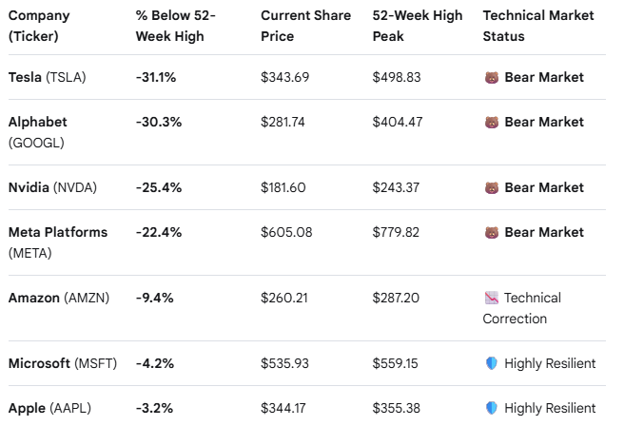
Listening to one of the female anchors this week whine about the "indiscriminate selling" plaguing the desk day in and day out, I decided to do a survey of the Mag Seven to see just how wonderful a year they are having.
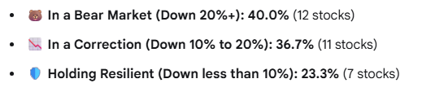
I then took a look at the more boring Dow Jones 30 Industrials and learned that only 23.3% of its members are still in bull market territory.
Dow Jone Industrials:
You have all heard me say that "bear markets arrive like thieves in the night"; it is only when you wake up in the morning that you realize how much has been taken away. I witnessed this in the data I get every day from my "X" feed, which is the marketing domain of every podcaster, YouTuber, and newsletter writer on the planet. Up until about two weeks ago, it was a non-stop flow of the same uber-bullish gibberish being spouted off by the same people, all talking up their books and trying valiantly to convince the reader that they all called the top in late January of this year and that gold and silver were still happily ensconced in long-term bull markets.
I usually start to lean to the bullish side when the whining and screaming in the social media feed morphs into hysteria. Last week, more than a few of the gold and silver perma-bulls threw in the towel and capitulated, and while they were lashing out with the finest of "blame-game" vitriol at "manipulation this" and "interference that", I got very busy building a position in the GLD:US and the most hated senior gold miner on the planet — Newmont Corp. (NEM:NYSE; NEM:ASX; NEM:PNGX) — which bottomed exactly one week ago at $104.70. It was as if the entire Fintwit mining community suddenly and at once woke up and realized that they were in a bear market!
Sure enough, at its low last Monday, the S&P/TSX Venture Composite Index was down 32.71% YTD, with many of the market darlings of 2025 trading significantly below their peak prices.
Here is a list of the top five performers in 2025:
% gain 2025 % gain 2026
- Prospector Metals Corp. (PPP:TSXV) +1,130% -44.9%
- Santacruz Silver Mining Ltd. (SCZ:TSX) +1,103% -22.45%
- Millennial Potash Corp. (MLP:TSXV) +950% -55.95%
- Goldgroup Mining Inc. (GORO:TSXV) +875% -29.45%
- Fuerte Metals Corporation (FMT:TSXV) +646% -47.82% (from top)
From this table, it is not difficult to see how the mighty have fallen. Other market darlings include Chilean copper explorer-developer Marimaca Copper Corp. (MARI:TSX; MARIF:OTCQX; MC2:ASX), down 38.45% YTD but down 50.63% from its January peak.
As for 2026, the list of top performers is shown below:
- Santacruz Silver Mining Ltd. (SCZ:TSX)
- Share Price Gain: +1,103%
- Market Cap Growth: +1,137%
- Distance from peak: -56.73%
- Ucore Rare Metals Inc. (UCU:TSXV)
- Share Price Gain: +627%
- Market Cap Growth: +1,109%
- Distance from peak: -81.34%
- Millennial Potash Corp. (MLP:TSXV)
- Share Price Gain: +950%
- Market Cap Growth: +1,140%
- Distance from peak: -61.31%
- 1911 Gold Corporation (AUMB:TSXV)
- Share Price Gain: +468%
- Market Cap Growth: +1,026%
- Distance from peak: -59.33%
- TDG Gold Corp. (TDG:TSXV)
- Share Price Gain: +641%
- Market Cap Growth: +1,470%
- Distance from peak: - 54.95%
While a few of these names are still ahead on a year-to-date basis, there is little doubt that the damage in the latter half of 2026 has been extreme.
This leaves me with the excruciating task of determining whether last Friday was the capitulation low for the metals and that, my friends, is no easy task. With markets being whipped around by the U.S. President's "X" account and by way of his "Truth Social" website, and with leverage being wrung out of markets at every twist and turn, it is agonizingly tough to determine whether or not sentiment has finally reached rock-bottom levels.
For me, I can gauge it pretty much by the number of emails I am answering on a weekly basis. At major turns in the S&P/TSX Venture Composite Index (both up and down), the frequency of emails increases. At major peaks like last January, there were dozens upon dozens of requests for "new junior mining ideas" intended to satiate the voracious appetites of traders clamoring for engorgement. At major lows, the emails tend to probe what management is doing to "enhance shareholder value" or "when is the next news?" types of inquiries.
Most importantly, when the emails begin to get "snarky" (which is actually quite seldom), it is always accompanied by an important low. I must confess that this time around, we have had the good fortune of watching my top pick and largest holding (Fitzroy Minerals Inc. (FTZ:TSX.V; FTZFF:OTCQX; C3Y:FSE)) trade at its highest level since last February and, as I said to a colleague earlier today, "What junior can you name that is trading at or near its high for the year?"
For that reason, the "Snarkiness Indicator" is hopelessly ineffective because shareholders/subscribers are relieved that FTZ/FTZFF has avoided the same fate as a whole lot of juniors that are currently eating out of dog food cans. Fitzroy is cashed up ($21 million) and is best summed up with the CEO Merlin Marr-Johnson's "Message to Shareholders," which was emailed out today:
"Work towards the maiden Mineral Resource Estimate (MRE) and Preliminary Economic Assessment (PEA) continues, with geotechnical, sterilization drilling, environmental baseline, metallurgy and engineering all running in parallel. We expect that the MRE will comprise mostly Measured and Indicated Resources (M&I) at Tenorita (with some Inferred), mostly Inferred Resources at Ortúzar (with some M&I), and Nativo somewhere in between. While in Chile, Gilberto and I gained Board approval for a further 3,300 metres of drilling to target the conversion of Inferred to M&I in the parts of Nativo and Ortúzar most likely to fall within an open pit shell for inclusion in the upcoming Pre-Feasibility Study (PFS)."
In other words, they are busy and looking forward to advancing the Buen Retiro copper oxides to production in 2028.
The Major Markets
Shifting back to the major markets, I have to admit that these are indeed exceedingly tough ones to navigate. I put on a series of hedges in the summer because the months of August and September (and a couple of weeks in October) are typically rough periods, with September being statistically the weakest month of the trading year. Well, this year the QQQ:US got a solid rally that began in late July and rallied to an all-time high on October 6, shattering the land speed record in — of all months — September.
The seasonally weak months of August and September knocked the cover off the proverbial ball while October (known affectionately as "The Bear Killer") turned out to be more like 1987 and 1929 than it was a "BUY-THE-DIP" moment. We had the biggest one-day point drop in the S&P 500 ever on Thursday, and after six months of being hedged, I was bereft of as much as a single put option. I chased my poor dog Fido out of the house and under the shed, where he has dug his sanctuary "hole" where he can hide from the dangers of flying ashtrays, disintegrating wine bottles, and photos of Jim Cramer serving as well-deserved targets for my vintage dartboard.
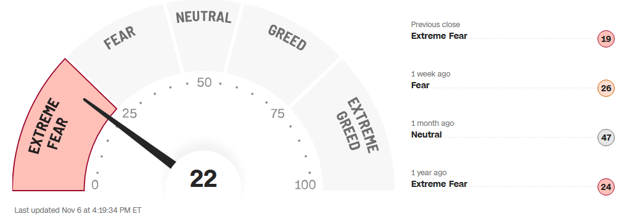
Anyone who has the gall to tell me that trading these markets is "easy" deserves to be marooned on a desert island with only a bobble-head look-alike of Mark Carney with which to converse. These markets are being whipped around by algo-driven computers that take one look at the CNBC Fear-Greed Indicator, and they yawn, after which they laugh, just after they have taken all of your excess margin and cash reserves.
Alas, I see a year-end rally materializing out of the terror inflicted upon the technology addicts that dominates the markets, the financial media, and the U.S. political landscape more and more with each passing day. It could easily take stocks to record highs by year-end, or it could stop on a dime at month-end, leading to a 2018-style crash such as the one we had during the President's first term. There are many similarities between 2018 and 2026, including the Democrats taking control of the House of Representatives. In 2018, high-flying technology and growth stocks — which had heavily driven the preceding bull market — collapsed under a wave of rotation.
Megacaps like Apple Inc. (AAPL:NASDAQ) plunged more than 20%, with capital shifting to dramatically underperforming defensive asset classes. Here in 2026, the market is processing a severe valuation reset across tech and artificial intelligence Megacaps. Heavily concentrated trades (such as the "Magnificent Seven" and semiconductor giants) have been aggressively unwound, leading to automated institutional margin debt liquidation. The only way that the bear market in 2018 was averted was by a violently dovish pivot by the Powell Fed that saw multiple rate cuts and liquidity injections rescue stocks. That is likely to be the savior of the 2026-2027 market malaise, but for me, the way to play it is through the commodities sector with heavy emphasis and allocations toward gold, copper, and energy.
In the interim, I urge all subscribers to put on a fire log, crack open a bottle of vintage wine, and be thankful that you held zero technology or "AI" stocks last week. Otherwise, you would today be anointed as a card-carrying member of the "Bagholders' Alumni".
That was the club that came into existence in March 2000 with the NASDAQ at 5,132.52. It took the NASDAQ more than 15 years to completely erase those losses, as the index did not officially close above its 2000 high until April 23, 2015, when it finally closed at 5,056.06. If October 6 was the top of the 2026 version of the NASDAQ bubble, it will take until October of 2041 for those egregious losses to be purged.
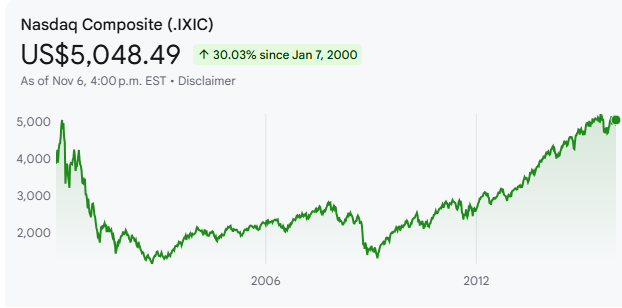
For those of you out there holding shares of NASDAQ-listed companies, despair not, as you may only need to wait fifteen years, which is a far less injurious price to pay when compared to the gold bugs whose 1980 peak took twenty-eight years to recover.
Actuarially, that is a third of human life expectancy, so perhaps it is the gold bugs that are in need of that vintage wine…
| Want to be the first to know about interesting Copper, Silver, Technology, Gold and Artificial Intelligence investment ideas? Sign up to receive the FREE Streetwise Reports' newsletter. | Subscribe |
Important Disclosures:
- As of the date of this article, officers, contractors, shareholders, and/or employees of Streetwise Reports LLC (including members of their household) own securities of Fitzroy Minerals Inc., Tesla Inc., Alphabet Inc. Class A, Nvidia Corp., and Apple Inc.
- Michael Ballanger: I, or members of my immediate household or family, own securities of: Fitzroy Minerals Inc. My company has a financial relationship with: None. My company has purchased stocks mentioned in this article for my management clients: None. I determined which companies would be included in this article based on my research and understanding of the sector.
- Statements and opinions expressed are the opinions of the author and not of Streetwise Reports, Street Smart, or their officers. The author is wholly responsible for the accuracy of the statements. Streetwise Reports was not paid by the author to publish or syndicate this article. Streetwise Reports requires contributing authors to disclose any shareholdings in, or economic relationships with, companies that they write about. Any disclosures from the author can be found below. Streetwise Reports relies upon the authors to accurately provide this information and Streetwise Reports has no means of verifying its accuracy.
- This article does not constitute investment advice and is not a solicitation for any investment. Streetwise Reports does not render general or specific investment advice and the information on Streetwise Reports should not be considered a recommendation to buy or sell any security. Each reader is encouraged to consult with his or her personal financial adviser and perform their own comprehensive investment research. By opening this page, each reader accepts and agrees to Streetwise Reports' terms of use and full legal disclaimer. Streetwise Reports does not endorse or recommend the business, products, services or securities of any company.
For additional disclosures, please click here.
Michael Ballanger Disclosures
This letter makes no guarantee or warranty on the accuracy or completeness of the data provided. Nothing contained herein is intended or shall be deemed to be investment advice, implied or otherwise. This letter represents my views and replicates trades that I am making but nothing more than that. Always consult your registered advisor to assist you with your investments. I accept no liability for any loss arising from the use of the data contained on this letter. Options and junior mining stocks contain a high level of risk that may result in the loss of part or all invested capital and therefore are suitable for experienced and professional investors and traders only. One should be familiar with the risks involved in junior mining and options trading and we recommend consulting a financial adviser if you feel you do not understand the risks involved.