

Peter Lynch is widely regarded as one of the greatest mutual fund managers of all time. Born in Newton, Massachusetts, in 1944, he rose from a working-class background to achieve legendary status on Wall Street. Like this author, as a youngster, Mr. Lynch earned money as a caddy at the upscale Brae Burn Country Club located just outside of Toronto.
I, too, discovered the wonders of working for a living at the age of twelve when I would hitchhike at sun-up from the aircraft factory village of Malton, Ontario, 15 miles to the northwest to the old Huntington Golf & Country Club, earning a fee of $2.50 for carrying a member's set of clubs around the 5,200-yard course in 90-degree heat. If you were lucky, you got a 50-cent tip that would pay for a hot dog and a Coke at the clubhouse snack bar. Although I was not fortunate enough to secure a caddy scholarship as did Mr. Lynch at Boston College, interacting with small business owners and professionals like doctors and lawyers was quite the departure from the hometown crew, who were primarily blue-collar workers at de Havilland or Orenda.
While toiling away at Boston College, majoring in finance and later securing his MBA from the Wharton School in 1969, he actually joined Fidelity Investments in 1966 as a summer intern largely because he had caddied for the former president, George L. Sullivan. It was in 1977 that he took over the Fidelity Magellan Fund and proceeded to run the fund from 1977 to 1990, achieving a legendary 29.2% average annual return and growing its assets from $18 million to $14 billion.
As a young stock salesman back in the 1990's, I recall taking one of my corporate clients, Mountain Province Mining Corp., into Fidelity for meetings back in 1996 after they had made the legendary AK5034 diamond discovery in Canada's Northwest Territories. There is nothing more intimidating than waiting in the reception area beside the CEO of Freeport and Chairman of Exxon Mobil Corp. (XOM:NYSE), preparing to take a tiny little peanut of a company into a room full of analysts, all ready, willing, and more than able to reduce one to a pile of humiliated rubble in a matter of minutes.
Luckily for us, these analysts knew nothing about diamonds, so it became an educational presentation as we explained how the hardest substance on the planet needed the ideal conditions of heat and pressure as it morphed from a lump of liquid carbon five miles below the earth's surface into a wondrous, clear, white, colorless crystal worth tens of millions of dollars.
What prompted me to touch on the topic of Peter Lynch and Fidelity was the quote shown above at the beginning of this missive. The reason I thought of it was twofold: the first is that today is the October option expiry day, when millions of expiring options contracts are sitting right at critical "strike price" battlegrounds. As institutional market makers hedge their underlying stock exposure to keep up with expiring options, this structurally amplifies intraday price swings. The second reason is that I can relate to Lynch's quote because I am definitely one of those analysts/investors who have lost more money "preparing for corrections, or anticipating corrections, than has been lost in the corrections themselves."
I have not trusted this move in technology (especially "AI") one iota in 2026, instead focusing on the copper market and what I view as a narrative fifty times as compelling as "AI," and that narrative is the Commodities SuperCycle. I might be proven correct over time, but trying to protect portfolios from the mania that has been megacap technology and the "Mag Seven" this year has been an exercise in futility until recently, as in a few weeks ago.
Last week, the title of the weekly missive was "Charging General; Retreating Troops" in reference to the abysmal breadth in the markets since the middle of August when the NYSE A/D Line decided to head south without the accompaniment of the handful of tech stocks that have magically maneuvered the major averages to record highs while the percentage of S&P 500 stocks trading above their 50-day moving average has tumbled by roughly 14 percentage points, dropping to just 44%. This indicates that more than half of the index is locked in short-term downtrends, which is not what healthy bull markets are supposed to look like.
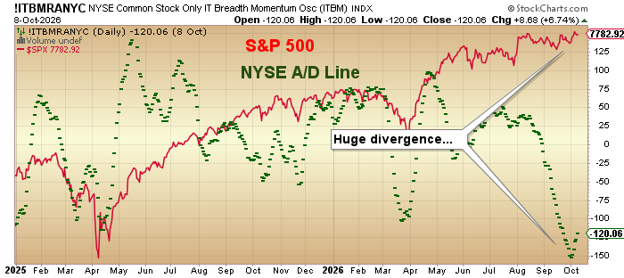
I posted this chart last week, but it bears re-posting because the perma-bulls were all chirping yesterday about the "broadening" of the advance, but today, there are 200 new weekly lows on the NASDAQ versus 47 new weekly highs, indicating that far more selling pressure than buying pressure is present.
Nevertheless, October is indeed the "bear killer" as thirteen times since WWII have bear markets ended in October. Accordingly, I tip my hat to the wisdom of Peter Lynch in abandoning all hedges this week, instead looking out to a positive end to the month and a strong year-end rally.
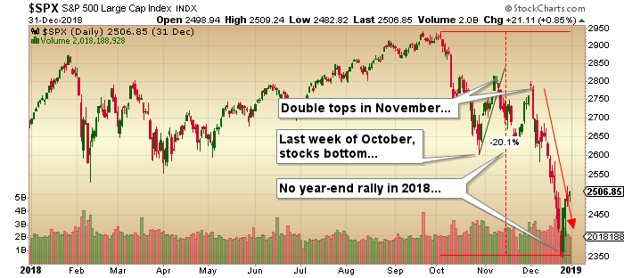
That said, I am dreadfully fearful that the second Trump mid-term year will mirror the first Trump midterm year when stocks turned on a dime at the end of November in 2018 and were down over 20% by Christmas Eve when only an emergency meeting between Trump, Powell, and Treasury Secretary Mnuchin could turn the tide (which it did). Nonetheless, there was some big money lost by Christmas 2018 by those who had blind faith in the certainty of the year-end rally.
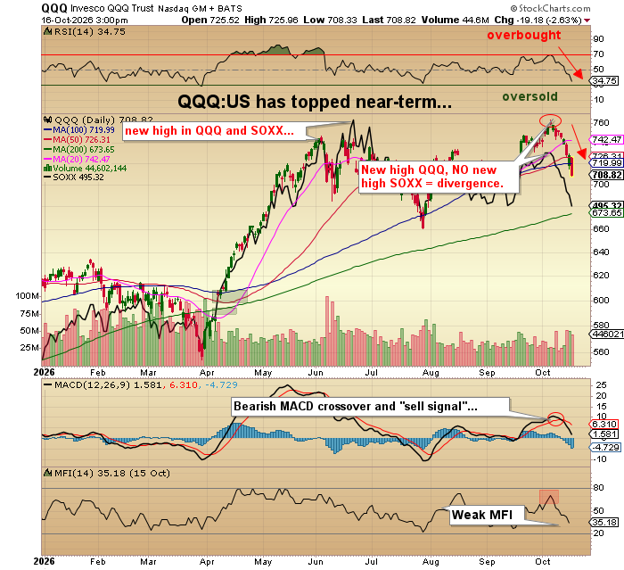
Technology is leading the markets as we approach the midterm elections, with the Invesco QQQ Trust (QQQ:NASDAQ) down over 7% from the top on October 6. In fact, it has given up $50 in the past ten days, proving once again that "timing is everything" when you are trying to short a cult like American technology stocks.
They have been " the gift that keeps on giving" for most of the last six years and certainly since the COVID lows in March 2020, but this week we finally got what I have been preparing for since the early summer, although it was "a penny too light and a week too late".
Last Monday, I sent subscribers an email alert pre-opening that was one of the best contrarian calls I have made all year. With the dollar index screaming higher at 102.58, and the U.S. 10-year Treasury Bond yield at 5.3%, I put out a "SELL" on both the dollar and on the 10-year yield.
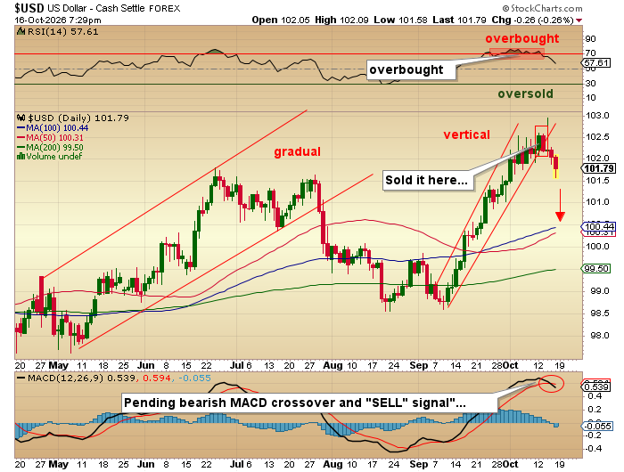
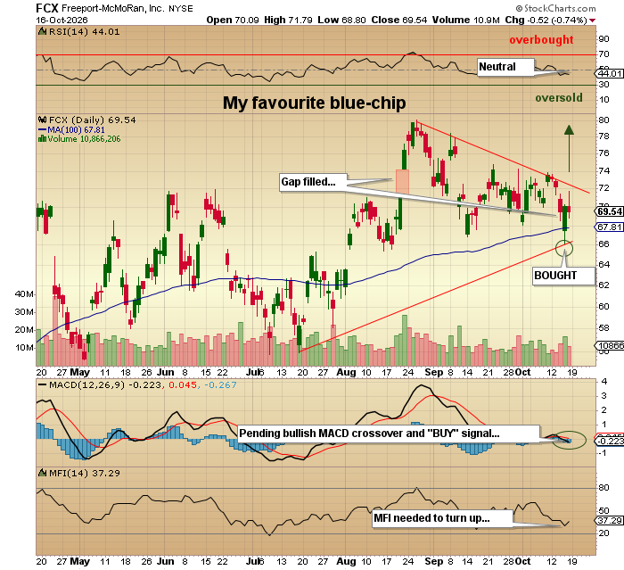
With an RSI at 74.72 last Monday and with the MACD indicator heavily overbought, I elected to go short the dollar and short the 10-year yield, but rather than buying the TLT:NASDAQ or trying to actually buy puts on the DXY, I opened a long position in both the SPDR Gold Trust (GLD:NYSEARCA) on Monday and on Thursday, I added Freeport-McMoRan Inc. (FCX:NYSE).
Since Monday, the U.S. dollar index has been down a full point to 101.61, with the MACD completing a full bearish crossover and "SELL" signal.
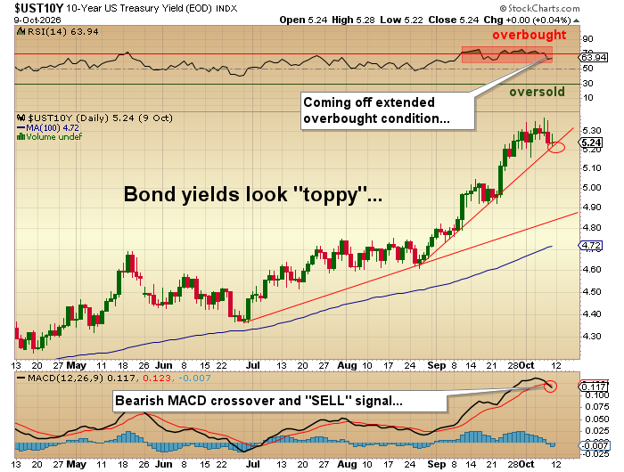
Similarly, the U.S. 10-year has now reversed lower with RSI now below 70 after being in overbought territory for nearly a month. It, too, has completed a bearish MACD crossover and is now operating on a "SELL" signal, which means the metals should have a tailwind behind them for at least the rest of the month. It is now yielding 5.079% versus 5.35% four days ago.
The fact that CPI and PPI came in "hot" this week yet failed to trigger a new high for the 10-year yield was important, especially since gold reversed Wednesday's decline to end the week on an "UP" note. Since we are heading into a seasonally strong period for the metals and for stocks, I am no longer going to fight the tape and gear up for a strong Q4, albeit one that has commodities leading the charge rather than the overhyped, overinflated "AI" bubble.
Junior Resources
The junior Canadian resource stocks are pretty much locked in a "blue funk" as investors are staying well ensconced on the sidelines in anticipation of a slowing global economy. I cannot tell you how desperately I have been wrestling with the well-beaten argument that has copper and gold declining into an economic slowdown.
Both of these metals are priced by different demand drivers, with copper the target of both the electrification movement and the "AI" build-out, while gold remains solidly in the crosshairs of central bank buying and both retail and central bank buying out of China.
As for gold, I find it fascinating that Judy Shelton has taken on a role with the U.S. Treasury Department and now serves as a "Counselor". Appointed in October 2026 by Treasury Secretary Scott Bessent, her core mandate is to advise the Secretary on global currency policy, with a hyper-specific emphasis on evaluating macro-financial conditions and exchange rates in China. Nowhere in any of the press clippings does it mention that Ms. Shelton is a card-carrying bull on gold and is one of the most prominent modern proponents of returning the U.S. dollar to a gold-backed standard. She has built her career on criticizing the post-1971 fiat monetary system, which she defines as a form of unstable central planning managed by unelected central bank committees.
Given my longstanding opinion that the only solution to the fiscal crisis in the U.S. will be to collateralize the debt with the 8,133 metric tonnes on the books at the Treasury Department, I find it very interesting to have Ms. Shelton bending Scott Bessent's ear, which means the President's ear as well.
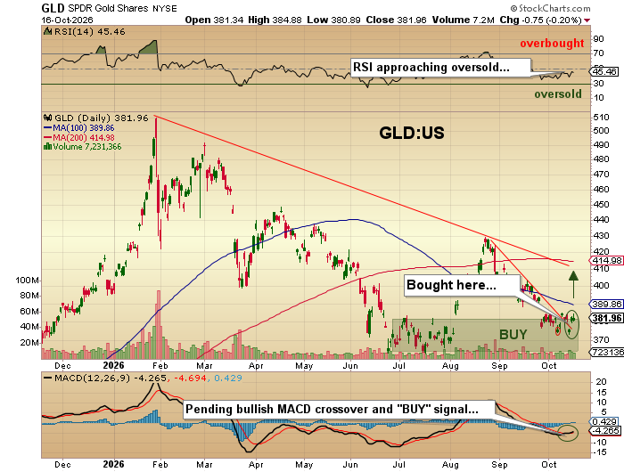
Using the SPDR Gold Trust (GLD) as a proxy for gold prices, there is a ton of resistance between 100-dma @ $389.86 and the 200-dma @ $414.98, but I opened a position on Monday after it knifed down into that zone of support that was the summer consolidation phase and low around $363.00. This past week, it tied twice to penetrate the $375 level and was rejected, so in light of the horrendous PPI numbers on Thursday, it acted really well and a great deal better than anyone might have figured.
There is an old trader's axiom that says "Markets that fail to fall into bad news are I also found the usual suspects on social media posting comments best described as "snarky" (as opposed to "whiny") which means they have largely given up on calling the lows for gold and silver after blowing their brains in the August rally which everyone was calling "the breakout", except, of course, yours truly. (I was tempted though.) markets searching for a reversal" and that is precisely what we got.
Of all the moves this week, I thank the market gods and goddesses for finally granting me the opportunity to replace my positions in Freeport-McMoRan Inc. (FCX:NYSE), which I trimmed with great angst back in August at the high of $80. For the record, I slump into a deep depression every time I sell FCX for two reasons:
1. It is a great company and 2. It has treated me so well since I first added it as a "core holding" back in the summer of 2022 at around $25.
I have traded the shares and the call options successfully no fewer than six times since then, and while it has worked out beautifully on each exit and re-entry, I find myself filled with angst and anguish every time I go flat. It wasn't such agony this time as I forced myself to hold onto at least 1,000 shares (that I hold "free" by now), and that allows me to avoid waking up in the middle of the night in cold sweats and hallucinating about FCX at $100, and I am flat.
Why is that?
I will tell you why:
Freeport-McMoRan is primarily famous for being one of the absolute largest and most strategically vital industrial metals and mining giants in the world. Headquartered in Phoenix, Arizona, the company holds key global designations that anchor its fame across commodities and international business:
Freeport is the premier global producer of molybdenum, a critical industrial metal used to manufacture high-strength steel alloys, structural steel, and superalloys essential for the aerospace, automotive, and construction sectors.
The company owns a 49% stake in and operates the legendary Grasberg mine in the remote highlands of Papua, Indonesia. Grasberg is globally famous for holding the single largest gold reserve and the second-largest copper reserve of any mine in history.
Freeport is the leading fully integrated copper producer in the Americas, controlling a massive market footprint:
- The company supplies roughly 60% of all U.S. mine production and 70% of the country's refined copper.
- It owns and operates the sprawling Morenci mine in Arizona, which spans 62,000 acres and stands as the largest open-pit copper operation anywhere in the United States. [
- Because the global transition toward electric vehicles, AI data centers, and clean energy grids depends heavily on wiring infrastructure, Freeport is heavily leveraged as a primary gatekeeper for future global copper demand.
FCX is a beast of a company and my favorite blue-chip stock on the planet. As of this week, I am now partially-positioned in the shares and fully-positioned in the December call options, looking for the century mark ($100) by New Year's Eve.
Now that the October expiries are over and done with, I shall be watching to see if markets begin to rotate away from technology into the "old economy" stocks that are ridiculed as "value" stocks or whether fears of the November elections force a rotation from stocks to bonds instead, which would be ugly at best.
My educated guess is that any rotation will be away from that which has been working (stocks, stocks, and more stocks) and into that which has not been working (gold, silver, banks, bonds), but until the election results are in, it is anyone's guess. The polls would have us believe that a Democrat sweep is coming, but as we know (and especially Hillary Clinton in 2016), polls can be deceiving.
| Want to be the first to know about interesting Copper, Silver, Gold, Artificial Intelligence and Critical Metals investment ideas? Sign up to receive the FREE Streetwise Reports' newsletter. | Subscribe |
Important Disclosures:
- Michael Ballanger: I, or members of my immediate household or family, own securities of: Freeport McMoRan Inc. and GLD. My company has a financial relationship with: None. My company has purchased stocks mentioned in this article for my management clients: None. I determined which companies would be included in this article based on my research and understanding of the sector.
- Statements and opinions expressed are the opinions of the author and not of Streetwise Reports, Street Smart, or their officers. The author is wholly responsible for the accuracy of the statements. Streetwise Reports was not paid by the author to publish or syndicate this article. Streetwise Reports requires contributing authors to disclose any shareholdings in, or economic relationships with, companies that they write about. Any disclosures from the author can be found below. Streetwise Reports relies upon the authors to accurately provide this information and Streetwise Reports has no means of verifying its accuracy.
- This article does not constitute investment advice and is not a solicitation for any investment. Streetwise Reports does not render general or specific investment advice and the information on Streetwise Reports should not be considered a recommendation to buy or sell any security. Each reader is encouraged to consult with his or her personal financial adviser and perform their own comprehensive investment research. By opening this page, each reader accepts and agrees to Streetwise Reports' terms of use and full legal disclaimer. Streetwise Reports does not endorse or recommend the business, products, services or securities of any company.
For additional disclosures, please click here.
Michael Ballanger Disclosures
This letter makes no guarantee or warranty on the accuracy or completeness of the data provided. Nothing contained herein is intended or shall be deemed to be investment advice, implied or otherwise. This letter represents my views and replicates trades that I am making but nothing more than that. Always consult your registered advisor to assist you with your investments. I accept no liability for any loss arising from the use of the data contained on this letter. Options and junior mining stocks contain a high level of risk that may result in the loss of part or all invested capital and therefore are suitable for experienced and professional investors and traders only. One should be familiar with the risks involved in junior mining and options trading and we recommend consulting a financial adviser if you feel you do not understand the risks involved.