



When I first entertained the notion of applying my writing skills (or lack thereof) to the practice of educating the public about the capital markets, there were only two newsletters around which I wanted to model my business. The first was Bob Bishop's Gold Mining Stock Report that handed subscribers every major discovery of the 1980's and 1990's. Bob was a trained journalist, having graduated from the University of California (Berkeley), and every financial advisor specializing in junior Canadian resource stocks would not make a move without reading his letter every week.
The second one was founded by Richard Russell (1924–2015), a man whose stories I grew to love over the years, as he did not restrict his content to securities analysis only. Born in New York City on July 22, 1924, Russell served as a B-25 combat bombardier for the U.S. Army Air Forces during World War II. After telling his readers how simplistic the Wall St. analysts were, he would launch into anecdotes about his missions in southern Italy during the war. You could feel his passion and appreciate his fear as he recounted his various brushes with the Grim Reaper.
Russell was a legendary financial writer and technical analyst best known as the founder and author of Dow Theory Letters. Established in 1958, his publication became widely celebrated as the longest-running financial advisory newsletter continuously written by a single person in history. Over nearly six decades, Russell gained a massive industry following by analyzing major market trends through the lens of traditional Dow Theory—a method derived from the editorials of Wall Street Journal founder Charles Dow.
Russell was famous for his patience, personal wisdom, and a unique "Primary Trend Index" (PTI) that he created in 1969 to mathematically time the stock market. He is particularly remembered for a number of historic market calls that included:
- The 1960 Gold Call: He was one of the first major financial writers to heavily advocate for buying gold stocks well before the massive precious metals bull run of the 1970s. This earned him a reputation as an "original gold bug".
- Calling Major Turning Points: He accurately predicted the top of the 1949–1966 secular bull market, as well as the exact bottom of the brutal 1972–1974 bear market.
He frequently reminded investors of the psychological realities of trading, with one of his most enduring and widely quoted phrases being "In a bear market, the winner is he who loses the least."
In today's day and age, it is rare to read or hear a newsletter writer tell his subscribers that the reason they are paying the fee is so they will "lose the least". By contrast, most would have us believe that everyone is making money all the time without error, which is a statistical impossibility. Subscribers of this publication know all too well the difficulty of not knowing when to "cut bait" on a bad trade, which is far more important and infinitely more difficult than posting only one's winners every week. Richard Russell taught me that in his writings, and I have tried for the past six years and nine months to adhere to the philosophy of "owning up to one's foibles."
My 'Raison D'etre'
I am asked constantly why I spend my "golden years" getting up at 7 am every morning to hammer out an email alert prior to market opening instead of reading the paper in bed, sipping tea, and listening to the morning weather report, basking in the glow of leisurely relaxation. The reason is that I have watched too many of my contemporaries atrophy from mental and physical inactivity, which usually happens when routine is removed from one's daily regimen.
I am also asked why I elected to launch an email advisory service when every Tom, Dick, and Harry is out there front-and-center with podcasts or YouTube channels interviewing the same "experts" over and over and over, all spouting off the same bullish messages that sent gold to $5,600 and silver to $123 last January. My "raison d'etre" is simple.
The two qualities that I admired the most in Dow Theory Letters and The Gold Mining Stock Report were the level of integrity they both delivered with amazing consistency, humility, and accuracy. While Russell's major trend analysis was arguably the best ever, for those advocates for junior resource speculation, there was never a newsletter writer who nailed every major discovery of the 1990's with more "on the screws" accuracy than Bob Bishop. Bob's "Diamonds in North America" to this day remains the reason I looked into funding a little junior in 1993 called Mountain Province Mining that three years later made the fateful AK-5034 diamond discovery at Kennady Lake in Canada's Northwest Territories.
The sheer wealth that gets created when the two goddesses of junior mining grant their blessing is unfathomable. That little junior traded between $0.38 and $0.75 from 1993-1995 and began 1996 at CA$0.49 before making that 3-ct/tonne diamond discovery in March of '96, and by the time the year was out, the stock hit $9.75, enriching a great many people along the way.
Of course, there are losers along the way, usually when the two goddesses frown upon you, but more often than not, it is the management team that commits multiple blunders that tend to destroy investor confidence. It has taken me five decades of interacting with thousands of mining executives to recognize the importance of investing in a solid team rather than any one individual manager or promoter. It has also taken me ages to appreciate the relative sophistication of today's junior mining speculator as opposed to the blind-eyed buyers of the 1980's and 1990's. I find that the new generations of fuzzy-cheeked investors tend to be far more skeptical than their greybeard dads and grandads, and while that is a positive development for the industry, it makes it far more difficult to raise the early "seed" capital required to initiate grassroots exploration in an unproven region.
In 1991, fueled by the unbridled optimism of Dia Met Minerals' initial find in Canada's NWT, over 50 junior mining companies rushed to stake claims covering an area larger than the size of Belgium. Industry data indicates that within the first few years of the rush, junior explorers raised and deployed hundreds of millions of dollars in equity financing solely to fund airborne geophysical surveys, soil sampling, and exploratory diamond drilling across the Barren Lands.
I doubt seriously whether today in 2026 there would be enough speculative capital to repeat the size and extent of the biggest staking rush in Canadian history, which was The Great Canadian Diamond Rush. However, once you have been part of a successful discovery, the narcotic never leaves your psyche. You are constantly striving to repeat that rush of adrenaline that surges through your bloodstream when you finally realize that improbable, verging upon impossible odds have been overcome by the rotation of a diamond drill and the analysis of core.
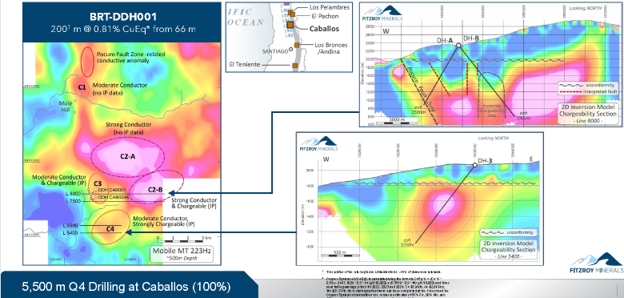
Here in 2026, I have been using skills honed in the 1990's to navigate a completely different landscape than I encountered back then, and it is not easy. I look at exploration programs like Fitzroy Minerals Inc.'s (FTZ:TSX.V; FTZFF:OTCQX; C3Y:FSE) Caballos copper project in Chile, where recent deep IP surveys have identified a 5km by 5km zone of chargeability and conductivity that appears to be amenable to porphyry copper mineralization.
With one drill hole already completed that yielded 174 meters of .47% CuEq mineralization, one might think that the cross sections indicating multiple large anomalies would generate a flurry of speculative activity.
However, my assumptions are based on 1990s sentiment rather than 2026 sentiment. The kiddies today have so many more avenues of speculation to pursue than junior mining, such as the prediction markets, Draft Kings, and fifty different lottery venues. With end-of-day option expiration all the rage these days, speculating on a drill hole is pretty boring stuff, by any and all modern measures.
Nevertheless, there is an old maxim that describes the difference between gambling and speculation. "Gambling…" it is said "is a venture without calculation" while "speculation is a venture with calculation". Those of us who lay down our hard-earned savings on an exploration program are not (as many wives would say) "gambling," but because there are data that provide many clues that only a few of us old timers choose to use, we are instead "speculating" with geophysics and geochemistry providing the all-important element of "calculation".
Gold, Silver, and Copper
Every time I turn around these days, I read or hear yet another gold and silver guru talking about the "ongoing consolidation" in the precious metals. Well, I don't know about you, but I for one would not call the last nine months an "ongoing consolidation".
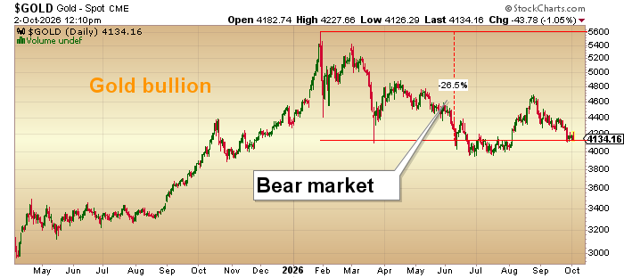
It has been like undergoing root canal surgery without the benefit of Novocain, conducted by a first-year dentistry student using drills from the 1960's. Gold is down 26.5% from the all-time high of $5,626 registered in late January, and since then, there have been a series of lower highs and lower lows despite a plethora of bullish cheerleading complete with cymbals clashing, pompoms waving, drums beating, and Peter Schiff doubling down on "$10,000 gold by Christmas!"
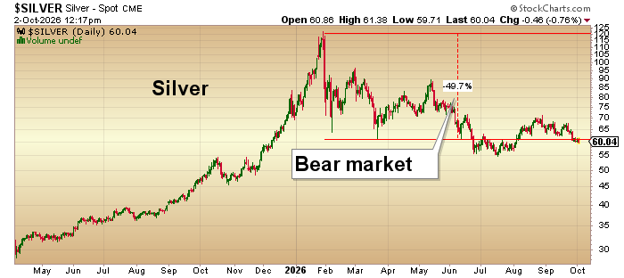
Silver is down a whopping 49.7% and while the podcaster armies are stuffing us with "ongoing consolidation", silver looks, acts, and feels like a vintage, class-A "bear market" complete with all the wailing, whining, and warbling that typifies an "Ursus Argenteus".
As a card-carrying, self-professed gold and silver advocate since the late 1970's, there were times like 2011-2015 when I was in full and complete denial of the arrival of the bear markets in gold and silver such that I fought it with every fibre of willpower which resulted in severe exhaustion not only of mind and spirit but of valuable cash reserves during a period in which I could least afford it.
After the 2011-2015 nightmare, I was lucky enough to identify the August 2021 peak in the metals and escaped to the sidelines, choosing instead to focus on copper, which largely saved me from another visit to investment purgatory until August of 2023.
Copper has been a warhorse for me since the metals all peaked last January because while gold and silver have failed to come even close to bettering their January 29th highs, copper has seen new record highs twice in that time frame and remains solidly in bull market territory.
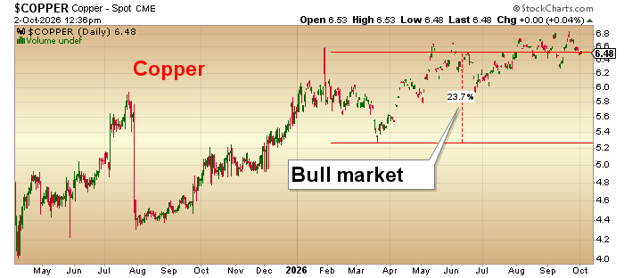
Although it closes out the week around $0.40 off its August record, it is still up 23.7% from the March lows and 12.04% on a year-to-date basis. The net result of pivoting to copper from the precious metals is that instead of flying into a gale force headwind, I am gliding along with a gentle tailwind overweight a commodity that is generally considered the most fundamentally sound of any of the metals.
I try to keep a level-headed approach to the metals, having been beaten up over the years for one reason or another, but there is no more asymmetric a bet than copper for all the reasons I have been writing about since 2021. Electrification is an ongoing movement on every continent and with every nation except perhaps Russia, which has more oil & gas than it knows what to do with.
To wit, with electrification comes accelerated demand for wiring which means copper and while rising interest rates are generally seen as negative for the monetary metals because they generate no income and cannot compete with a 5.60% long bond yield, copper shrugs off the "global recession" risk and the "rising rate cycle" risk and trades purely on the "structural deficit" narrative that is present thanks to decades of underinvestment and political misdirection.
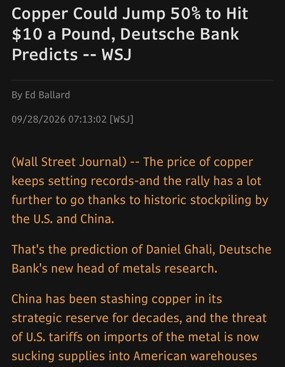 If the good chaps at Deutsche Bank are correct in their forecast, then perhaps by 2035 the cure for rising prices may well be rising prices because it will take at least ten years to test, confirm, and model prospective mine plans before they even approach feasibility, permitting, and construction.
By the time they recover the first copper concentrates, a great deal of money will have been spent to not only develop new projects but also to refurbish old mines like Codelco's El Teniente (and the $5.5 billion Andes Norte expansion). For every new deposit found, at least three old depleting mines are moving closer and closer to shutdown and closure as grades diminish and profitability wanes.
As a result, my task is to find a suitable basket of nascent producers, the next generation of copper mines capable of meeting the demands of an Electrification world. I go down the list of projects in various jurisdictions and have determined that countries that have a history of nourishing and nurturing the mining industry, such as Chile, remain the best places to secure funding, receive permits, and, most importantly, find new mines.
I then go through a list of potential projects with the help of some very capable mining engineers and geologists, whom I use diligently to augment my pitiable lack of geological knowledge, and in doing so, come to the realization that there are very few projects out there that will actually achieve positive feasibility even at $6.80 copper. This is why my list of companies all fall into the category of "asset rich" and qualify as candidates for ownership in several portfolios.
What is my vindication of adhering to copper and avoiding the "headless chicken" style of investing in the precious metals these days?
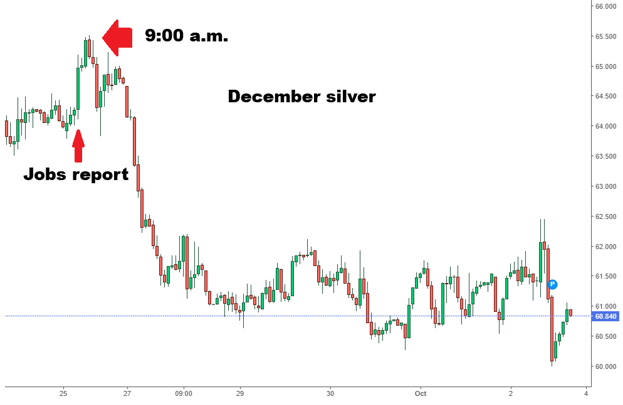
Look at Friday morning after the release of the Non-farm Payroll report that saw new job creation come in weaker (29k vs expected 64k) than expected. along with downward revisions for July and August that saw a 31,000 reduction to the original 162,000 and a 29,000 revision to July, dropping to a net loss of 10,000 jobs. Gold immediately rose like it was shot out of a cannon, jumping $93, while silver exploded out of the gate for a $2.20 spike.
However, after 9:00 a.m., the sellers came thundering in and before you could say "J.P. Morgan", gold lost every dime of advance and was sitting down on the day with a similar outcome for silver which, I should add, briefly broke below $60.
I sent an email alert to subscribers shortly after the jobs number came out, in which I stated rather boldly that "This morning has silver outperforming gold nicely (1.241% to .52%) but the GLD:US is still not able to surpass the upper range of the resistance zone at $385. In fact, rallies to $385 should be used as a selling opportunity. I see a capitulation low for gold around mid-month below $4,000 for spot and around $365 for the GLD:US."
Well, the opening high for the GLD:US was $385.22, and by the closing bell, it was at $380.14. Fading these rallies in gold and silver has been the proper stance, just as it was in 2011-2015, when every minor uptick sent the gold bugs into a Mardi Gras-type celebratory parade only to find them weeping audibly on the sidewalk an hour later.
By contrast, copper had a very modest $0.12 trading range on the day, going out at 4:00 p.m. at $6.5845 for a decent .54% gain on the session, but it was enough to vault my beloved Freeport-McMoRan Inc. (FCX:NYSE) ahead by 3.98%. The copper bears have been forced into hiding by the voracious appetite exhibited by the hoarders who still fear tariffs will curtail imports for the hyperscalers desperately in need of metal for the AI build-out, which isn't going away anytime soon.
Like Richard Russell, copper has the stuff from which legends are made…
Hail copper!
| Want to be the first to know about interesting Copper, Gold and Silver investment ideas? Sign up to receive the FREE Streetwise Reports' newsletter. | Subscribe |
Important Disclosures:
- As of the date of this article, officers, contractors, shareholders, and/or employees of Streetwise Reports LLC (including members of their household) own securities of Fitzroy Minerals.
- Michael Ballanger: I, or members of my immediate household or family, own securities of: GLD, Fitzroy Minerals, and Freeport McMoRan Inc. My company has a financial relationship with: None. My company has purchased stocks mentioned in this article for my management clients: None. I determined which companies would be included in this article based on my research and understanding of the sector.
- Statements and opinions expressed are the opinions of the author and not of Streetwise Reports, Street Smart, or their officers. The author is wholly responsible for the accuracy of the statements. Streetwise Reports was not paid by the author to publish or syndicate this article. Streetwise Reports requires contributing authors to disclose any shareholdings in, or economic relationships with, companies that they write about. Any disclosures from the author can be found below. Streetwise Reports relies upon the authors to accurately provide this information and Streetwise Reports has no means of verifying its accuracy.
- This article does not constitute investment advice and is not a solicitation for any investment. Streetwise Reports does not render general or specific investment advice and the information on Streetwise Reports should not be considered a recommendation to buy or sell any security. Each reader is encouraged to consult with his or her personal financial adviser and perform their own comprehensive investment research. By opening this page, each reader accepts and agrees to Streetwise Reports' terms of use and full legal disclaimer. Streetwise Reports does not endorse or recommend the business, products, services or securities of any company.
For additional disclosures, please click here.
Michael Ballanger Disclosures
This letter makes no guarantee or warranty on the accuracy or completeness of the data provided. Nothing contained herein is intended or shall be deemed to be investment advice, implied or otherwise. This letter represents my views and replicates trades that I am making but nothing more than that. Always consult your registered advisor to assist you with your investments. I accept no liability for any loss arising from the use of the data contained on this letter. Options and junior mining stocks contain a high level of risk that may result in the loss of part or all invested capital and therefore are suitable for experienced and professional investors and traders only. One should be familiar with the risks involved in junior mining and options trading and we recommend consulting a financial adviser if you feel you do not understand the risks involved.