


The Year of our Lord 2006 was a memorable one.
It marked the birth of Twitter, now called "X" in honor of the billionaire owner's favorite alphabetical unit. It was also the year that Julian Assange founded "WikiLeaks", the website that gained global notoriety for pioneering "scientific journalism"—publishing raw, unredacted, or minimally curated datasets alongside its news reporting so the public could verify the facts directly. It is also the creation that got him thrown in jail. Not to be outdone, it was the year that saw the trial of former Iraqi dictator Saddam Hussein, which resulted in his death by hanging in December of that year. Also notable in the year 2006 was the assassination of Al Qaeda leader Abu Musab al-Zarqawi and the declaration of independence in Montenegro.
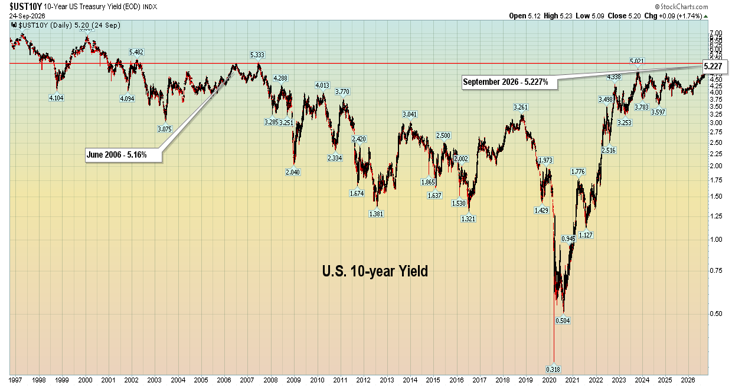
It was in the month of June of that year that the U.S. 10-year treasury bond last sported a yield of over 5.15%.
That's right. Twenty years ago last June, the 10-year yield was over 5%, but then along came the Great Financial Crisis, the most severe global economic meltdown since the Great Depression of 1930. It began with the collapse of the U.S. housing market and rapidly mutated into a full-scale systemic banking panic that brought the international financial system to the brink of total collapse. The crisis destroyed trillions of dollars in wealth, caused tens of millions of job losses worldwide, and triggered "The Great Recession". It also forced policymakers to suppress borrowing costs around the world in order to heal the banking system. Two decades later, there are millions of younger investors who are shocked at the level of mortgage rates, failing to heed the warnings of their older colleagues who were forced to deal with a 22.36% Fed Funds rate in July of 1981 under then-Fed Chairman Paul Volcker.
Twenty years ago this month, the level of the U.S. national debt was $8.507 trillion, with the average yield on the 10-year bond at 4.72%. The amount required to cover interest payments on the debt averaged $401,530,400,000. Today, in September 2026, that same interest payment is estimated to be $1.88 trillion (with a "T").
Another interesting tidbit from June of 2026, the last time the 10-year bond yielded over 5.16%, was that it marked the day that Warren Buffett pledged $31 billion (the majority of his fortune) to the Bill & Melinda Gates Foundation, marking the largest single philanthropic donation in history. Shortly before Buffett's announcement, Bill Gates announced on June 15 that he would transition out of his day-to-day role at Microsoft by July 2008 to focus entirely on philanthropy. Of course, that was before Gates' wife, Melinda, booted him out of her life, taking with her the piddly sum of $62.5 billion to fund her philanthropic lifestyle.
There were many memorable events in 2006, but I would wager that not one headline announced a "Farewell!" to the 5% yield on the 10-year T-bond. No parties, no commemorative speeches, and certainly nothing on the cover of Time Magazine marking the significance of the event. That is precisely why here in 2026, the vast majority of investors think lightly of a rapidly escalating interest rate regime and cannot imagine that there could ever be such a thing as a "hostile Fed". In September 2006, the debt-to-GDP level was 61.5%, whereas today it stands at 124.5%. In September 2006, the U.S. Buffett Indicator stood at approximately 135% to 140%, marking a period of significant market overvaluation right before the eventual peak of the pre-crisis housing bubble. For comparison, the Buffett Indicator has today broken far past its historical trendlines. Fueled by highly concentrated tech expansions, the modern indicator tracks at an unprecedented 236.1% as of late September 2026.
Another interesting piece of information was that on Monday of this week, the S&P 500's new high-new low list today reflected a widening "internal divergence" despite the index's strong, tech-fueled 1.5% rally. Even as megacap tech giants lifted the headline index back toward its record highs, beneath the surface, new 52-week lows were outnumbering new 52-week highs. This trend highlighted that market breadth remained remarkably narrow following the prior week's Federal Reserve interest rate hike.
And yet, rumours of yet another "Memorandum of Understanding" between the Iranians, Israel, and the U.S. has stocks galloping higher along with a 2.53% drop in crude oil futures as traders take an "Everything is awesome!" attitude into the last weekend of the month and quarter. The only response that comes to mind is the immortal words of stock market legend Marty Zweig from the 1980's, who cautioned all of us in his many Wall Street Week with Louis Ruckeyser segments that we should "Never fight the tape," and even more importantly, "Never fight the Fed."
Gold and Silver
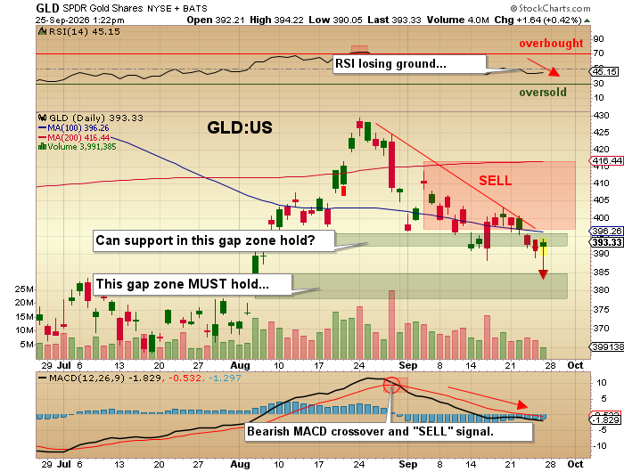
Gold and silver had a rough week as of midday on Friday, with spot gold trading at $4,293.89 per ounce, down roughly 1.37% from last week's close of $4,353.66, and Spot Silver is trading at $64.57 per ounce, down roughly 1.48% from last week's close of $65.54. I have been cautioning subscribers against buying into the widely broadcast narrative that "GOLD has bottomed!" (followed by ten exclamation marks in bold underlined italics) that was the rage of the social media circuit for the entire month of August.
Make no mistake; that rally off the Bessent loan of dollars to help the Bank of Japan in July was the most explosive, seductive, and thoroughly confusing rally that I have witnessed over five decades of slash-and-burn in the precious metals trading pits. I would love to be writing how I bought the lows around $3,950 in gold and dumped it right at $4,700, but the truth is I did neither.
I told subscribers to wait for a 2-day close above the zone where the 100-dma and the 200-dma converge, after which I would attempt to tee up a leveraged trade on the GLD:US, but what happened was that it rocketed from $415 to $430 so fast that I barely had the chance to catch my breath before it went into overbought territory.
I held back, thinking that I might get another crack at it as it retested the zone, but with silver failing to confirm, I did absolutely nothing. Nada. Nil. Nothing. A lot of bluff and bluster and fancy hypothecating only to arrive at ZERO conclusion, other than having avoided a nasty whipsaw as GLD:US closes out the week unable to reclaim even the 100-dma at $396.26, let alone the 200-dma at $416.44.
As we all look back and reflect on the July-August rally, we can only conclude that it was a classic, textbook "bear market rally" and of a vintage that can only with the passage of time be widely admired. The violence and velocity of the bounce off the July lows was magnificent and convincing enough to lure even the greybeards like me that should have known better. Alas, we did not lose anything other than a dollop of bragging rights, and that sure is whale of a lot better than those advisors that went "ALL-IN" as soon as they heard that the U.S. Treasury was intervening in markets to bolster a foreign currency. How that favored gold I will never know.
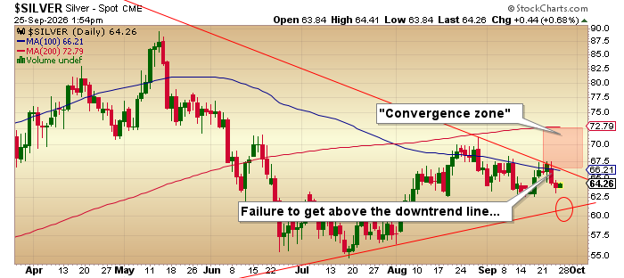
The action in the silver market was another reason that I could not muster up the courage to buy into the "new bull market" narrative, as silver this week came very close to breaking back above that downtrend line drawn off the January and August highs, represented by resistance at around $66.25/oz.
It tested it on Tuesday, trading ever so briefly above resistance and above the 100-dma to $67.53, but then abruptly turned and crashed on Wednesday and Thursday, ending the week well below its 100-dma and well below resistance.
As many of you all have grown to know in reading these missives, no bona fide precious metals bull can remain intact without the leadership of silver and the miners. Silver is lagging badly, but the mining stocks, as represented by the HUI:US, are acting far better than silver or gold, which is a positive divergence.
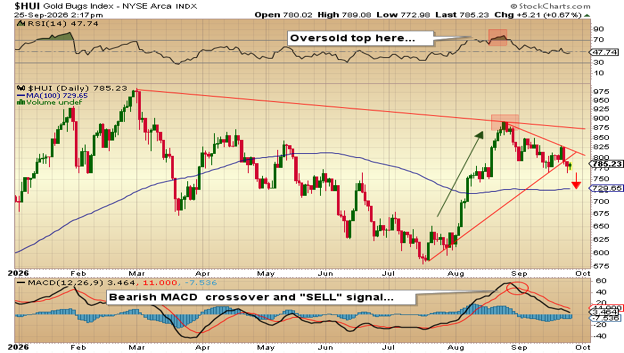
Note how they almost got back to the levels achieved in late January and are still holding nicely above the 100-dma.
If silver could have exceeded that convergence zone last week and held above it, I would have initiated an accumulation program on the GLD:US December calls, but without silver and the miners in sync with one another, I am forced to stand aside.
Copper
Lastly, there is the matter of copper.
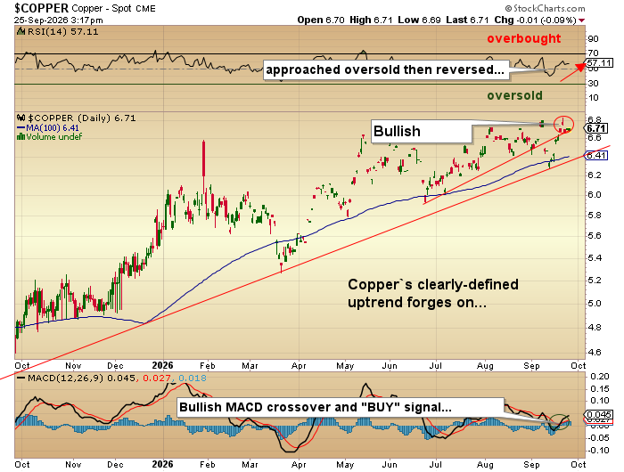
December copper made a record high on August 5, which marked the third record of the year, and then tried for another one earlier this week, although it fell a few pennies short of the mark at $6.96/lb.
I have a gentleman's bet on with a colleague that copper will see $7.00 before $5.00, and I made that bet last year when it was in the $5.35 range. Everything I read and hear regarding the outlook for copper demand and supply spells "H-I-G-H-E-R P-R-I-C-E-S" and while I get a giddy feeling every time I see one of Robert Friedland's posts on "X", I am also reminded of ex-Merrill
Lynch market strategist Bob Farrell's Rule #9: "When all the experts and forecasts agree—something else is going to happen." It is hard not to be a copper bull these days with the records falling every other day, but I am concerned that the copper equities, which include the large multinational producers, are not confirming the move in December copper by establishing new highs themselves.
My beloved Freeport-McMoRan Inc. (FCX:NYSE) is a full $8.00 or 9.97% from its record high of $80.24. Bob Friedland's Ivanhoe Mines Ltd. (IVN:TSX; IVPAF:OTCQX) is 43.15% from its record high, and TSX Venture darling Marimaca Copper Corp. (MARI:TSX; MARIF:OTCQX; MC2:ASX), which hit US$9.87 back in January, is trading at a mere fraction of that at $6.07, down 38.5% since then.
I learned decades ago that gold shares lead gold bullion, so I must assume that copper shares must lead physical copper. On that basis, such underperformance is trying to tell us something, but what exactly that is has been an annoying beguilement. Are they telling us that a stock market correction, which is long overdue, is going to bring weakness into the spot copper market and with it the copper mining shares?
Alas, I am unable to put aside the bullish narrative that echoes down from senior executives like Kathleen Quirk of Freeport-McMoRan Inc. or Gary Nagle of Glencore Plc (GLEN:LSE; GLN:JSE; GLCNF:OTCMKTS). Appointed in 2021, Nagle has been heavily focused on overseeing a strategic shift toward energy transition metals—including aggressive copper asset expansions in South America—while guiding the firm's ongoing corporate restructuring and capital allocations. Even ex-Barrick Mining Corp. (ABX:TSX; B:NYSE) CEO Mark Bristow was a major, vocal copper bull. Throughout his tenure as CEO of Barrick, he famously declared that "copper is the most strategic out of all the metals," arguing that it is as strategic to the global economy as gold is precious.
I choose to allow the actions of these copper behemoths rather than their words to be the governing initiative for my investment strategy and allocations. However, I remain a nervous bull because when the Fed shifts policy as it did this month, all metals (and stocks) are facing a new and formidable headwind for the first time since 2022 in the form of a hostile monetary policy. How many times do we see a "guest commentator" on "CNBS' tell viewers that "it's different this time because the Fed cannot stand in the way of rising corporate earnings"? My response would be a very simple "BS" because history has proven time after time that the cost of borrowing is a powerful deterrent to unbridled earnings growth.
All paths lead to caution these days and while I am not yet prepared to change my bullish view on copper (and all commodities including energy), my radar is scanning the landscape and my sensors are in acute "detect" mode for signs that the globe may be slowly sliding into recession.
Stay tuned…
| Want to be the first to know about interesting Gold, Copper, Critical Metals and Silver investment ideas? Sign up to receive the FREE Streetwise Reports' newsletter. | Subscribe |
Important Disclosures:
- Michael Ballanger: I, or members of my immediate household or family, own securities of: Freeport-McMoRan Inc., Marimaca Copper Corp., Freeport-McMoRan Inc., and GLD. My company has a financial relationship with: None. My company has purchased stocks mentioned in this article for my management clients: None. I determined which companies would be included in this article based on my research and understanding of the sector.
- Statements and opinions expressed are the opinions of the author and not of Streetwise Reports, Street Smart, or their officers. The author is wholly responsible for the accuracy of the statements. Streetwise Reports was not paid by the author to publish or syndicate this article. Streetwise Reports requires contributing authors to disclose any shareholdings in, or economic relationships with, companies that they write about. Any disclosures from the author can be found below. Streetwise Reports relies upon the authors to accurately provide this information and Streetwise Reports has no means of verifying its accuracy.
- This article does not constitute investment advice and is not a solicitation for any investment. Streetwise Reports does not render general or specific investment advice and the information on Streetwise Reports should not be considered a recommendation to buy or sell any security. Each reader is encouraged to consult with his or her personal financial adviser and perform their own comprehensive investment research. By opening this page, each reader accepts and agrees to Streetwise Reports' terms of use and full legal disclaimer. Streetwise Reports does not endorse or recommend the business, products, services or securities of any company.
For additional disclosures, please click here.
Michael Ballanger Disclosures
This letter makes no guarantee or warranty on the accuracy or completeness of the data provided. Nothing contained herein is intended or shall be deemed to be investment advice, implied or otherwise. This letter represents my views and replicates trades that I am making but nothing more than that. Always consult your registered advisor to assist you with your investments. I accept no liability for any loss arising from the use of the data contained on this letter. Options and junior mining stocks contain a high level of risk that may result in the loss of part or all invested capital and therefore are suitable for experienced and professional investors and traders only. One should be familiar with the risks involved in junior mining and options trading and we recommend consulting a financial adviser if you feel you do not understand the risks involved.