


As I sat at my keyboard this morning trying desperately to conjure up a topic that my subscribers would not only find entertaining but also useful, I started off with several paragraphs about this being the twenty-fifth anniversary of the 9/11 attacks on the World Trade Center in New York. However, when I reread what I had written, I suddenly realized that as a non-American, I have little if any right to make any comments about one of the most important events of the past eighty years.
While it was a quarter of a century ago that a number of Saudi Arabian activists flew planes into the North and South Towers, the Pentagon, and a farmer's field in Pennsylvania, it was eighty years ago in August that WWII ended with the surrender of the Japanese Imperial Forces. While the end of WWII marked the start of "The Era of American Exceptionalism", it also marked the rise of the U.S. dollar as the world's reserve currency.
While the U.S. dollar began mounting a serious challenge to the British pound sterling after World War I, heavily indebted European nations were forced to send gold to the U.S., thus allowing the dollar to emerge as a dominant currency for international bond issues. For the next eighty (or so) years, the U.S. has ruled over the globe with what might be deemed a "dictatorial presence".
However, since the events of 9/11/2001, the reverse has been true. America has found itself embroiled in foreign wars in defense of "free market capitalism and democracy" in places like Vietnam, Iraq, Afghanistan, and now Iran, as desperate attempts to maintain the petrodollar system are getting more and more difficult with each passing day and conflict.
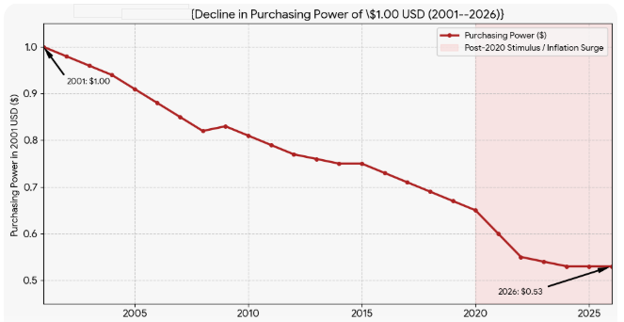
In fact, looking at the purchasing power of the dollar since 9/11, one sees a protracted erosion in value, with the 2026 dollar buying only $.53 of the same goods and services bought in 2001. The National Debt in 2001 was $5.77 trillion, whereas today it is north of $40 trillion. The Defense budget in 2001 was $305 billion; today it stands at over $1 trillion, with interest on the debt now exceeding that figure, a surefire sign of an empire in decline.
The decision in 2022 by the Biden White House to freeze $300 billion in Russian assets had a deleterious effect on the reputation of the U.S. and the sanctity of assets held in the U.S. banking system. The freezing of Russian foreign exchange reserves acted as a "seismic structural catalyst" for the global gold market, permanently altering how central banks view sovereign reserves. By proving that U.S. dollar and Euro assets held offshore could be frozen overnight due to geopolitical shifts, the G7 sanctions triggered a historic "de-dollarization" scramble into physical gold.
Every few years since 2001, there has been a series of events that, against the test of time, have proven to be serious policy blunders, with most of them seemingly self-inflicted. Looking back to February, pressure on the U.S. by Israeli politicians coerced the U.S. into attacking Iran with three primary objectives: regime change, handover of enriched uranium, and control of the Strait of Hormuz. To date, none of these objectives have been met yet the cost since February is now approaching $113 billion. Furthermore, with oil prices now again through the century mark (US$100/bbl.), consumer prices are rising across the board with record highs seen recently in corn, rough rice, copper, zinc, and diesel fuel.
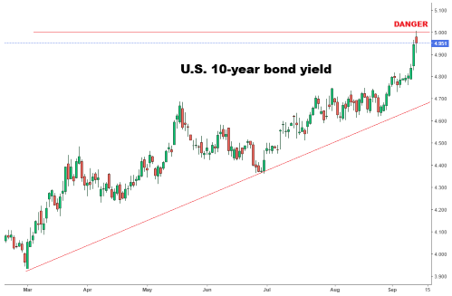
All of this is having an unexpected consequence on the cost of borrowing, with the yield on the U.S. 10-year bond moving through 5% earlier today, throwing considerable pressure on the cost of mortgages for would-be homeowners. In this manner, it was an ill-fated decision to flex American military muscle that has actually backfired in the direction of the mid-term elections, as President Trump's approval ratings have just hit a record low for both terms at 36%. In other words, if an election were tomorrow, it is unlikely that Republicans would retain control of either the House or the Senate.
With this many crosscurrents wreaking havoc on markets, it is no wonder that the U.S. 10-year yield is now threatening to move above 5%, as it did Friday morning very briefly.
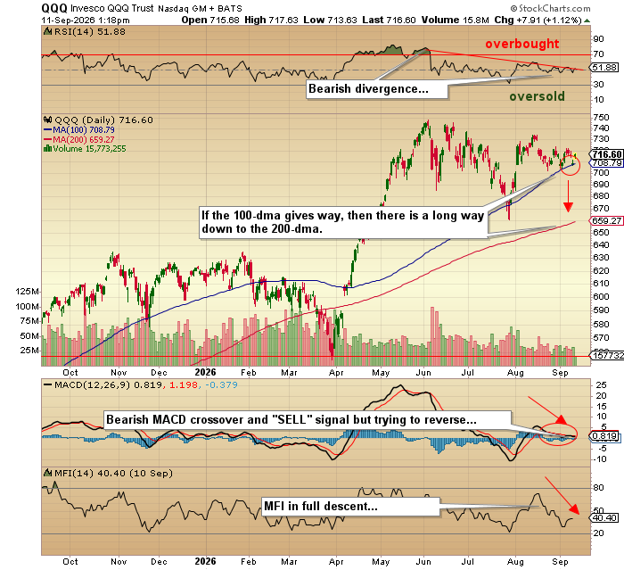
What is surprising is how the S&P 500 remains a mere 2% from its record high from last August 13. With September now nearly half-over, stocks have been historically weak up until around the middle to the third week of October, and while there have been notorious crashes such as October 1929 and October 1987, they typically get followed by year-end rallies, many of which have been immensely robust.
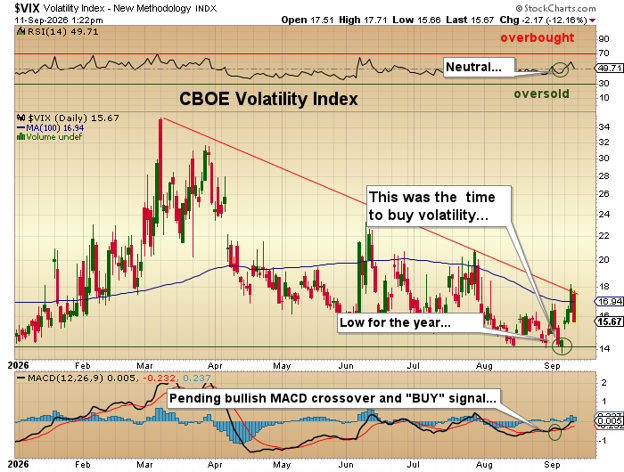
The one trade that has remained suppressed all year has been the volatility trade with the CBOE Volatility Index (VIX:US) locked in a downtrend drawn off the early March peak above 35. Pro traders just keep shorting the VIX:US every time it threatens to take off in order to keep markets at the very least stable going into the November midterms.
Thus far, as unpredictable as he has seemed, President Trump has been a very "market-friendly" chief executive with a habit of judging his performance by the action in the NASDAQ or S&P. Traders could do a great deal worse than having Donald Trump in the White House, especially if a socialist Democrat gets the nod in 2028, and traders would prefer to see the Republicans retain control of Congress until then. That is why traders are trying to keep oil down and stocks up going into the midterms. They need everything to remain "status quo" until 2028.
As for the metals, the month of August had the bulls chirping from the rooftops as every armchair technician on the planet was screeching "BREAKOUT" failing to realize that most bear market rallies tend to appear "foolproof" as they lure the masses back from the safety of the sidelines, inflicting once again lethal doses of FOMO as well as that little green man that jumps out of your left ear from time to time called "GREED".
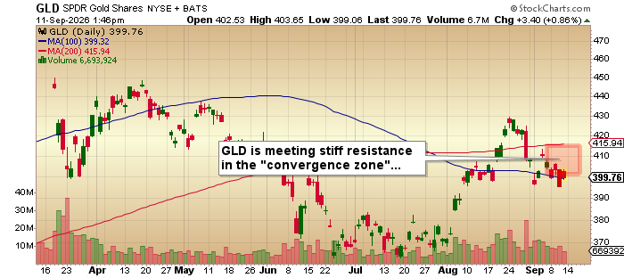
The rally off the late-July lows for the GLD:US was breathtaking and alluring, but it did the unthinkable, which only gold and silver can do with such narcotic intensity. Gold broke out above the "convergence zone" bordered by the 100-dma at $399.32 and the 200-dma at $415.94. The area in between those two lines is to be considered "stiff resistance," and it is doubly stiff now because of the breakout on August 20, where we got the 2-day close above the 200-dma and subsequent "chase" that propelled it to $430 before the rug got pulled with a vengeance.
For the week ending September 11th, GLD:US is clinging onto the resistance just above the 100-dma by the skin of its teeth, so there is not a lot one can do. Luckily for me, I refrained from buying into the "sucker rally" that has seen me drawn and quartered numerous times in the past five decades. I told everyone that "just because you get the 2-day close, you do not chase the breakout". We waited for GLD:US to re-enter the "convergence zone" before even entertaining the notion of adding a leveraged gold trade to the list of holdings. Here we are, three full weeks since the "false breakout," and I still refuse to get lured into a beguiling trade. We have our gold juniors and our physical gold, but as to leveraged ETF's or calls on gold or silver, we are happily sidelined.
The bigger story for me was the manner in which the color commentators over at CNBC tried in vain to knock Freeport-McMoRan Inc. (FCX:NYSE) CEO Kathleen R. Quirk off the throne with some pointed (and thoroughly biased) questions about the White House's refusal to commit to tariffs on copper imports triggering a 6% rout on Thursday.
They tried to get her to acknowledge that the only reason copper was at record highs was fear of tariffs that was prompting hoarding amongst the big copper users.
She was resolute in her replies, stating firmly that "copper is a very important commodity as we look toward the future".
Appearing on the broadcast directly following reports of the White House pausing its copper tariff plan, Quirk addressed the ongoing price volatility by highlighting that "the long-term structural demand fundamentals remain entirely intact".
Amen and Hallelujah to Ms. Quirk.
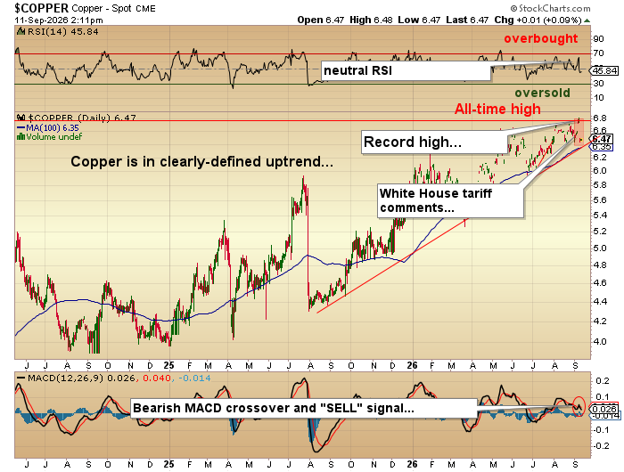
With the entire globe competing for AI supremacy and full domestic electrification, American tariff decisions are not going to alter long-range structural deficits one iota. Ergo, I remain bullish on copper and am looking to replace the leveraged long positions in FCX:US that I sold back in late August with it over $80. Since I still think September has more downside risk to the overall equity markets, a print in the sub-$70 zone will certainly have my undivided attention for my beloved Freeport-McMoRan Inc.
The Canadian junior resource sector has been on the defensive all spring and summer since the blow-off top occurred in late January, with peaks in gold and silver, and of course, the temporary peak in copper. As can be seen from the chart of the TSX Venture Exchange, the juniors rallied in sympathy with the "BREAKOUT" narrative that permeated the Twitterverse and the Blogosphere all through August, but which reversed on a dime the moment the gold and silver rally ended on August 24.
Since then, the TSXV has followed gold and silver down and should continue to consolidate well above the July lows until the metals can finally overcome that stubborn resistance that sits like a London fog above them.
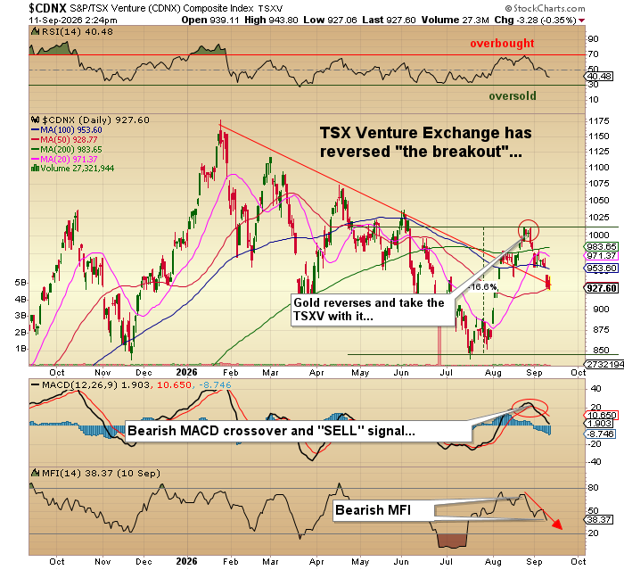
From the perspective of seasonality, the junior resource space is slowly setting up for a rip-roaring end-of -year rally led by copper and zinc, who have been acting great in recent weeks, the copper blip on White House tariff news notwithstanding.
It is my belief that we are in the early stages of a massive commodities supercycle geared almost solely to the AI buildout and global electrification. Energy, food, and base metals will remain in short supply for the balance of the decade. Furthermore, the old economic system called "Mercantilism" is back in vogue after forty years of "Globalization". Mercantilism was an economic system spawned from the 16th to the 18th century that stated that a nation's power depends directly on its wealth, specifically its supply of gold and silver, and it relies on several Core Principles, which are:
- Bullionism: Wealth was measured in physical gold and silver (bullion). Governments tried to accumulate as much precious metal as possible within their borders.
- Favorable Balance of Trade: A country needed to export more goods than it imported. Selling more to other nations brought gold in; buying more sent gold out.
- Colonial Exploitation: Colonies existed solely to benefit the mother country. Colonies provided cheap raw materials and served as a captive market to buy finished manufactured goods.
- Protectionism and Tariffs: Governments imposed heavy taxes (tariffs) on foreign imports to stop people from buying goods made in rival countries.
- Monopolies and Charters: States granted exclusive trading rights to favored corporate monopolies, such as the British East India Company, to control specific trade routes.
Over the next several years, the hyper-globalization of the late 20th century — defined by free trade, open borders, and optimized global supply chains — will continue to run in reverse. Instead of prioritizing global economic efficiency and cheap consumer goods, national governments are pivoting toward national self-interest, state-driven industrial policy, and economic security.
If managed correctly, resource-rich countries like Canada, Russia, Chile, and Argentina should prosper and excel, but there exists a very large caveat in the word "IF".
| Want to be the first to know about interesting Copper, Gold and Silver investment ideas? Sign up to receive the FREE Streetwise Reports' newsletter. | Subscribe |
Important Disclosures:
- Michael Ballanger: I, or members of my immediate household or family, own securities of: GLD and Freeport McMoRan Inc. My company has a financial relationship with: None. My company has purchased stocks mentioned in this article for my management clients: None. I determined which companies would be included in this article based on my research and understanding of the sector.
- Statements and opinions expressed are the opinions of the author and not of Streetwise Reports, Street Smart, or their officers. The author is wholly responsible for the accuracy of the statements. Streetwise Reports was not paid by the author to publish or syndicate this article. Streetwise Reports requires contributing authors to disclose any shareholdings in, or economic relationships with, companies that they write about. Any disclosures from the author can be found below. Streetwise Reports relies upon the authors to accurately provide this information and Streetwise Reports has no means of verifying its accuracy.
- This article does not constitute investment advice and is not a solicitation for any investment. Streetwise Reports does not render general or specific investment advice and the information on Streetwise Reports should not be considered a recommendation to buy or sell any security. Each reader is encouraged to consult with his or her personal financial adviser and perform their own comprehensive investment research. By opening this page, each reader accepts and agrees to Streetwise Reports' terms of use and full legal disclaimer. Streetwise Reports does not endorse or recommend the business, products, services or securities of any company.
For additional disclosures, please click here.
Michael Ballanger Disclosures
This letter makes no guarantee or warranty on the accuracy or completeness of the data provided. Nothing contained herein is intended or shall be deemed to be investment advice, implied or otherwise. This letter represents my views and replicates trades that I am making but nothing more than that. Always consult your registered advisor to assist you with your investments. I accept no liability for any loss arising from the use of the data contained on this letter. Options and junior mining stocks contain a high level of risk that may result in the loss of part or all invested capital and therefore are suitable for experienced and professional investors and traders only. One should be familiar with the risks involved in junior mining and options trading and we recommend consulting a financial adviser if you feel you do not understand the risks involved.