


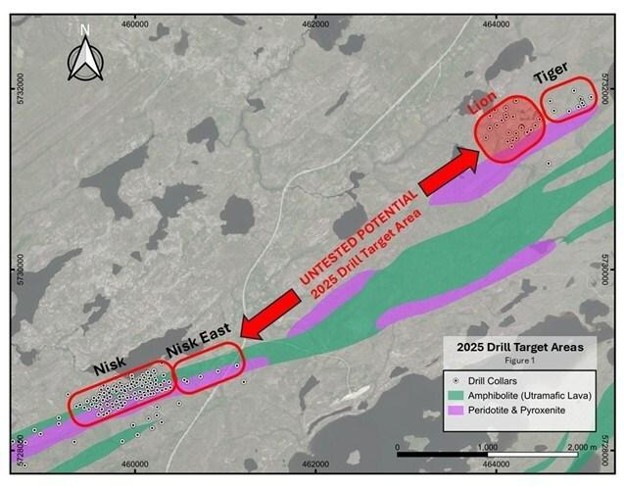
Power Metallic Mines Inc. (PNPN:TSXV; PNPNF:OTCQB) is quietly assembling what looks like one of the most compelling high‑grade polymetallic stories in the critical metals space. All market participants have to do is look at the resource map of the Nisk and Lion deposits and simply connect the dots. What lies underneath is 5km of untested potential that could make this one of the largest polymetallic stories in the world.
This could be the highest-grade Copper and PGE discovery in the world. Right now, they have three high-grade copper veins that rank in the top five in the world. That's just a talking point because the real story is the near-term catalyst that the world's smartest mining investors like Friedland, McEwen, Rhinehart, and Sprott have already connected the dots on. The unveiling of the NI-43-101 resource estimate is imminent, which has the potential to catapult the stock price.
Geological Origin Mimics the Norilsk-Talnakh (Russia)
The geologist behind Power Metallic is Steve Beresford, and his life's mission appears to be finding the next Norilsk-Talnakh, which is a Russian mine with a copper-rich sulfide ore that contains other precious metals, including gold, silver, palladium, and platinum. The Lion mine resembles a potential copper-rich Norilsk-style magmatic sulphide discovery in metal composition.
Is this the next Norilsk?
Only time will tell, but it's off to a good start when you look at how the drilling program has evolved and how the infill and step-out drilling have significantly defined and expanded the mineralized system ahead of the initial resource estimate. When Beresford joined in 2024, he was looking to "transform the NISK into a polymetallic deposit," but he's been on the hunt all his life for the "Trillion Dollar Deposits," and he believes they are "overlooked and in plain sight."
There's probably a good reason why he picked this team and this resource.
Norilsk-Talnakh Setting the Bar
Using napkin math and the 2021 reserve inventories, we know that Norilsk contains 1.5Bt of rock, of which 11.2 Mt Ni, 11.2 Mt Cu, and 231.7 Moz Platinum Group Metals (PGMs).
Assuming spot metal prices here, this is what the value of the Norilsk reserve could be worth. It's worth noting that PNPNF's Geologist Steve Beresford went on record in 2022 and estimated that the in situ value was US$1.4 trillion (2020). So these napkin math numbers are extremely conservative.
|
Metal |
Contained quantity |
Illustrative price |
Gross in-situ value |
|
Nickel |
11.2 Mt |
US$16,000/t |
US$179 billion |
|
Copper |
11.2 Mt |
US$9,500/t |
US$106 billion |
|
PGMs |
231.7 Moz |
US$1,300/oz blended |
US$301 billion |
|
Total |
— |
— |
US$586 billion |
Investors looking for other comparison metrics should know that the Norilsk-Talnakh mine is roughly 16.5 km². Now here is the cool part: if you are an investor inclined to think there is something between the two points. Power Metallic's Nisk–Lion–Tiger project area is about 330 km². If this is a consistent orebody, the napkin just isn't big enough for what is coming.
This orebody has been underestimated from the beginning. When it was first discovered in 2024, the VP of Exploration, Kenneth Williamson, thought "the system starts essentially at the surface and goes down to 275 meters," but the latest update puts the depth at 700-800 meters.
From Single Deposit to District‑Scale System
What began as a straightforward high‑grade nickel sulfide play has evolved into a district‑scale, multi‑commodity system with copper, platinum group metals (PGMs), gold, silver, and nickel. The metallurgy of processing the ore works because they are sitting on very valuable existing infrastructure that places them near a highway, an airport, a power plant, an ample water supply, and a labor force. Add to this the unimaginable tax credits that derisk the project even more.
Nisk is the original orebody, which is a high‑grade class‑1 nickel sulfide deposit in Quebec's James Bay region. It has a filed NI 43‑101 resource of roughly 4.9 million indicated tonnes grading 0.78% nickel, 0.05% cobalt, 0.42% copper, and 0.78 g/t palladium, plus additional inferred tonnage. That equates to around 38,300 tonnes of nickel, 2,400 tonnes cobalt, 20,500 tonnes copper, and 123,100 ounces of palladium in the indicated category alone — a solid foundation for any future nickel operation.
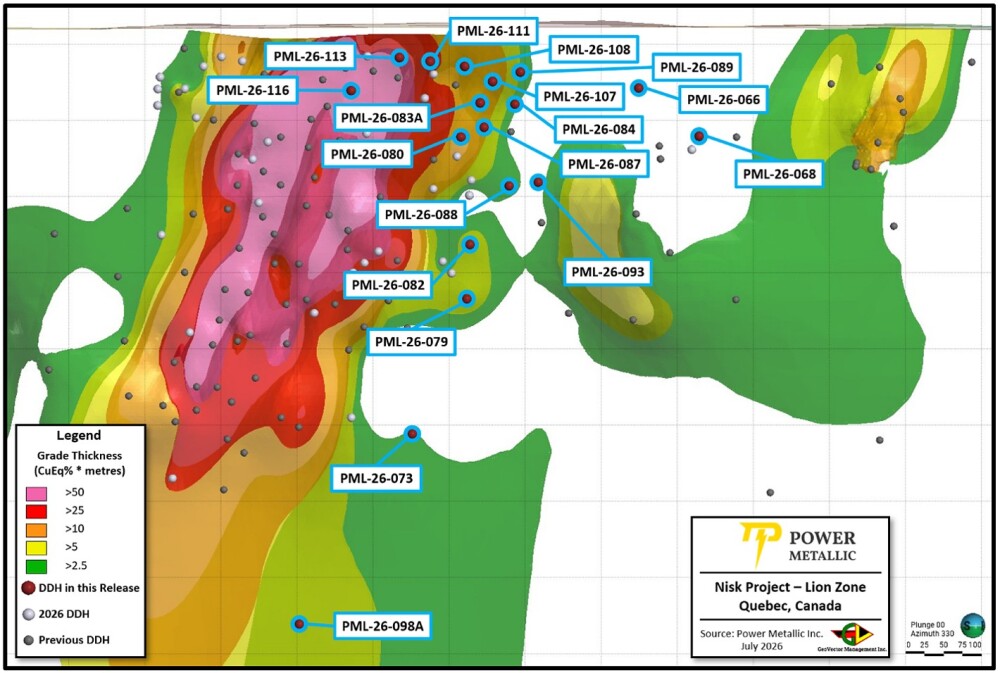
The real inflection point came when Power Metallic followed the orebody out roughly 5 km along the same ultramafic trend and hit the Lion Zone. This was a near‑surface, high‑grade polymetallic discovery whose copper‑equivalent grades rival some of the best deposits globally. Infill drilling at Lion during the winter 2026 drill campaign delivered multiple thick intersections with multi‑percent copper, double‑digit grams per tonne PGMs, payable gold and silver, and appreciable nickel. One representative hole (PML‑26‑094) returned 17.45 m at 9.47% CuEq, 7.07 g/t Pd, 3.11 g/t Pt, 0.53 g/t Au, 23.76 g/t Ag, and 0.23% Ni, that included 6.3 m at 17.91% CuEq while a slightly deeper hole (PML‑26‑101) delivered 39 m of 5.66% CuEq that included 9.2 m at 15.18% CuEq with very high PGM grades.
When those metals are converted to copper equivalent, length‑weighted averages across the zone come in around 7–10% CuEq, with more than 100 intersections above 4.24% CuEq over thicknesses greater than 11 m. For context, those are "elite tier" grades that materially lower capital investment and drive very high operating margins.
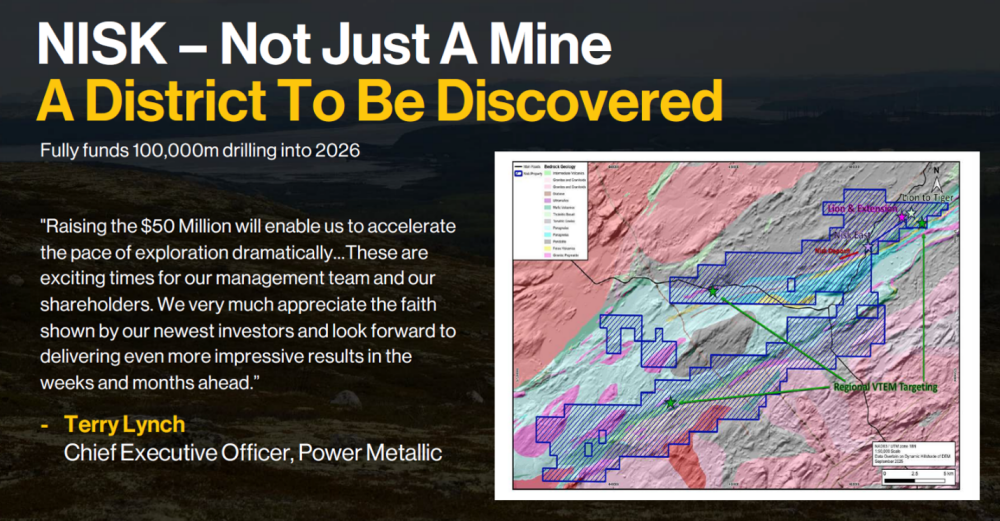
There is a 5km ultramafic corridor that holds the potential of a continuation of the orebody between the two points. The company's July 2026 corporate deck highlights a dedicated 2,000m program targeting the "virgin ground" between the two discoveries, with management emphasizing that there are six kilometers of trend with no holes yet in it. The implication is straightforward: Nisk and Lion may simply be the first two outcropping expressions of a much larger orthomagmatic Ni‑Cu‑PGE system that continues along strike and at depth.
If drilling along that corridor starts to fill in the gap — with additional deposits or connecting shoots — investors are no longer looking at two discrete orebodies, but the skeleton of a district‑scale polymetallic camp. That is where step‑function re‑ratings typically occur.
Polymetallic Structures Offer Optionality
In nickel sulfide exploration, it is common to have additional metals in the mix. These metals are copper and PGMs that add incremental value to a nickel deposit. Polymetallic deposits are a different animal. Here, copper, PGMs, gold, silver, and nickel all contribute meaningful and often equivalent value, and you can see that clearly at Lion.
Power Metallic's own analysis of Lion shows an estimated economic value split roughly 45% copper, 20% palladium, 20% platinum, 10% gold, and 5% silver, with nickel and cobalt providing further upside. That revenue mix is essential to understanding how polymetallic mineralization de‑risks the mining proposition. PNPNF's head geologist, Dr. Steve Beresford, is an internationally recognized geologist who has worked on most of the world's nickel sulfide mines. He likes the optionality of multiple metals because it adds a layer of flexibility to the mine development, regardless of the economic climate.
In simple terms, for investors:
- When nickel is out of favor, but copper and PGMs are strong, a polymetallic system like Nisk‑Lion can pivot toward copper‑rich and PGM‑rich zones (Lion).
- When nickel tightens, the high‑grade nickel sulfide core at Nisk Main can take center stage again.
- Over a full mine life, the operation can flex its production plan to chase whichever metals offer the best margins in each commodity cycle.
That built‑in optionality is a powerful hedge against the inevitable shifts in demand for individual metals. Instead of betting on one commodity, you're effectively buying a basket of critical metals — nickel, copper, cobalt, PGMs, gold, and silver — in a single project, with the ability to sequence mining to maximize free cash flow at any given time.
The Compelling Economics of High-Grade Metallurgy
When it comes to mining, the grade of the ore is the great equalizer in a project. The lion project has three of the top five best veins in the world, and it's close to the surface. The mine plan is literally a no-brainer, which makes this project highly fundable. Here is an analysis of the economic impact by comparing project types:
- Low‑grade porphyry copper projects typically deliver 0.4–0.7% Cu or CuEq and require US$20,000–30,000 per tonne of annual copper capacity, generating IRRs in the mid‑teens at US$4/lb Cu.
- Medium‑grade oxide projects sit around 0.5–1% Cu or CuEq, with capex investment of US$15,000–20,000 per tonne and IRRs in the 20–30% range.
- High‑grade projects (1–3% CuEq) can push IRRs into the 30–40% range.
- Ultra‑high "Lion‑style" projects at 5%+ CuEq can potentially achieve capex investment below US$10,000 per tonne and IRRs north of 30–40%, even under conservative price decks.
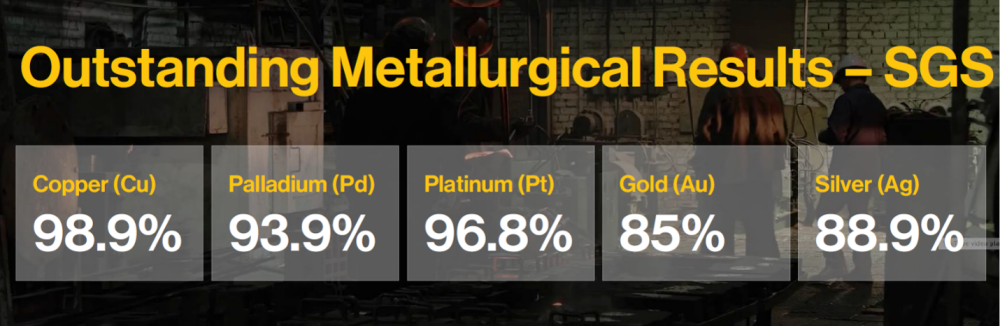
These economics only work if they can get the metallurgy of separating the metals to cooperate. The good news is they did some bench‑scale locked‑cycle testing with SGS Canada and proved out recoveries of roughly 98.9% for copper, 93.9% for palladium, 96.8% for platinum, 85% for gold, and 88.9% for silver.
In other words, the vast majority of in‑situ value appears recoverable in concentrate, which is critical when you are dealing with a multi‑metal system.
High head grades plus high recoveries are exactly what you want going into a Preliminary Economic Assessment (PEA). Analysts compiling early economic scenarios in the company's deck have penciled in a combined Nisk‑Lion tonnage of ~16.5 Mt at around 7% CuEq. Investors should realize that these numbers are not from a 43-101 and should be treated as directional rather than definitive. Separate coverage has suggested Lion alone could host 5–7 Mt at 5–7% CuEq, with a path toward 15–20 Mt as drilling expands the envelope.
Whether those volumes prove out or not, the grade profile already puts Nisk‑Lion in a very small peer group.
Tiny Infrastructure Buildout
Many mines are in hard-to-reach places, literally at the end of the earth, which means infrastructure needs to be built. The project has all the infrastructure they need in place, wrapped up in a nice bow. This is a huge plus for the project in terms of time and money.
The story remains an advanced exploration play with a compelling combination of grade, scale potential, jurisdictional quality, and technical leadership, but watch out because the next six months could be explosive.
The principals of the company really hammer this point home in the interviews and investor decks, and investors should realize how much this existing infrastructure derisks the project even more.
The project is located just off a major highway in the James Bay region, roughly 8 km outside the Cree community of Nemaska, which offers hotels, shops, and a regional airport.
Across the road from the project sits a Hydro‑Québec substation, delivering low‑carbon, inexpensive hydropower that fits neatly with the company's ambition to build Canada's first carbon‑neutral nickel mine using hydro power and carbon capture. That kind of plug‑and‑play infrastructure — power, road access, airport, local workforce — can save hundreds of millions of dollars versus remote projects that have to build everything from scratch.
Embedded Tax Credits
The local government is very supportive of this project and has significant tax credits. Quebec's tax credits effectively cover around 50% of eligible exploration and development expenditures. Power Metallic recently priced a large flow‑through financing at CA$2.83 per share, raising roughly CA$40 million (~US$28 million) to fund accelerated drilling across Nisk and Lion and additional electromagnetic targets. The ability to recycle exploration spending through refundable credits is a structural advantage that reduces capital risk and allows for more aggressive drilling than would otherwise be possible. Assuming the project cost comes in at $400 million, that could represent a $200 million tax credit.
The icing on the cake of these tax incentives comes in the form of community relations. The community and the government stakeholders all want the mine to succeed, and that creates less friction during the permitting and development stage of the project. It represents another huge positive that most mining projects don't have.
Leadership and Geological Firepower
Grade and geology alone are never enough. Execution matters, and here Power Metallic has quietly built a formidable team.
On the corporate side, CEO Terry Lynch brings decades of experience in mining finance and junior development. He has chaired and led multiple TSX‑listed companies, founded Cardiol Therapeutics (CRDL:TSX; CRDL:NASDAQ), and created Save Canadian Mining to advocate for market structure changes. He has also demonstrated the ability to raise capital in difficult markets, as evidenced by the most recent CA$40 million financing and a roster of blue‑chip mining investors who are now on the register.
Those investors include Eric Sprott, Rob McEwen, and Robert Friedland – names that you typically only see attached to projects they believe can scale to serious outcomes. Their involvement offers a strong signal that the technical story at Nisk‑Lion is attracting attention beyond retail and small institutions.

On the technical side, Joe Campbell, P.Geo., serves as VP Exploration and is the qualified person reviewing and approving the technical disclosure. Campbell's track record includes the discovery of an Agnico Eagle mine for Western Mining, a credential that speaks to his ability to turn good rocks into real mines.
Then there is Dr. Steve Beresford, arguably one of the top polymetallic Ni‑Cu‑PGE geologists in the world. His resume includes Chief Geologist roles at three major mining companies, professorships at leading universities, and field work in more than 60 countries focused primarily on magmatic nickel‑copper‑PGE deposits. In public commentary, Beresford has made it clear that he specifically sought out polymetallic systems like Nisk‑Lion, noting that polymetallic deposits remain the premier deposit style through market cycles and that Nisk-Lion projects exhibit the geological formation and size characteristics he's been searching for his entire career.
The board also includes figures such as Peter Kent (a respected corporate commercial lawyer) and Seamus O'Regan (a former Energy Minister and Indigenous Affairs Minister), bringing political and regulatory experience directly into the boardroom. That combination of technical, financial, and governmental expertise materially improves the odds that value will be crystallized through development, strategic partnership, or eventual M&A.
Handicapping the NI-43-101 Mineral Resource Estimate
Key upcoming milestones include an updated Mineral Resource Estimate (MRE) for Nisk, expected at the end of Aug 2026, and a project‑level PEA targeted for early Q1 2027 and Feasibility by the end of 2027. This is an unusual discovery with a huge concentrated resource close to the surface.
This isn't normal; it's a Goldilocks type of mine, and that's why it's been misunderstood by many. It's also why Management moved the MRE up to drop before Labor Day. The average copper mine is 0.62% Cu content, but this mine is looking at 5-7%, which is almost 10x normal. This transforms the economics because each scoop is worth so much more. The napkin math supports a huge resource, and so are the analysts, but the stock price is languishing in comparison to the growing body of evidence of a world-class anomaly.
It's apparent in the slide decks that management believes most investors don't understand the importance of grade. The last discovery of this type was 17 years ago by Anglo American Plc (AAUK:OTCQX; AAL:LSE) (The Sakatti Project in Finland). Sakatti is an underground mine vs the Lion, which is likely to be an open-pit mine. Apples and oranges in terms of economics. Moving up the MRE was management's way of saying, if we just go with what we have now, look at how wildly profitable an operation is possible. They are out to prove to the market without any doubt that they have a profitable mine. So, expecting a NAV over $1.0 billion is not unreasonable, and it's expected to grow. Between now and the PEA, investors can expect a steady cadence of assay results, continued metallurgical work, and potential land package expansions.
Drilling, Catalysts, and the "Connect the Dots" Moment
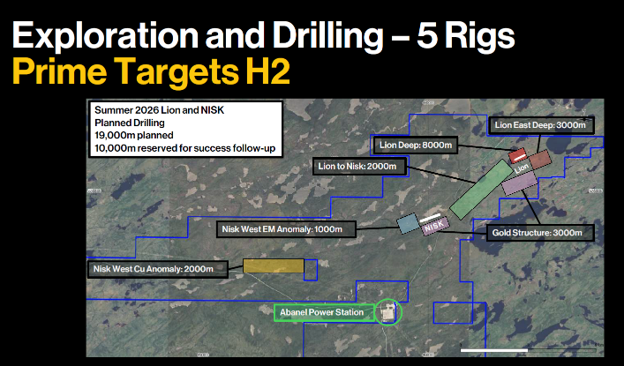
The current plan is aggressive. According to the July 2026 corporate deck, Power Metallic is running up to five or six rigs between Nisk and Lion, targeting over 100,000 m of drilling through late 2026, with 40,000 m already scheduled from June to December and additional meters reserved for success follow‑up. Priority targets include:
- Deep drilling at Lion to test for larger feeder systems at depth (up to 8,000 m).
- Systematic step‑outs along the 5–6 km corridor between Nisk and Lion (initial 2,000 m specifically dedicated to this trend).
- EM anomalies and copper‑rich zones at Nisk West and Lion East.
- Gold structures and other satellite targets that could add incremental value.
The market has started to take notice. In various coverage, analysts have framed Power Metallic as having "transformed from a nickel junior to a polymetallic play" with potential for a high‑grade mid‑sized deposit at Lion that carries analogs to world‑class Norilsk‑style systems. Some estimates have floated conceptual resource potential in the range of 1 billion pounds of high‑grade copper equivalent at Lion and 178 million pounds of nickel equivalent at Nisk, with both zones open in multiple directions and numerous targets yet to be drilled.
For investors, however, the real "connect the dots" moment may come not from any single hole, but from the first maps and cross‑sections that show additional deposits or continuous mineralized shoots between Nisk and Lion. At that point, the market will have to grapple not just with two special orebodies, but with a polymetallic district sitting on road, power, and airport in one of the world's best mining jurisdictions.
Risks to Monitor
As with any exploration‑stage polymetallic discovery, there are material risks that investors must weigh. Resource estimates for Lion are still conceptual and non‑compliant, and there is no guarantee that drilling will deliver the tonnage or continuity implied by early results. Metallurgical performance, while encouraging in bench‑scale tests, must be confirmed at larger scales, and processing flowsheets may need to be optimized to handle complex multi‑metal concentrates.
Market risk is another consideration because even if the project has a diversified revenue mix, sustained weakness in key metals such as nickel or copper could impact project economics and timing of development. Project financings are a big risk that could turn at any moment. Although the current financing environment is favorable, building a mine that is supposed to be carbon-neutral adds additional complexities. The mine is located near a hydroelectric power plant.
Finally, execution risk around permitting, community relations, and infrastructure upgrades must be monitored, even in a supportive jurisdiction like Quebec. Investors should pay close attention to how Power Metallic manages environmental assessments, tailings and water management, and engagement with Cree and other local stakeholders as the project advances.
These are all manageable risks, but they are real. The story will ultimately be determined by drill results, metallurgy, economics, and management's ability to execute.
Investment Summary
For investors seeking leveraged exposure to critical metals with meaningful discovery and re‑rating potential in the near term, Power Metallic offers a legitimate path to development and a buyout by one of the majors.
- District‑scale polymetallic system — Nisk Main and Lion are emerging as parts of a larger orthomagmatic Ni‑Cu‑PGE system, with 5–6 km of untested ground between the two ore bodies and plans for multiple targets to be drilled over this stretch. Early results suggest grade and thickness profiles seen in world‑class deposits.
- High grades, strong metallurgy, and supportive jurisdiction — Ultra‑high CuEq grades at Lion, robust nickel grades at Nisk, and excellent metallurgical recoveries drive attractive economics, while Quebec's infrastructure and fiscal incentives reduce capex and operating risk.
- Experienced team and strategic backing — A leadership group with deep geological, political, and capital markets experience is complemented by backing from marquee mining investors, improving the odds that value will be crystallized via development, partnership, or eventual M&A.
The current market cap is US$215 million. The NI-43-101 is literally weeks away and is likely to result in a re-rating to the upside. The value of this project has been consistently underestimated. When drilling results come in from the Nisk–Lion corridor and confirm additional deposits or a continuous mineralized trend, the current valuation gap relative to global polymetallic peers may narrow rapidly.
For now, the story remains an advanced exploration play with a compelling combination of grade, scale potential, jurisdictional quality, and technical leadership, but watch out because the next six months could be explosive.
| Want to be the first to know about interesting Critical Metals investment ideas? Sign up to receive the FREE Streetwise Reports' newsletter. | Subscribe |
Important Disclosures:
- As of the date of this article, officers, contractors, shareholders, and/or employees of Streetwise Reports LLC (including members of their household) own securities of Power Metallic Mines Inc.
- Mike Sheikh: I, or members of my immediate household or family, own securities of: None. My company has a financial relationship with: None. My company has purchased stocks mentioned in this article for my management clients: None. I determined which companies would be included in this article based on my research and understanding of the sector.
- Statements and opinions expressed are the opinions of the author and not of Streetwise Reports, Street Smart, or their officers. The author is wholly responsible for the accuracy of the statements. Streetwise Reports was not paid by the author to publish or syndicate this article. Streetwise Reports requires contributing authors to disclose any shareholdings in, or economic relationships with, companies that they write about. Any disclosures from the author can be found below. Streetwise Reports relies upon the authors to accurately provide this information and Streetwise Reports has no means of verifying its accuracy.
- This article does not constitute investment advice and is not a solicitation for any investment. Streetwise Reports does not render general or specific investment advice and the information on Streetwise Reports should not be considered a recommendation to buy or sell any security. Each reader is encouraged to consult with his or her personal financial adviser and perform their own comprehensive investment research. By opening this page, each reader accepts and agrees to Streetwise Reports' terms of use and full legal disclaimer. Streetwise Reports does not endorse or recommend the business, products, services or securities of any company.
For additional disclosures, please click here.