


The week ended August 21, 2026, will go down in the annals of history as "The Week the Golden Bull Returned," and returned it most certainly did, thanks to the new narrative asserting that "Bessent is panicking!" and that the U.S. Treasury is resorting to full "print" mode. First, in late July, operating through the Federal Reserve Bank of New York via Goldman Sachs and Morgan Stanley, the Treasury specifically sold €26 billion worth of euros to purchase yen as a "rescue package" for the Bank of Japan. Then on Wednesday, the Treasury department announced that they were doubling the maximum size of liquidity support buyback operations for longer-dated nominal coupon securities from $2 billion to at least $4 billion per operation. While many of the pundits have been dismissing these actions as "normal course", traders see differently and have sent the USD lower and stocks lower as the "dollar debasement trade" has been resurrected with a veritable vengeance.
Followers of this publication know all too well of my five-decade love affair with "all things precious" that began in the halls of Saint Louis University in the 1970's. Dr. Frederick Yeager, who joined the SLU faculty in 1970, right at the turn of the decade, was the professor who first introduced me to the gold market during his lectures (verging upon tirades) that lambasted the Nixon Administration for abandoning the gold standard in 1971. He went on to spend the next 40 years teaching at the university until his retirement. "Doc" (as I used to call him) was highly regarded by students during the 1970s for teaching foundational finance and corporate finance courses, often guiding students through the turbulent economic conditions of that decade. And "turbulent" it was, starting in 1971, when President Nixon ended the convertibility of the U.S. dollar into gold, unilaterally dismantling the post-WWII Bretton Woods international monetary system. This was followed by the 1973 OPEC Oil Embargo, when the Organization of Arab Petroleum Exporting Countries (OPEC) instituted an oil embargo against the U.S. for its support of Israel in the Yom Kippur War. Crude oil prices quadrupled from $3 to nearly $12 per barrel, sparking severe fuel shortages, driving rampant domestic inflation, and plunging the U.S. into a deep 16-month recession.
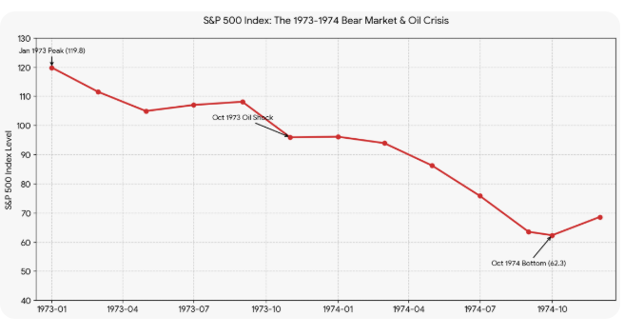
That recession was felt in the stock market as a grueling, multi-month capitulation driven by the oil crisis, compounding inflation, and the political instability of the Watergate scandal, which caused the Dow Jones Industrial Average to lose 45% of its value, marking one of the worst bear markets in Wall Street history and devastating consumer confidence.
Just as stocks were beginning to get back on their feet, along came the Iranian Revolution in 1979, which severely disrupted global oil production, sending crude prices soaring to historic highs. Lines returned to gas stations, inflation accelerated toward an annualized rate of 14.8%, and the stock market faced renewed downward pressure as economic instability widened.
Events turned for the better in 1979 when President Jimmy Carter appointed Paul Volcker to lead the Federal Reserve with a mandate to "break the back of entrenched inflation". Volcker immediately began aggressively hiking the federal funds rate, eventually pushing it to an unprecedented peak of 20% by 1981. This crashed bond prices, triggered a severe double-dip recession, but ultimately crushed inflation and set up the massive 1980s bull market.
The United States was a creditor nation throughout the 1970s. During this decade, the U.S. net international investment position (NIIP) remained positive, meaning American citizens and the U.S. government owned more foreign assets than foreign investors owned inside the United States. This was the setup that allowed Volcker to yank up interest rates and force inflation out of the system.
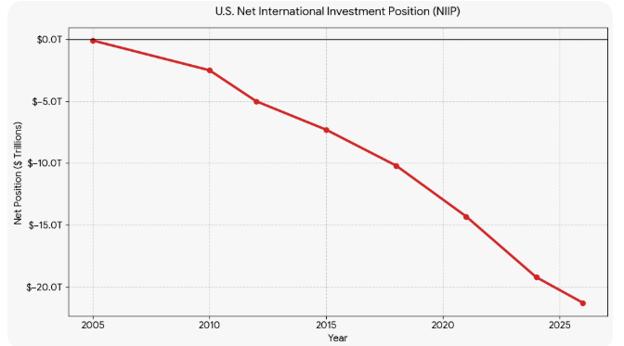
Here in 2026, the United States is currently the world's largest debtor nation. According to data released by the U.S. Bureau of Economic Analysis (BEA), the U.S. Net International Investment Position (NIIP) stands at –$21.27 trillion. This means that the total value of U.S. financial assets owned by foreign investors vastly exceeds the value of foreign assets owned by American citizens and corporations. It is also why current Treasury Secretary Scott Bessent is running into a brick wall when attempting to "manage" the nation's finances using tools that went obsolete in the early 2000's.
If late-July was the moment when the U.S. Treasury "blinked", then this week was the moment where they "fainted" because the expectation was for yields to drop in the long end of the curve after they averted the indiscriminate dumping of U.S. Treasury bonds by the Bank of Japan, but what happened was that yields actually rose. Wall Street quickly realized that doubling the long-end buyback from $2 billion to $4 billion per operation did not provide enough actual buying power. Fixed-income strategists labeled the move a "drop in the bucket" and "strategic signaling rather than an actual fix" because a $4 billion purchase is too small to meaningfully alter a massive $32 trillion cash Treasury market. The buyback announcement happened the exact same week that total U.S. national debt officially breached the $40 trillion threshold. With the Congressional Budget Office (CBO) estimating that the annual U.S. deficit will exceed $2 trillion this year outside of a recession, bond investors remain highly skeptical that the Treasury can fundamentally backstop yields while simultaneously issuing a "tidal wave" of new debt to fund the government.
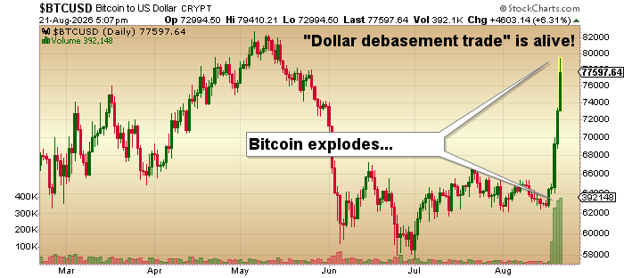
Unlike the Federal Reserve, the Treasury cannot print money to buy bonds. To fund the buybacks of long-term bonds, Bessent's Treasury must issue more short-term T-bills. Bond vigilantes interpreted this structural shift—swapping long debt for short debt—as an artificial manipulation of the yield curve. This sparked fresh "dollar debasement" fears, prompting investors to dump bonds and rotate into hard assets like gold and Bitcoin.
I learned a long time ago (embarrassingly long time ago, I might add) that "when Fed or the White House policy shifts, investment policy should shift". Since the arrival of Alan Greenspan in the 1980's under Ronald Reagan, it was always the Fed that controlled the narrative. That continued and grew to the point where the media ordained Greenspan with the moniker of "The Maestro," treating him with rockstar idolatry, who then passed on the baton to Bernanke, Yellen, and then Powell, who all took a collective pride in managing markets higher through constant cheerleading through the mainstream financial media.
However, that all changed when Kevin Warsh assumed control last May when he told the world that under his watch "the Fed will achieve the 2% inflation objective", repeating the same mantra dozens of times over the next several public appearances. Markets have been floundering under Warsh, meandering aimlessly without the leadership of the technology sector and certainly without the constant siss-boom-bah of the Fed governors and regional presidents who are now seemingly operating under a "gag rule" and no longer receiving standing ovations for turning a waning market into a new all-time high by way of a resounding speech covered by five hundred cable networks around the globe. Exit the Fed as "cheerleader" and enter the Treasury Secretary Scott Bessent as "pompom shaker of the first order".
Not only does Bessent say he is going to solve the problem of the twin deficits, he now claims that his control over international money flows is the solution to the problem called "Iran". The next thing we might expect is that he will be competing with Elon Musk for a settlement called "Mars Station Bessent". If we truly have a new stock market savior in the form of the Treasury Secretary, then any need for hedges should be filed in the section called "Redundant and Immaterial" because if there is one entity on the planet impervious to scrutiny, compliance, and/or margin calls, it is the U.S. Treasury. Sure, we are entering the most hazardous two months of the year for stock ownership, but that matters little when reserve currency status is on the table.
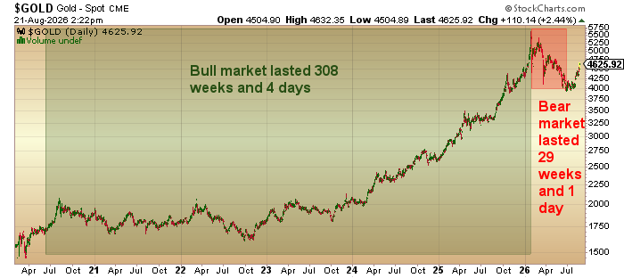
To use the word "renaissance" (when referring to gold's resurgence) might have been somewhat of a misnomer because it is actually described as "any period of time when something becomes popular, active, or successful again after a long period of decline or neglect." It is relatively difficult to describe the gold market since the January blow-off top as a "long period" (although for many it felt like an "eternity").
In fact, using a chart dated back to the COVID Crash of March 2020, there were 308 weeks and 4 days between the COVID lows and the January 29 blow-off top, but a mere 20 weeks and 1 day from January 29 'til today. That is hardly a "long period of decline or neglect".
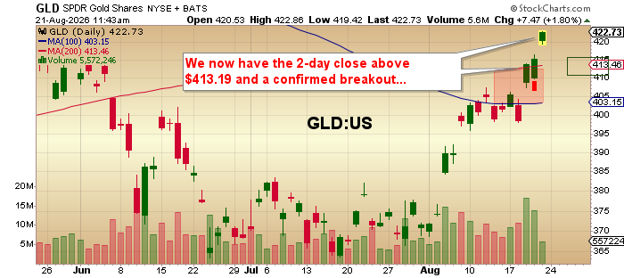
All gold is doing is resuming its uptrend from 2020, but realistically, despite the fact that technically, it entered into a bear market on June 10, 2026, when gold futures plummeted past the critical technical threshold of $4,335 per ounce (marking a 20%+ drawdown). It took only 91 trading days to go from record highs to a bear market, making it the fastest gold capitulation since the 2008 financial crisis. However, when I study the chart shown below, the bear market was merely a cooling-off period after one of the most torrid ascents in market history.
It is true that I have been hedged using limited-risk put options on the GLD:US, representing under 2% of my total portfolio, but when measured against the total value of my gold and silver securities, it was an immaterial drawdown. Of utmost importance is "what to do now".
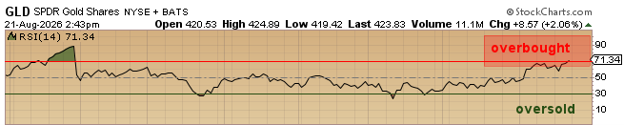
The two charts shown below for both spot gold ($GOLD) and GLD:US show the relative strength index for both now firmly into "overbought" territory, and while this may continue for another few weeks, prudence tells me to avoid new positions until markets cool off a tad.

It is all very good news for owners of gold and silver securities because that painful, jaw-dropping, divorce-creating correction that many of us knew was coming last January has now ended. One can accumulate one's favorite companies without the nagging suspicion that new lows are on the horizon or that one should lighten up on recent strength. I gave up a little ground with expiring hedges, but this rally has rocketed values for many of the positions wonderfully, so I need not "buy back" anything because I did not sell anything.
For me, the bigger story lies in copper. Never as exciting as gold and certainly nowhere as heart-stopping or drop-dead sexy as silver, copper just keeps grinding along, and since my largest individual stock position is Freeport-McMoRan Inc. (FCX:NYSE), it gives me enormous satisfaction to see the shares rocket to an all-time high this week with a print at $77.33.
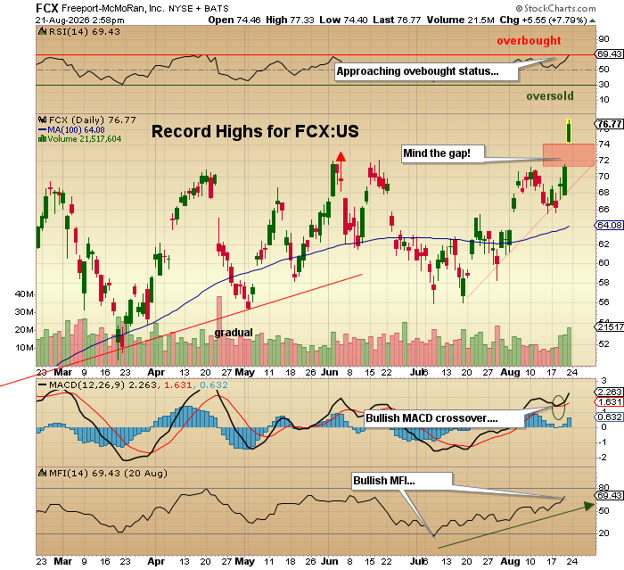
I was discussing this with a subscriber who was rather dismissive of the move, saying that "it's no wonder because all the copper stocks are climbing" but that statement was badly in need of fact-checking because the Senior Copper Miners ETF (COPX:US), which topped at $99.99 last January is nowhere near a record high and the leader of the gold miners, Agnico Eagle Mines Ltd. (AEM:TSX; AEM:NYSE), which topped at $255.24 is still only at $215.87 so the move to record highs by FCX is full and total justification of my faith in this management group since 2022. I find it interesting that I have only been "flat" in the position for a very brief period after the "mud rush" accident at the Grasberg Mine last year, and like a rank amateur, I panicked out at $45, failing of course to buy the ensuing crash to $35. I wound up replacing positions at an average of $62.05, and despite intense trepidation, I can once again sleep at night knowing I own a comfortable position in the best mining company on the planet.
As a group, I continue to favour copper over all other metals but currently carry an overweight allocation to the junior copper explorer/developers by way of Fitzroy Minerals Inc. (FTZ:TSX.V; FTZFF:OTCQX), who reported this week a superb intercept from drill hole BRT-DDH095 which returned 8.8 m @ 3.70% Cu from 30.0 m, including 2.8 m @ 11.35% Cu from 36.0 metres, and 1.0 m @ 21.84% Cu from 37.0 m, the highest grade recorded to date at Buen Retiro.
Turning to the TSX Venture Exchange, the last two weeks of August are for me the last two weeks of summer, in that kiddies are soon back in school and investors are back at work. It is also statistically the worst time of the year to SELL juniors, which by default means that it is the best time of the year to BUY juniors.
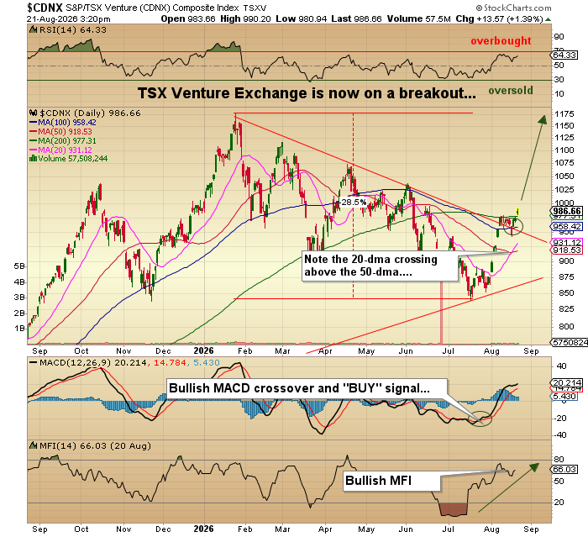
With the U.S. dollar in decline, with gold, silver, copper, and Bitcoin screaming higher, and with 10-year and 30-year treasury bond yields on the rise despite White House and Treasury Department jawboning, it certainly appears as though the final week of the month of August will be a very interesting one.
Important Disclosures:
- As of the date of this article, officers, contractors, shareholders, and/or employees of Streetwise Reports LLC (including members of their household) own securities of Fitzroy Minerals.
- Michael Ballanger: I, or members of my immediate household or family, own securities of: GLD, Fitzroy Minerals, and Freeport McMoRan Inc. My company has a financial relationship with: None. My company has purchased stocks mentioned in this article for my management clients: None. I determined which companies would be included in this article based on my research and understanding of the sector.
- Statements and opinions expressed are the opinions of the author and not of Streetwise Reports, Street Smart, or their officers. The author is wholly responsible for the accuracy of the statements. Streetwise Reports was not paid by the author to publish or syndicate this article. Streetwise Reports requires contributing authors to disclose any shareholdings in, or economic relationships with, companies that they write about. Any disclosures from the author can be found below. Streetwise Reports relies upon the authors to accurately provide this information and Streetwise Reports has no means of verifying its accuracy.
- This article does not constitute investment advice and is not a solicitation for any investment. Streetwise Reports does not render general or specific investment advice and the information on Streetwise Reports should not be considered a recommendation to buy or sell any security. Each reader is encouraged to consult with his or her personal financial adviser and perform their own comprehensive investment research. By opening this page, each reader accepts and agrees to Streetwise Reports' terms of use and full legal disclaimer. Streetwise Reports does not endorse or recommend the business, products, services or securities of any company.
For additional disclosures, please click here.
Michael Ballanger Disclosures
This letter makes no guarantee or warranty on the accuracy or completeness of the data provided. Nothing contained herein is intended or shall be deemed to be investment advice, implied or otherwise. This letter represents my views and replicates trades that I am making but nothing more than that. Always consult your registered advisor to assist you with your investments. I accept no liability for any loss arising from the use of the data contained on this letter. Options and junior mining stocks contain a high level of risk that may result in the loss of part or all invested capital and therefore are suitable for experienced and professional investors and traders only. One should be familiar with the risks involved in junior mining and options trading and we recommend consulting a financial adviser if you feel you do not understand the risks involved.