



Since the outbreak of major regional hostilities on February 28, the Strait of Hormuz (SoH) has been effectively closed to routine commercial shipping for 166 days, with Iran officially declaring the waterway out of commission on March 4, 2026. During that period, the world watched in horror as oil prices came within a fraction of $120 per barrel, sending inflationary supply shocks to all four corners of the globe. Stocks at first had an allergic reaction with the S&P 500 falling around 10%, but quickly found their footing around the end of March and have since been on yet another mindboggling tear with record highs for the DJIA and S&P 500 registered on August 5, with no "Great Peace Deal" yet in place and Iran still threatening to disrupt marine navigation and charge fees for passage.
However, the "earnings beat" parade continued despite retail sales coming in a tad on the light side as sales for July unexpectedly dropped by 0.6% to $763.6 billion, marking the sharpest contraction in over a year (since May 2025). It was interesting that numbers associated with "Main Street," such as non-store retailers (e-commerce), tumbled 2.2% as online sales cooled significantly following heavy June promotions like Amazon Prime Day. Sales at the auto dealers (another "Main Street" outlet) fell 1.8%, representing the first monthly decline for auto and parts dealers since April. Gasoline stations also dropped 0.9%, primarily reflecting fluctuations in pump prices. Finally, electronics and appliances slipped 0.5% as consumer tech spending slowed.
What did show pockets of growth and core resilience were clothing stores (up 1.9%), health and personal care (up 0.7%), and restaurants and bars (up 0.5%), illustrating that the upper echelon of income earners still want to look sharp and feel good while guzzling martinis at the local watering hole. Joe Sixpack is too busy struggling with household bills to be able to enjoy similar pleasures, further confirming that the average middle and working class stiff is under pressure.
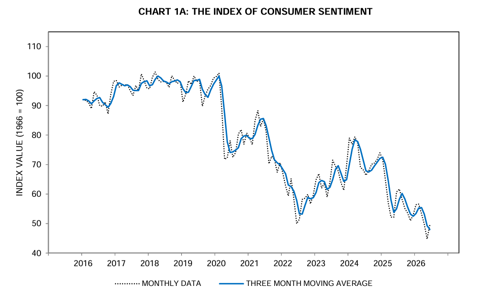
Yet Wall Street rejoices day in and day out over "Record Highs!" despite the 30-year bond yield hitting 5.27% for the first time in nineteen years, while the University of Michigan Index of Consumer Sentiment sits at or near ten-year lows.
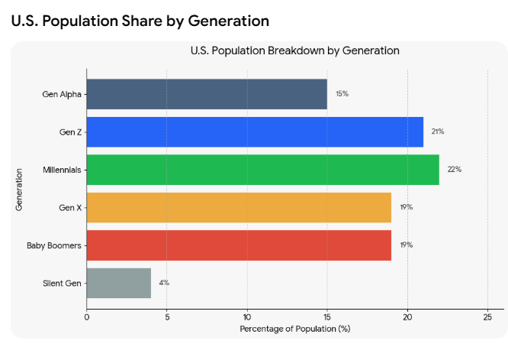
Since the bulk of the voters in the U.S. are no longer baby boomers and since Generation "X" was a baby "bust" generation, the new control group for American elections has suddenly shifted to Millennials (30-45 in age) and Gen Z-ers (14-29 in age). This is the exact demographic that is graduating from college (totally in debt) with few or no job prospects and zero ability to afford a new home, who are going to suddenly lodge their form of protest by way of the ballot box. When that happens, 43% of the voting public is going to demand government policy which "makes them whole," which means more and more subsidies representing their entitled slab of the American Pie.
New Yorkers were shocked when they awoke on January 1 of this year and a devout socialist, Zohran Mamdani, was their new mayor. Since then, there has begun an exodus of wealth from the city that is taking with it billions upon billions of tax dollars desperately needed to fund all those socialist programs promised by their new "progressive" mayor.
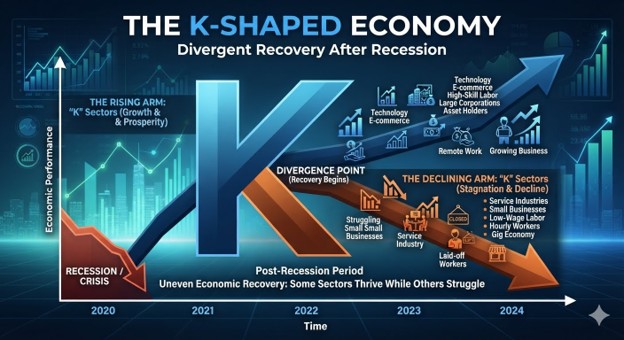
When you look at this graphic of the "K-shaped economy", the brown part to the lower right represents that 43% of the U.S. demographic born between 1997 and 2012. They are the people who voted for Mamdani, and they are the voters who will vote for the next Democratic nominee that promises forgiveness of their college loans or "a chicken in every pot and a car in every backyard, to boot", the campaign slogan of Republican presidential candidate Herbert Hoover in 1928, in celebration of the "boom times" that accompanied "The Roaring Twenties". With stocks hitting record highs almost on a quarterly basis, there are those who are calling the 2020's a modern version of those "Roaring Twenties" that preceded the worst economic collapse of the modern era from 1931-1933 (aptly nicknamed "The Dirty Thirties").
In past times, the younger members of our society would scrounge together a few thousand dollars and agonize over buying that first "starter home" for $10-15 thousand, knowing that it would take twenty years of toil and tears to finally pay off that mortgage and become a true "owner". Not so in Canada, where the average age of the "first time buyer" is now the oldest in the world — I repeat — IN THE WORLD. Those baby-boomer Canadians who had their entire net worth locked up in their principal residences decided to elect politicians who would give their blessing to unbridled immigration and hyperinflationary monetary inclinations of the Bank of Canada in order to goose the housing prices to buttress their annual net worth statements so they could leverage the "ol' Homestead" in order to buy second and third houses for rental purposes. Now they have wonderful balance sheets but are plagued by four of their grown children as well as a gaggle of grandchildren living on top of each other in their basement recreation room. Now you have to be forty-six (46!) to "get in the game" through the wonderment of home ownership, which means that the 30-year mortgage you took on will be finally paid out when you are seventy-six years of age.
No healthy society can thrive and prosper with demographic hindrances like that.
It divides the populace into "owners" and "renters" with the former group in control of the primary family asset, while the latter is simply augmenting the income of the former by way of monthly rent cheques. That is all fine and dandy as long as the amount of the rent cheque exceeds the amount of the monthly mortgage payment, because in the hyperinflationary period of 2008 until a couple of years ago, what fell out of the bottom of that set-up was the rapidly escalating cost of buying a home. I always look at it in a slightly different light. One always BUYS a "home" but one never RENTS a "home". A family usually RENTS a "house" but never ever RENTS a "home". The whole idea of owning a home is that it is a refuge for the family, with the functional word being "FAMILY". If the family that inhabits the home can suddenly find themselves out on the street because a landlord owes CRA or wants a new Porsche, then that family was simply renting a "house". Again, this is an extremely unhealthy societal blight that is only going to create an even larger divide between those who "have" and those who "don’t have," and that rarely goes well at the end of the day.
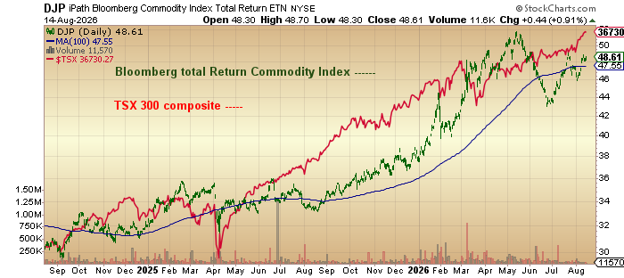
So, Canadian markets are at record highs led by — according to the pundits — "Financials, Technology, Industrials, Energy, and Materials," but based upon the chart shown above, I might hazard a guess at the notion of the TSX being correlated very closely to the Bloomberg Total Return Commodity Index, which has been in a steady uptrend for the past two years.
Surely, Financials and Technology are being swept ahead by the monopolistic economic chessboard called "Canada," where bankers control basically EVERYTHING, but the Technology part is simply the Bay St. boys piggybacking on their NY brethren, who have the finest "Golden Goose" ever in the form of the technology sector. They started creating the narrative back in 1915, at the moment when IBM Common Stock (IBM:NYSE) first went public under the name Computing-Tabulating-Recording Co. (C-T-R), with an initial share price of $47. The corporation officially rebranded to International Business Machines (IBM) a few years later, in 1924, but by then, the official narrative was passed down from generation to generation, heralding IBM's role as "computer of the future".
As far as the TSX is concerned, I give them credit for never altering the weightings of the index because while they love to call mining "Materials", I truly wish they would call it "Metals" or "Mining" or better still — "Monetary Debasement Hedge" — because the bulk of the wealth contained in the Dominion of Canada is dominated by resources and that means oil & gas but also metals whose value remains constant in real terms versus paper money which constantly shrinks thanks to the errant policies of the baby-boomer dominated politicians.
Gold and Silver
The gold and silver markets have been rejuvenated by the Scott Bessent version of Mario Draghi's "whatever it takes" version of central bank policy, back when he was trying to save the Euro from a Weimar-like fate. The U.S. Treasury Secretary pulled out all stops to prevent the Bank of Japan from unloading several trillion dollars worth of U.S. Treasury bonds. You will recall the days of July 2012 when Draghi told the world that the Euro would survive despite turmoil in Greece and Italy because the ECB would do "whatever it takes" to maintain the Euro. That calmed crashing Eurozone bond markets, and within days, markets stabilized, and that was exactly what happened when Scott Bessent took the call for BoJ Governor Kazeo Ueda and agreed to "step up," which they did, in size, and without remorse, to stabilize the Yen.
What we have now is a scenario where the U.S. Treasury Secretary (a former hedge fund operator alongside George (WEF sponsor) Soros) will go all out to make sure that the dollar remains at the pinnacle of the world currency ladder in terms of respect and collateral (borrowing power) because with a $40 trillion national debt figure, he can never lose one finger of the grip he has on the dollar's reserve currency status. If the grip slips, the credit card goes kaput, and the USS Gerald R. Ford (CVN-78) will never be able to buy a refit in Gibraltar or any other port that does not fly the American flag. And when that happens, gold goes to $75,000 per ounce, and your morning toast and jam is $100.
Copper
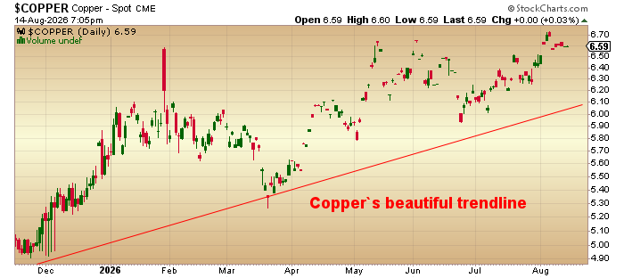
The main story for me last week was the record print for September copper futures, but the LME returned the favor this week as it crested beautifully above $14,424.50 per tonne, driving a fierce physical supply squeeze that pushed one-month delivery spreads to their widest levels in five years.
I have been a card-carrying, table-pounding bull on copper to the astonishment of my gold and silver apostles for the better part of three years and while I have also owned gold (from 2001 at around $300) and silver (from 2014 at around $14), I started to follow the copper story in mid 2023 in earnest because I detected a growing, under-the-radar desperation by long term gold bugs like former Barrick Gold CEO Mark Bristow, whose maneuvers after the merger of Randgold with Barrick in 2019 saw Barrick move aggressively to acquire copper assets rather than gold or silver. As I began to delve into the demand side, it dovetailed perfectly with my views on "Electrification," which I deemed in 2020 to be a global phenomenon and one that was, quite simply, not going away.
The copper trendline is not as breathtaking as silver in 2025 or the semiconductors in 2026, but over the last five years, it has been one solid and very sustaining uptrend. Nothing fanciful, nothing compelling, just totally reliable and solid with no one and nothing able to get in its way. Not pandemics nor wars nor blow-off tops in gold and silver last January have put as much as a dent in the copper market's gradual yet powerful uptrend, and that is a "generational" event, by any and all measures.
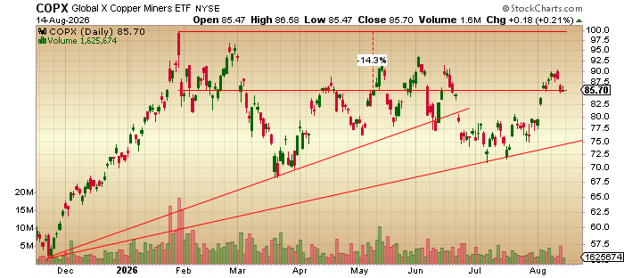
However, the reliability of the copper uptrend has not been reflected by the valuations in either the senior copper producers or (and for us, this is far more important) the junior copper explorer/developers. One glance at the Global X Copper Miners ETF (COPX:US) and you see a disconnect between the beautiful performance of copper in 2026, but a lag-effect underperformance of copper miners in the COPX:US. This has further reflected miserably on the copper juniors, many of whom are busy developing near-term production, such as Marimaca Copper Corp. (MARI:TSX; MARIF:OTCMKTS; MC2:ASX), whose Pampa Medina project has yielded some spectacular results, yet the stock is still 42.55% off its peak price last January. Closer to home (as in 3 centimeters to the left of my right ventricle) was the market's reaction to this week's announcement by Fitzroy Minerals Inc. (FTZ:TSX.V; FTZFF:OTCQX) of the results of their "deep IP" survey of the Caballos Copper Project located in the Atacama region of copper-rich Chile.
Fitzroy announced that all four lines totaling 18.4 line-kms had returned compelling levels of both chargeability and conductivity over an anomaly that appears to be 5km by 5km in area, with the first series of drill holes expected to probe over 1,500m of depth. Despite already having confirmation of copper-bearing sulphides via hole DDH CAB004A that yielded 174m of .47% CuEq mineralization, the market took this week's news and completely yawned. Back in the day (as in the 1980-2000 junior mining boom period), if a junior reported news like this for an exploration play in a commodity hitting record highs on international exchanges, the stock would double on speculative expectation alone, long before assays and completely "on spec".
However, in this new world of online gambling on everything from "Trump's next haircut" to "Warsh's shoe size" to "Danube water levels by September 5", people enamoured by the possibility, no matter how remote, of a tenfold or twenty-fold win in order to purchase a "home" ( as opposed to a "house") will bet their next five month's rent on anything that they perceive gives them the "leverage to Nirvana" as opposed to a "penny mining stock".
Consider this: In the 1970's, when I first entered the securities industry, the only means of gambling was taking your auntie to the local "Bingo Hall", driving your dad to Woodbine Racetrack, or (for those with money) buying a plane ticket and going to Vegas. If you hated all of that nonsense, you "dabbled" in the markets, and if you were hooked, you speculated (i.e., "gambled") in the only venue that did not (at least in your mind) involve rank speculation. Due to the absence of legal "venues of speculation", the one that arose as the venue of choice was the penny mining market which was dominated since post WWII by the junior explorers, both mining and oil & gas. When I entered the business after a wonderful career in college-level and semi-pro hockey, the oil & gas juniors were at the peak of the speculative boom in Canada, circa 1977.
Oil plays like West Pembina, Leduc, and Elmworth dominated the penny juniors, and when rumors arose that a new oil discovery was made in any of these plays, the $.05 junior caught bid after bid on rising volume that took the stock to many multiples long before the truth was actually revealed. In 1981, the mining stocks started to take control of the speculative narrative led by the famous Hemlo discovery of 1981 (which was my first injection of heroine-like liquid) that saw my first 20-bagger in the form of Golden Scepter Resources. From the Hemlo discovery of 1981 until the Bre-X Fraud in 1997, Canada enjoyed a period of massive wealth creation, the likes of which have never been matched.
With the exception of Research in Motion (Blackberry) in the late 1990's, there has been no stock in Canadian mining history that has ever risen in such a rapid ascent as Vancouver-based Diamondfields Resources Inc., the Friedland-owned company that discovered the mighty Voisey's Bay Nickel-Cobalt-Copper Discovery of 1993. Few people recall that event, but as a Toronto-based stock salesman in the 1990's, it was not only career-changing but also life-changing. I watched people who bought the stock in 1993 at $3.00 with their last $3,000 of savings turn to me in 1997 and ask me, "How can I repay you?" as I handed them their cheque for $163,000. That was before 43101's and before all the regulatory BS that today clogs up what used to be a perfectly efficient method of funding exploration.
The excellent management group at Fitzroy Minerals Inc. is executing what I believe is an excellent example of how a junior mining company should be run. They are covering shareholder backsides by moving the oxides at Buen Retiro into production, estimated to be by 2028, while having 90% of all production expenditures covered by partner Pucobre SA, a mid-tier Chilean copper producer. Yet, despite the incredible leverage to the upside, there are simply "no buyers" as the speculative throng are wounded from the late-January blow-off and are unwilling to speculate on the likelihood of a life-altering event at the upcoming Caballos drill program. As I was commiserating with a colleague today regarding the state of the junior mining industry, "if this were the 1990's, Fitzroy would have tripled on that press release alone".
However, this is not the 1990's, and there are dozens of other ways to throw money down the rabbit hole, such as "AI" and "Crypto" and "Bet65," so investment flow gets diluted away from a genuinely "high-probability" outcome like Fitzroy Minerals Inc.
Such is life in the world of 2026. . .
| Want to be the first to know about interesting Silver, Gold and Copper investment ideas? Sign up to receive the FREE Streetwise Reports' newsletter. | Subscribe |
Important Disclosures:
- As of the date of this article, officers, contractors, shareholders, and/or employees of Streetwise Reports LLC (including members of their household) own securities of Fitzroy Minerals.
- Michael Ballanger: I, or members of my immediate household or family, own securities of: Fitzroy Minerals. and Marimaca Copper Corp. My company has a financial relationship with: None. My company has purchased stocks mentioned in this article for my management clients: None. I determined which companies would be included in this article based on my research and understanding of the sector.
- Statements and opinions expressed are the opinions of the author and not of Streetwise Reports, Street Smart, or their officers. The author is wholly responsible for the accuracy of the statements. Streetwise Reports was not paid by the author to publish or syndicate this article. Streetwise Reports requires contributing authors to disclose any shareholdings in, or economic relationships with, companies that they write about. Any disclosures from the author can be found below. Streetwise Reports relies upon the authors to accurately provide this information and Streetwise Reports has no means of verifying its accuracy.
- This article does not constitute investment advice and is not a solicitation for any investment. Streetwise Reports does not render general or specific investment advice and the information on Streetwise Reports should not be considered a recommendation to buy or sell any security. Each reader is encouraged to consult with his or her personal financial adviser and perform their own comprehensive investment research. By opening this page, each reader accepts and agrees to Streetwise Reports' terms of use and full legal disclaimer. Streetwise Reports does not endorse or recommend the business, products, services or securities of any company.
For additional disclosures, please click here.
Michael Ballanger Disclosures
This letter makes no guarantee or warranty on the accuracy or completeness of the data provided. Nothing contained herein is intended or shall be deemed to be investment advice, implied or otherwise. This letter represents my views and replicates trades that I am making but nothing more than that. Always consult your registered advisor to assist you with your investments. I accept no liability for any loss arising from the use of the data contained on this letter. Options and junior mining stocks contain a high level of risk that may result in the loss of part or all invested capital and therefore are suitable for experienced and professional investors and traders only. One should be familiar with the risks involved in junior mining and options trading and we recommend consulting a financial adviser if you feel you do not understand the risks involved.