


I returned last night from a two-week cruise of the mighty Danube River that began near Budapest and ended in Passau, Germany, despite water levels that are threatening to break all-time record lows. In fact, we were originally scheduled to board the ship in Budapest but had to detour to Komárno, which is ninety-five kilometers away, due to the shallow river. Exacerbating the issue were equally low water levels at the end of the cruise, as the ship could get no further than Passau while it was scheduled to arrive in Nuremberg, Germany, for disembarkation. That was over one hundred and fifty kilometers of riverbank scenery that was rendered unavailable due to the incredibly hot summer that has engulfed much of Europe, resulting in France, Spain, and Greece being the hardest-hit countries by a historic wave of devastating summer wildfires. Driven by consecutive heatwaves, extreme winds, and severe drought conditions, intense blazes are actively impacting multiple nations across Southern and Western Europe. Unfortunately for the climate-change protesters, low water levels on the Danube and Rhine rivers are "normal and expected" after late July during dry summers, making low water levels a normal seasonal issue rather than being a direct cause of the carbon footprint left by humans.
What I experienced was a complete reboot of all the biases one has about Europe, and particularly Eastern Europe, which suffered under communist dictatorships since the end of WWII until 1989. Since then, the advances in countries like Poland, Slovakia, and the Czech Republic make Canada look like a third-world country. Sitting in the coach riding through the Slovakian countryside, I got the impression I was in Nebraska or Iowa, as corn and soybeans were everywhere as far as the eye could see, with modern machinery and state-of-the-art soil management systems in place everywhere. One forgets that the natives of this part of the world have been farming for over a thousand years, so to assume that I would see an old plow pulled by a mule was faulty at best and ethnocentric at worst.
The architecture in all major cities and even the smaller towns is unique and awe-inspiring. Vienna is everything (and more) than I expected, and exceeded my opinion of the Austrians and Germans in their mastery of physics and engineering. I thought last year's marvel of the railroad they constructed that runs through the snowy Swiss Alps, some 3,454 meters above sea level, was impressive until I saw some of the engineering feats carried out by the Austrians in Vienna. This degree of civilization can do nothing but humble any native of North America that seems to have prided itself on size and volume as opposed to quality and culture, the way the old churches and buildings have been carefully preserved and protected in every city and town.
I am sure I could spend an entire day on the topic of multigenerational cultures and the benefits associated with the preservation of said culture and fill ten or twenty pages of the weekly missive doling out praise and admiration for "old Europe," but of course I will refrain. However, what I will say is that of all the cities we visited sailing the Rhine last year and the Danube this year, the city that should be on everyone's "bucket list" is Prague, the capital of the Czech Republic. They say the "Praha" translates into "the city of 100 spires," but the reality is that there are over 500 spires dotting the landscape of this magnificent cityscape. We ended the trip with a full walking tour of the city as well as a tour of the Prague Castle, which contains several famous sites, including the Gothic St. Vitus Cathedral, the Old Royal Palace, and the historic street known as the Golden Lane. However, after taking a tram ride (in 40° humidity) to the non-tourist sections of the city, you suddenly realize that the entire city is comprised of structures constructed centuries ago, which have endured over time to preserve a truly unique culture. From an architectural perspective, there really is not a "tourist" section of Prague; the entire city is a veritable delight.
The Markets
To have one's eyes opened wide to other cultures, as happened to me last week, is an interesting, if not enlightening, life experience. I came away with the sense that we in North America have been conditioned to lives whose successes are measured by accomplishments that are gauged by size and velocity rather than quality and durability. One look at the Toronto lakefront these days, whose views of the harbor and the Toronto Island, once accessible from buildings such as the Royal York hotel and all of the office buildings, are now completely blocked by dozens upon dozens of the ugliest condominiums ever conceived. Visitors who once rode along the Gardiner Expressway to see the pageantry of old Fort York and old ferries shipping visitors to the island are now confronted with glass and concrete, with laundry draped over balcony railings and tinfoil in the windows. Everyone is allured by the "majesty" of forty or fifty condos rather than the cultural importance of the old Royal York Hotel, a rare architectural throwback to the traditions of the old Canadian Pacific Company that built the railroad from coast to coast in Canada while leaving behind the classic CP Hotels like Chateau Frontenac in Quebec City and the Banff Springs in Alberta.
Developments in financial markets since I departed on July 17 were similarly focused on the "effect" rather than the "cause" of the severe rout experienced by the technology sector as the semiconductors entered into bear market status early last week before rebounding to close out the month in "correction" territory, down 29.7% from the June 22 peak at lows on Wednesday but down only 19.2% by the Friday close.
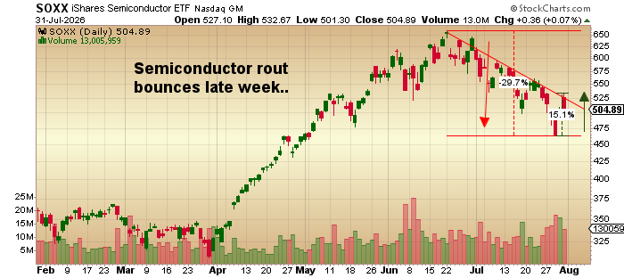
The financial media was hyper-focused on the hyperscalers and the tech rout all week long, trotting out "Guest Commentators" left and right, telling viewers why "AI" is going to bring lifestyle enhancements to the world and that we all should be "patient" in our expectations of immediate profits for the creators. What they were missing was one chart that I have been providing for subscribers intermittently since the start of 2026, and that is the one that displays the most important number in all of finance — the price (or cost) of money!
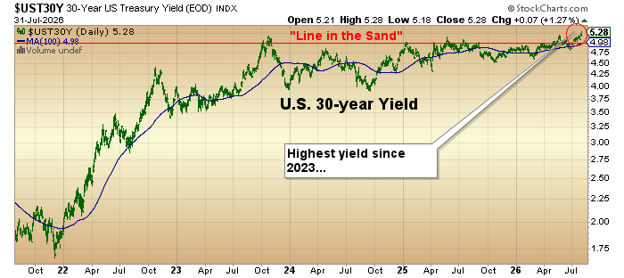
While everyone was agonizing over the crash in their favourite semiconductor stock or ETF, the bond vigilantes were busy telling new Fed chairman Kevin Warsh that his concept of "following the ball not the referee" (in reference to his abandonment of "forward guidance") was not
exactly what they wanted so they took the 30-year yield to its higher point in over nineteen years to July of 2007 — you know — when the S&P was at 1,455. They say that the more important bond yield is that of the 10-year treasury that went out at 4.75%, so while I made the case that a 5% yield on the 30-year is the "line-in-the-sand" for the yield curve (and stocks), a 5% yield on the 10-year is a "line-in-the-sand" for the U.S. (and global) economy.
Stocks made the determination that with yields rising along with a hostile Fed, Marty Zweig's old adage of "Don't fight the tape and don't fight the Fed" was front-and-centre all week long resulting in the big money totally ignoring the CNBC bubbleheads and instead taking heed from bonds resulting in full correction for the NASDAQ with the DJIA and S&P 500 both threatening to move into a similar status by a hair's breadth. Yet despite all of the gnashing and gnarling of teeth over the AI debacle (as they are calling it), the Dow is barely 10% off its record high, with the usual Wall Street cheerleaders all whining and wailing about the Fed and its inability to rescue the crashing NASDAQ. As it turned out, Situational Awareness, a high-flying, multi-billion-dollar AI-focused fund founded by 25-year-old former OpenAI researcher Leopold Aschenbrenner, became the catalyst for a relief rally as the bulls pointed to it as a "shark-clearing" event, making it safe to go "back in the water" again. That translates into "no more forced selling" of securities that totaled some $15 billion in equity value, taking the fund's NAV down from $20b to $5b in a couple of trading sessions. Unfortunately, such a "relief catalyst" was immaterial to the bond assassins and had no effect on either the 10-year or 30-year yields, which is not good. I go into the weekend "less short" my technology ETF's and "less long" the hedges, but still very much in expectation of new lows for the NASDAQ and S&P by October, as we are now entering the two months "most hazardous to your wealth" on a seasonal basis.
There was some good news on the week as September copper closed within 4.04% of a record high, while December gold went off 29.11% and September silver off 53.5% from their respective record highs. Copper is still treating investors beautifully, but not the copper stocks.
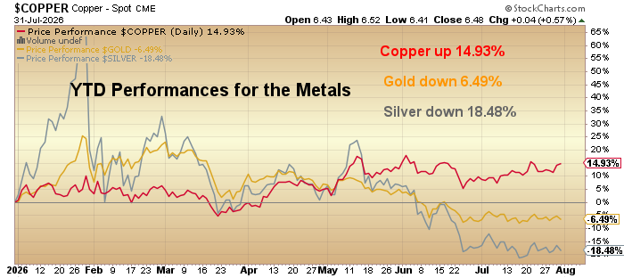
The Globa X Copper miners ETF (COPX:US) closed the month down 21.13% of its January 29 high despite the metals price being off a mere fraction from its high and still up nicely YTD.
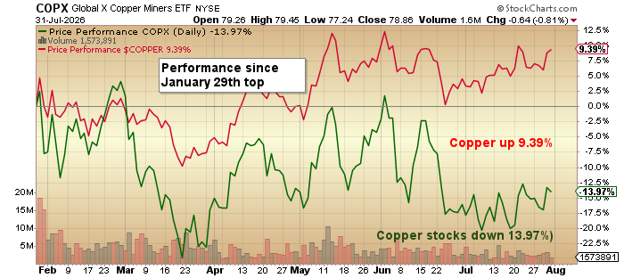
The gap in performance since the January 29 blow-off in most of the metals has not been corrected anywhere except in copper, which hit an interim high that day but went on to register a new ATH on May 13th by a move in the September contract to $6.7815/lb.
Fundamentals continue to rapidly improve. Since January 29th, global copper inventories have undergone an unseasonal, aggressive geographical dislocation and a massive recent drawdown outside of the United States. After global visible stocks briefly built up during the spring due to macroeconomic headwinds, a major supply squeeze over the last few weeks has cut London Metal Exchange (LME) on-warrant inventories roughly in half, plunging them to a low of approximately 102,000 tonnes. And this is without the stress that is coming from the "AI build-out". Global electrification is accelerating. In Prague, all of the trams are run by electricity, as are many of the buses, a phenomenon occurring across the globe with frightening speed. The problem is quite simple: For three and a half decades, mining of copper ore has been "uncool" so legislators either banned it or made it impossible to obtain permits such that no one would dare try to build a copper mine, nor try to even find new deposits – until recently. And that "until recently" does not allow enough time for the world to produce nearly enough copper to offset the oncoming supply shock. Econ101 teaches us that "limited supply meeting accelerating demand equals rising prices," and that is exactly what is coming — fresh new record ATH's for copper and inevitably for the companies that produce it.
Which brings me to the topic of the junior copper stocks.
A recent post on "X" by billionaire Robert Friedland highlighted some comments on copper from Puneet Singh's team at Cantor Fitzgerald, who issued a metals market update last week, making some very good points on copper: -
"The copper price has held its gains year-to-date, due to very tight fundamentals in the physical market. However, copper equities have underperformed. - The copper supply deficit is expected to continue to grow. From 2030, the deficit is expected to open up significantly, reaching 14 million tonnes (equivalent to 28 Kamoa-Kakula Copper Complexes) by 2040. - The cost curve of copper producers has been rising significantly and will continue to rise. The marginal cost to operate a copper mine in 2025 was $3.50/lb, up 37% over the prior 6 years... and operating costs will continue to rise due to various inflationary pressures. For a new copper mine with a 15-20% IRR, a margin of up to $2.79/lb above the AISC is needed to justify the investment. This translates to an incentive price of up to $6.29/lb in 2025... Where we are in 2026, it's already higher than that. - The capital intensity of new copper mines is between $20,000 and $30,000 per tonne of annualized copper produced... at $13,732.50 (LME price today). This is another way of saying we need higher copper prices if we are to get the required investment to meet the oncoming deficit. So those who invest in growth and build today will be handsomely rewarded."
I highlighted the last sentence because it is increasingly relevant not so much for the senior copper producers, because they rarely (if ever) find new Tier One deposits; they usually buy them from the junior copper explorer/developers that historically make the majority of new meaningful discoveries. A great case-in-point of the market punishing the companies that least deserve to be punished is Marimaca Copper Corp. (MARI:TSX; MARIF:OTCMKTS; MC2:ASX), whose Chilean oxide copper deposit is expected to be producing by 2030, but whose Pampa Medina mineralized sulphides are shaping up to be a large, tier-one scale asset. As of mid-2026, drilling has proven that the core footprint covers an area exceeding 2 square kilometers (2 km²), while the broader regional target footprint spans several kilometers.
The scale of the discovery is broken down into the following dimensions and exploration targets:
Footprint Dimensions
- Drilled Mineralized Horizon: Ongoing campaigns have successfully confirmed economic-grade widths spanning over 5 kilometers from north to south and 600 to 800 meters from east to west.
- Thickness: The main mineralized package features an average true thickness ranging between 50 and 100 meters, often revealing multiple "stacked mantos" of high-grade copper layers.
- Ultra-High-Grade Core: Within the broader system, an ultra-high-grade bornite zone stretches over an area of at least 1,000m by 600m. This includes exceptional drill intersections like 16 meters grading 5.7% copper and 62.6 g/t silver.
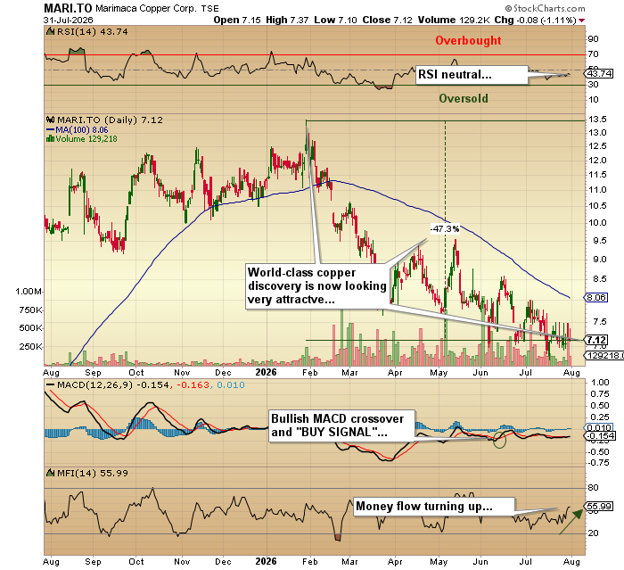
The stock peaked with the rest of the metals at CA$13.49 on January 29, and last week went out at CA$7.12 as the month-end purging of underwater accounts wreaked havoc on the junior resource sector. Falling under the banner of "baby getting thrown out with bathwater", investors have been dumping the name for a number of reasons one of which is referred to as the "Developer Discount" Lifecycle". Marimaca's flagship asset, the Marimaca Oxide Deposit, is currently transitioning into its pre-construction phase following Definitive Feasibility Study (DFS) completion. Junior miners frequently experience a stock decline during this intermediate phase — known mathematically as the "Lassonde Curve" — as short-term retail excitement over initial drill results fades. Valuations become tightly bound to upcoming structural hurdles: project financing, infrastructure engineering, and the absolute capital expenditures required to build the mine.
In the case of Marimaca, they are fully funded, and with results that have been generated recently from drill holes at Pampa Medina, the exploration stage (and associated investor excitement) should actually be accelerating instead of being plagued by the Lassonde Curve line of thinking.
Marimaca is one of those companies that will "invest in growth and build today," in the words of Cantor Fitzgerald, and represent a classic buying opportunity for those looking to profit from the upcoming copper supply shock.
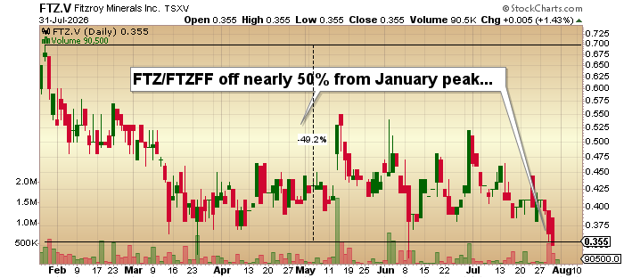
Of course, GGM Advisory #1 pick Fitzroy Minerals Inc. (FTZ:TSX.V; FTZFF:OTCQX) expects to achieve full production of 10 million pounds of copper commencing in 2028 and stands ready to benefit from aggressive exploration programs in the deeper sections below their Buen Retiro Oxide Copper Deposit and at their Caballos Copper-Molybdenum Discovery from March of 2025.
They are where Marimaca was prior to late-December 2024 before they discovered the high-grade extensions to Pampa Medina with the stock at $4 after which the share price soared to its record high of $13.49.
The discovery phase for these juniors is always the most exciting period in which to own them, but unlike the precious metals, which are battling disinflationary and policy-related headwinds, copper juniors have the benefit of an enormous macroeconomic tailwind, so that, combined with near-term production and new discoveries in the face of depressed share prices, spells only one word — opportunity.
The precious metals are a completely different story from the bullish narrative surrounding copper. Since very early in my career, I learned that the gold and silver mining shares have a "lead indicator" status when it comes to the precious metals arena. The gold miners always had a habit of selling off days before the same corrective action hit the physical metals, and I used to use that relationship (and still do to a lesser degree) in trading the physical metals. I have been trying gingerly to find a tradable bottom in gold and silver and have tried twice now (unsuccessfully) in the ETFs (GLD:US and SLV:US) and have taken small, survivable hits on both but exited July flat. The precious metals bull in me wants to believe that we are still in a long-term secular uptrend in both gold and silver, but if I judge recent action in the miners as evidence of a more prolonged period of underperformance ahead of us, then I have to throw my hat into the bearish ring and avoid both metals that are now unarguably immersed in dual bear markets.
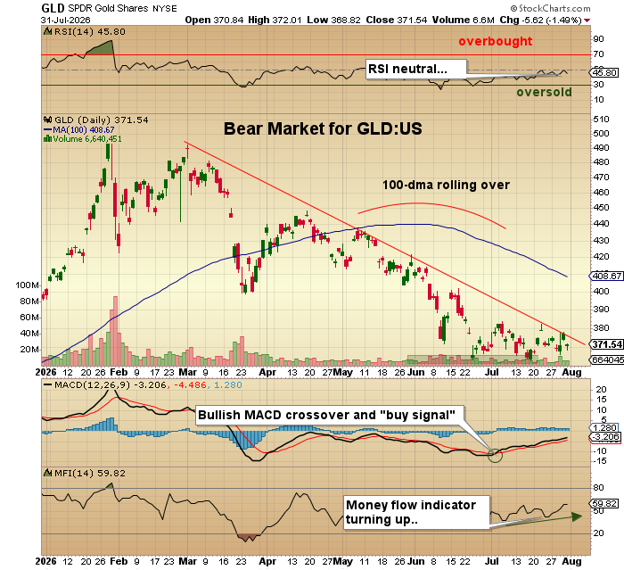
The chart of the gold ETF (GLD:US) shows a series of lower highs and lower lows since the January 29 top, but also shows a downtrend line that seems to be capping any and all attempts at a bullish reversal. We had oversold dips in price and RSI back in late March and early June that had all the characteristics of tradeable lows, but the bounces that were both brief and feeble soon failed, sending me scurrying to the sidelines. On a near-term basis, I am most
concerned about the action in the Senior gold producer ETF (GDX:US) whose share price set a new 52-week low on July 17 at $69.74. The silver miners ETF (SIL:US) also hit a new low at $69.68 the same day, so if I am to use the miners as leading indicators for the physical metals, then we should expect new lows in both gold and silver in the next month, as August is in the bottom third for monthly seasonality.
When I look across the spectrum of today's financial market landscape, I see a massive jumble of intersecting macroeconomic crosscurrents driven by the unbridled optimism of another technological breakthrough (AI) and all of the concomitant benefits improving the human condition while at the same time driven by a dangerous race for global military, economic, and technological supremacy between the current hegemon (the U.S.) and the aspiring hegemon (China). Scattered in between are the regional geopolitical hot-spots like Ukraine and Iran (not to mention Gaza), and what falls out of the bottom is a world far removed from the safety of globalism, with few conflicting forces designed to scupper global growth and peace.
Investing has become a minefield for the active manager that tries to seek out value and refuses to simply "own the index". However, at the end of the day, owning businesses that provide products and/or services in limited supply but enjoying the wonderful world of accelerating demand are businesses that will prosper and grow. Such is the future of the emerging copper producer whose outlook has no moat around it other than the one created by the two goddesses of junior mining – Mother Nature and Lady Luck. It's an exciting space in which to exist.
| Want to be the first to know about interesting Copper investment ideas? Sign up to receive the FREE Streetwise Reports' newsletter. | Subscribe |
Important Disclosures:
- As of the date of this article, officers, contractors, shareholders, and/or employees of Streetwise Reports LLC (including members of their household) own securities of Fitzroy Minerals.
- Michael Ballanger: I, or members of my immediate household or family, own securities of: Fitzroy Minerals. My company has a financial relationship with: None. My company has purchased stocks mentioned in this article for my management clients: None. I determined which companies would be included in this article based on my research and understanding of the sector.
- Statements and opinions expressed are the opinions of the author and not of Streetwise Reports, Street Smart, or their officers. The author is wholly responsible for the accuracy of the statements. Streetwise Reports was not paid by the author to publish or syndicate this article. Streetwise Reports requires contributing authors to disclose any shareholdings in, or economic relationships with, companies that they write about. Any disclosures from the author can be found below. Streetwise Reports relies upon the authors to accurately provide this information and Streetwise Reports has no means of verifying its accuracy.
- This article does not constitute investment advice and is not a solicitation for any investment. Streetwise Reports does not render general or specific investment advice and the information on Streetwise Reports should not be considered a recommendation to buy or sell any security. Each reader is encouraged to consult with his or her personal financial adviser and perform their own comprehensive investment research. By opening this page, each reader accepts and agrees to Streetwise Reports' terms of use and full legal disclaimer. Streetwise Reports does not endorse or recommend the business, products, services or securities of any company.
For additional disclosures, please click here.
Michael Ballanger Disclosures
This letter makes no guarantee or warranty on the accuracy or completeness of the data provided. Nothing contained herein is intended or shall be deemed to be investment advice, implied or otherwise. This letter represents my views and replicates trades that I am making but nothing more than that. Always consult your registered advisor to assist you with your investments. I accept no liability for any loss arising from the use of the data contained on this letter. Options and junior mining stocks contain a high level of risk that may result in the loss of part or all invested capital and therefore are suitable for experienced and professional investors and traders only. One should be familiar with the risks involved in junior mining and options trading and we recommend consulting a financial adviser if you feel you do not understand the risks involved.