


When recently-appointed Fed Chairman Kevin Warsh took to the podium two Wednesdays ago to lecture the Wall Street media throng about Fed accountability, he was operating on the assumption that the bogeyman hiding behind the curtains of economic vibrancy was inflation.
He had good reason, as the past two dozen reports had confirmed a CPI running sharply higher than the Fed's 2% target rate, and that jobs were plentiful and growing and therefore of little or no concern for the keeper of the Wall Street punchbowl that has been the life-sustaining teat for a bull market now in its seventeenth year.
Oh, sure, there have been tiny corrections along the way, but all of them have been brief and, more importantly, met with Fed stimulus and/or Fed "jawboning" designed to prop up sagging equities.
Chronological List of Corrections (March 2009–Present)
|
Timeline |
Approximate Peak-to-Trough Decline |
Primary Market Catalyst |
|
Spring 2010 |
-16.0% |
European Sovereign Debt Crisis & "Flash Crash" |
|
Summer 2011 |
-19.4% |
U.S. Debt Ceiling Crisis & S&P Credit Downgrade |
|
Spring–Summer 2015 |
-12.4% |
Chinese Economic Slowdown & Yuan Devaluation |
|
Winter 2015–2016 |
-13.3% |
Crashing Global Oil Prices & Fed Rate Hike Fears |
|
Early 2018 |
-10.1% |
"Volmageddon" (VIX Volatility Spike) |
|
Late 2018 |
-19.8% |
Aggressive Federal Reserve Quantitative Tightening |
|
Fall 2020 |
-10.0% |
Overextended Tech Valuations & COVID Second-Wave Fears |
|
Late 2023 |
-10.3% |
Surging 10-Year Treasury Yields ("Higher for Longer" Rates) |
|
Early 2024 |
-10.2% |
Sticky Inflation Prints & Delayed Fed Rate Cut Expectations |
|
Early 2025 |
-11.0% |
Escalating Global Trade and Tariff Tensions |
|
Spring 2026 |
-10.5% |
Geopolitical Friction in the Middle East & Tech Sector Profit-Taking |
On average, the market has hit a correction roughly every 1.5 years over this period and while most of these corrections resolved quickly, they took a miniscule average of 3 to 5 months to hit bottom and bounce back with every single one of these 11 corrections ultimately acting as a launchpad for the market to march onward to new all-time highs with the Fed largely to thank for the outcomes. (In contrast, the 1973-1974 bear market lasted 21 months and shed 48.2%.)
So Chairman Warsh, operating under the guise of "inflation fighter," put the Wall Street crowd on full alert that under his watch ‘the Fed will deliver price stability," a phrase which was repeated numerous times during his prepared remarks and in the presser that followed.
However, if one is a cynic, as I am, one might surmise that the bankers and brokers (and White House spin doctors) had to find an innocuous way of tilting Warsh's propensity for "punchbowl removal tactics," and it had to be a departure from the antics of the last two years with the POTUS openly critical (verging upon slanderous) of the performance of then-Chairman Jerome Powell.
During that period, President Trump used the following adjectives to describe Chairman Powell:
- "Too Late Powell" coined to complain that the Fed was too slow and delayed in lowering interest rates.
- "A Stiff": Trump used this to describe Powell's public demeanor and rigid stance on monetary policy.
- "Total Loser": Used in social media posts blasting Powell's overall performance at the central bank.
- "Numbskull": Trump repeatedly used this label during White House remarks and on social media when demanding deeper rate cuts.
- Stubborn Moron" / "Moron": Hurled after the Fed chose to hold interest rates steady despite White House pressure.
- "Knucklehead": Used by Trump when addressing journalists regarding reports about his relationship with the Fed chief.
- "A Real Dummy": Used interchangeably with other playground taunts to criticize Powell's economic strategy.
- "Fool": Posted on Truth Social after a Fed decision to keep benchmarks unchanged.
- "Too Stupid": Part of a longer social media rant claiming Powell was too political and lacked the intelligence for the job.
As the year wore on, the polls began to show that the voting public did not necessarily approve of the antics of a sitting president insulting a member of a "hallowed hall" like the Federal Reserve, so the battery of Fed advisors realized that since no amount of public verbal abuse could change Fed policy, they had to find another way. That arrived last Thursday in the form of the data.
The Wall Street gang pored over every verb, noun, and adjective in the initial Warsh speech delivered two weeks after the S&P registered its 2026 top, and they determined that this Fed Chairman will respond to one thing and one thing alone and independent from all other extraneous inputs, and that one thing is the data. What the data last Thursday revealed to Chairman Warsh was that the number of new jobs, expected to be in the 110,000 to 115,000 range, came in at 57,000 new jobs. In addition, May's initially strong job growth numbers were revised down significantly, from 172,000 down to 129,000. Combined with April's downward revision, the economy actually had 74,000 fewer jobs than previously reported heading into June.
But wait! The data had been telling Warsh in the weeks and months leading up to his appointment that he needn't worry about jobs because jobs were plentiful and that it was the CPI that was to be uncomfortably ensconced in the crosshairs of his anti-inflation bazooka.
The data revealed a rapidly slowing economy, and in the minds of those who have gorged themselves on the Fed punchbowl for nigh on five decades, they determined that the only way to keep that punchbowl full to the brim with bonus pool sustenance was to make sure the data fed to Chairman Warsh would be "Wall Street friendly". No need for insults, personal attacks, or character assassination commentaries; putting out a weak jobs report was tantamount to leaving a trail of bread crumbs in the snow while trying to catch a pigeon.
The problem for Wall Street is that the babelicious group (as opposed to "bubblicious" group) of semiconductor stocks that have been running rampant since the end of March has now entered into a full-blown correction. Their massive run eventually pushed the $SOX:US to a record all-time high of 14,655.29 in late June, briefly placing the index up roughly 94% year-to-date before suffering a sharp profit-taking correction heading into July. By financial definition, a market correction occurs when a major index drops between 10% and 20% from its recent peak, which means that the semiconductors, now off 13.85% since their June 22 top, have officially entered "correction" mode.
The former leaders — the Mag Seven — hit their correction low on June 26 before a late-week bounce took them out of correction mode as chip stocks gave way to the hyperscalers as a rotational transition.
Shorting the semiconductor stocks has been a particularly hazardous pastime for this septuagenarian author and market historian since they first caught my eye back in April. I did my absolute best to break every major trading rule in the book. Not only did I take on short positions in an obvious bull market, but I also added to losing positions on the way up while abandoning any consideration of perfunctory risk management techniques in favor of self-confidence, ego massage, and unbridled hubris. Luckily, I adopted a "Damn the torpedoes, full speed ahead" strategy after the Warsh FOMC speech on the assumption that Mr. Warsh is determined to remove the Wall Street feeding trough amply stocked by Fed policy since 1987.
I use the term "luckily" quite loosely in reference to the act of throwing investment caution to the proverbial wind in trying to rescue a losing position because the adoption of a "Hail Mary" type of play can, many times, result in catastrophic losses. However, I cannot count the number of occasions where I have been "early" on a trade and bailed because one or more of the trading rules told me to get out. The most glaring was September 1987, when, after taking losses on hedge positions for the prior four months, I let a "senior research director" convince me to abandon any notion that stocks were overvalued because, after all, "this time is different". Had I replaced the hedges in October, the gains would have been in excess of CA$3 million on a CA$20k downstroke, which would have occurred because of the sheer magnitude of the 1987 Market Crash. Events like that at an early stage of a career rarely, if ever, go unremembered.
The Philadelphia Semiconductor Index ($SOX:US) (or as I call it, "the Semi Trade") has caused me all kinds of headaches since mid-April, but thankfully, this week it has finally begun to move my way. The $SOX:US closed at 14,246.96 on Tuesday, June 30, 2026, before suffering sharp consecutive losses (11.38%) due to heavy profit-taking across major chipmakers.
The index now sits at 12,626.22, having broken the 20-dma on Wednesday. The uptrend from the March 30 low has hugged the 20-dma all the way up, and now that it is broken, the 50-dma at 12,323 will be next to give way, leading to a break of the 100-dma at 10,247. I see an RSI under 30 if it tests the 100-dma, so that is where I will cover some (but not all) of my shorts.
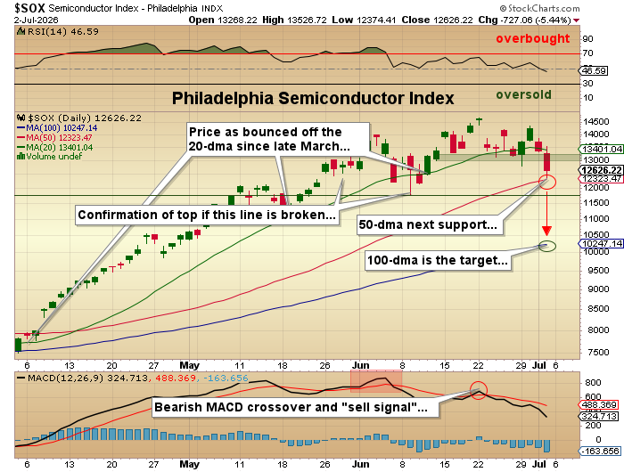
Alas, if the 100-dma gives way, the 200-dma is at 8,671, a 40.87% drop from the June highs. That would be one serious drop at which many might scoff, but which this old cynic thinks entirely probable.
In the Friday email alert sent out at around 9:30 a.m., I made the remark that perhaps it would be wise to stick to areas of the market in which I am both experienced and skilled, namely, the metals. As a person often branded as having an "addictive personality", I have always wondered whether that moniker comes from people being addicted to my personality or whether it is because of my affection (affliction?) for addictive substances.
I often joke about my predilection for taking sledgehammers to locks on containers such as liquor cabinets or medicine chests (usually during periods of market turmoil), but when it comes to markets, I am an absolute sucker for any asset that becomes the recipient of that wondrous "group chase" by robot-driven hedge funds or social media campaigners like Robin Hood.
Hence, I elected to take on the singular most powerful stock promoter on the planet in the form of Elon Musk, who has mismanaged Tesla Inc. (TSLA:NASDAQ) incorrigibly in its quest for EV market share and dominance, but who has managed brilliantly in the area of "stock price management". Musk is the living embodiment of past promoters masquerading as "entrepreneurs" and, as such, reminds me of business leaders of past eras that had brief stays at the top of the mountain but who all crashed and burned horrifically once the curtains were finally pulled back.
Elizabeth Holmes (Theranos), Adam Neuman (WeWork), Sam Bankman-Fried (FTX), Leona Helmsley (Helmsley Hotels), and Kenneth Lay (Enron) were all absolutely revered by Wall Street bigwigs and, in fact, lionized by the financial press, as we saw countless times with "featured interviews" with all these personalities by the leader of the cartoon networks, CNBC.
Now, I am sure that at every turn, Elon Musk has followed all the rules and never once transgressed any of the "grey areas" of corporate governance or compliance issues. I just have a difficult time fathoming how a company that burns US$5 billion a year, like SpaceX (SPCX:NASDAQ), can command a US$3 trillion market cap and be the darling of the marketplace, especially with failed EV-makers like Tesla out there struggling to make ends meet.
What I should probably attempt in future forays is to stick to the knitting that absorbed me for the better part of fifty years as an investor, which, of course, is the metals.
A subscriber reminded me this week that the best call he had ever witnessed was my call on March 16, 2020, to buy gold and silver, miners. As global financial markets panicked over spreading pandemic lockdowns, investors aggressively liquidated positions across all asset classes — including safe havens like precious metals — to raise immediate cash. This broad liquidity squeeze forced the GDX:US down to an intraday low of US$16.18 on March 16, before it closed the session at US$19.00. On the opening that morning, I was buying every call option I could afford in the GDX August US$20 calls and held them right into the summer of 2020, where I pitched them for a ten-bagger gain. However, that, as they say, was then, and this is now, so what have I done in 2026?
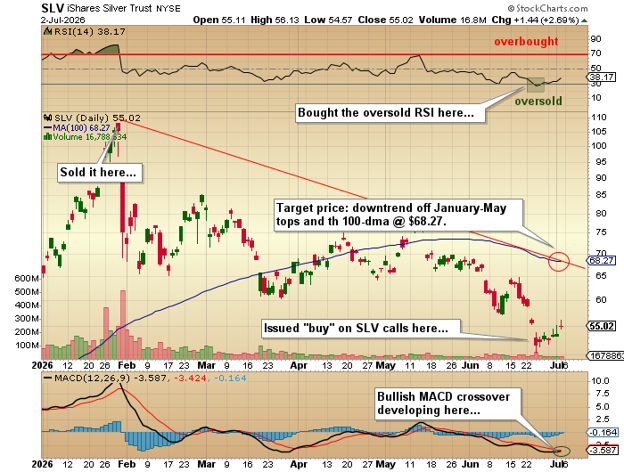
While fixated with the galloping semis, I exited most of my long positions in gold and silver into late-December 2025 with gold around US$4,600 and silver around US$75 with RSI readings for both in the high 70s-low-80s (meaning really overbought). They both kept on rising, so I attempted my first short sale on silver between US$75 and US$80, but was stopped out two days later with a 20% haircut.
Then again, in mid-January of 2026, I again attempted to short silver in the US$85 range and again limped away with a minor scratch as opposed to a life-ending amputation. Finally, on the last Sunday of the month, I told subscribers to divide their speculative capital into five equal parts and buy a 20% position in the ProShares Ultra Short Silver 2X ETF (ZSL:US) each day for the next five sessions in order to "scale in" to what was going to be my final stab at timing the top of what was an obvious bubble.
In fact, here is what I wrote that day: "Remember that it is a US$17,175 speculation within a US$2.7 million trading account — a 0.64% hit if I'm wrong and silver goes to US$500 and never turns back, and if THAT happens, my big junior silver holdings will undoubtedly be sporting profits many times the dollars invested in the ZSL:US."
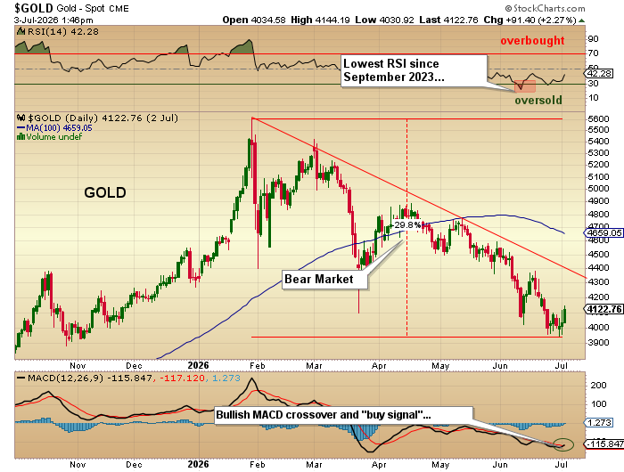
I scaled into a big silver short position all week long, with the final tranche being the very day of that violent outside key reversal that marked the top above US$120 per ounce. While I have since taken profits, I did not issue a buy signal on either gold or silver until June 24, when I took out a modest long position on the SLV August US$50 calls (after a false buy signal the week before). I honestly was not sure if the metals had put in a tradable bottom at the time, but since then, gold has moved from under US$4,000 on June 29 to over US$4,187 today, with September silver moving from US$56.13 to US$62.815 at the same time, giving me comfort that the lows are in for at least a little while.
Unfortunately, these trades on the metals are nothing more than trades because, as the chart on page 8 reveals, gold is in a bear market, trading down 6.97% YTD and is down almost 30% from its January peak. I see gold rallying to US$4,320 first (the downtrend line) and then US$4,659 (100-dma). September silver should recover to around US$75.00, which is both the downtrend line and the 10-dma. For SLV:US, a recovery to around US$68.00 is possible (but I dare not print "probable").
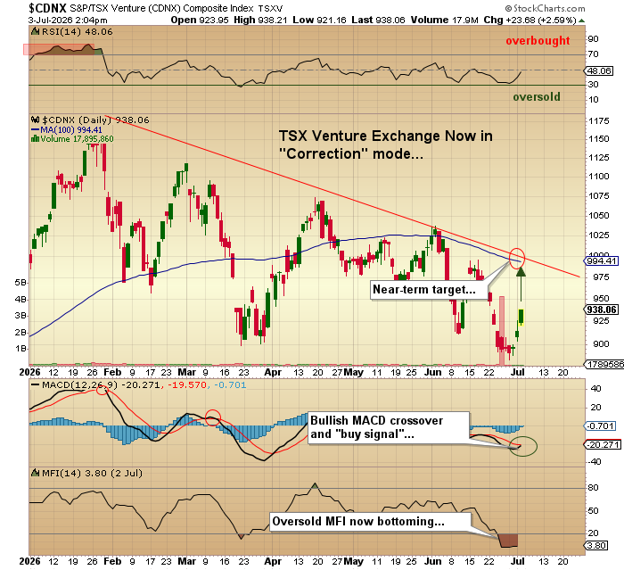
The bulk of my speculative capital remains in the GGMA 2026 Trading Account, which means that it is fully invested in junior resource companies listed on the S&P/TSX Venture Exchange.
My largest holding and top pick since 2023 has been Fitzroy Minerals Inc. (FTZ:TSX.V; FTZFF:OTCQB), which provided an update on their 2026 drill program at Buen Retiro in the Atacama Region of northern Chile. The company reported 57.0 meters at 1.73% Cu, including 12.0 meters at 5.39% Cu (note: this is not "CuEq"; this is straight copper), which came from the southwest section of the property, the exclusive domain of an oxide cap, which they are currently drilling out.
They keep drilling "sterilization" holes to define the outer perimeter of the deposit, and they keep hitting copper-bearing oxides, so it is no surprise that a drill program originally pinned at 7,500 meters has been expanded to the current 22,000 meters, a superb testimonial to the success of the current drill program.
It is no longer a question of whether there are economically viable amounts of copper residing here, but rather how much copper is actually there.
While gold and silver are technically in bear market territory seeking out bottoms, copper is not in such a state, still strongly positioned in a secular bull market that is driven purely by the need and wants of an ever-expanding electrical grid on every continent and the insatiable demand for copper wiring by the AI-driven data-center build-outs.
Junior copper developers are at the top of my investment food chain, as there are few new projects scheduled to be in production before the decade is over.
Fitzroy Minerals Inc. is expected to commence production with partner Pucobre SA by 2028, which sets its fully apart from most of its counterparts.
As a group, the juniors are doing exactly what the juniors do in the months of June through September, which is "very little".
Even a superb drill at Buen Retiro had only a brief bullish impact on the stock price.
However, over time, this will change, and by mid-September, the speculative juices should have returned to the junior metals.
In the meantime, continued results at Buen Retiro should act as the battering ram shown above, pounding away at the walls of "institutional apathy" currently plaguing the sector.
This, too, shall pass…
Important Disclosures:
- As of the date of this article, officers, contractors, shareholders, and/or employees of Streetwise Reports LLC (including members of their household) own securities of Fitzroy Minerals and Tesla Inc.
- Michael Ballanger: I, or members of my immediate household or family, own securities of: Fitzroy Minerals, SLV, and $SOX. My company has a financial relationship with: None. My company has purchased stocks mentioned in this article for my management clients: None. I determined which companies would be included in this article based on my research and understanding of the sector.
- Statements and opinions expressed are the opinions of the author and not of Streetwise Reports, Street Smart, or their officers. The author is wholly responsible for the accuracy of the statements. Streetwise Reports was not paid by the author to publish or syndicate this article. Streetwise Reports requires contributing authors to disclose any shareholdings in, or economic relationships with, companies that they write about. Any disclosures from the author can be found below. Streetwise Reports relies upon the authors to accurately provide this information and Streetwise Reports has no means of verifying its accuracy.
- This article does not constitute investment advice and is not a solicitation for any investment. Streetwise Reports does not render general or specific investment advice and the information on Streetwise Reports should not be considered a recommendation to buy or sell any security. Each reader is encouraged to consult with his or her personal financial adviser and perform their own comprehensive investment research. By opening this page, each reader accepts and agrees to Streetwise Reports' terms of use and full legal disclaimer. Streetwise Reports does not endorse or recommend the business, products, services or securities of any company.
For additional disclosures, please click here.
Michael Ballanger Disclosures
This letter makes no guarantee or warranty on the accuracy or completeness of the data provided. Nothing contained herein is intended or shall be deemed to be investment advice, implied or otherwise. This letter represents my views and replicates trades that I am making but nothing more than that. Always consult your registered advisor to assist you with your investments. I accept no liability for any loss arising from the use of the data contained on this letter. Options and junior mining stocks contain a high level of risk that may result in the loss of part or all invested capital and therefore are suitable for experienced and professional investors and traders only. One should be familiar with the risks involved in junior mining and options trading and we recommend consulting a financial adviser if you feel you do not understand the risks involved.