


For the last fourteen weeks, the headlines have been filled with a number of extremely deceptive narratives, such as the end of the war being imminent every time oil moved above $100 per barrel and, I might add, delivered exclusively by the American President to the exclusion of virtually everyone else connected to the military campaign. Thirty-eight times in that period, the world listened to how Iran was "begging for" a "Great Peace Deal" and how the mighty American armed forces were destroying everything in its path. The reality is that the Iranian missile defense system, embedded deep in caves in their mountainous regions, was virtually unscathed and wreaked havoc upon the U.S.-Israeli forces to the extent that even the carriers had to stay well out into the Indian Ocean to avoid lethal encounters.
Ten days ago, markets rallied over the delivery of a "Memorandum of Understanding", not anything vaguely resembling a "Great Peace Deal" which has both sides agreeing to "talks" intended to prevent a resurrection of hostilities, which, if you track the clearly-stated objectives of the original February 28 assault, are certain to resurface unless the U.S. and Israel get a handover of the enriched uranium used to make nuclear weapons, a guarantee regarding safe passage through the Strait of Hormuz, and the most important one, regime change, where the Islamic clerical hardliners are replaced with pro-West moderates.
Now that they have entered a sixty-day period of "negotiations" with Israel hell-bent-for-leather to coerce the U.S. into resuming its bombardment of everything Iranian, President Trump ordered V.P. Vance to reel in the main attack dog, Benjamin Netanyahu, in his efforts to destroy Hezbollah in Lebanon. So, you have the White House scrambling for peace and the Israeli's thirsting for continued aggression during the very period that Trump assumes that he has the stronger poker hand. With dissension in the U.S.-Israeli ranks and with Iran backed by Chinese high-tech weaponry, the U.S. will be playing bluff poker against a Persian foe known for its cunning and perseverance.
However, of all the objectives that the White House hoped to achieve, they did come away last week with one of them.
Last Wednesday, the U.S. secured a regime change, albeit a far different brand of change than one might have expected. The regime of the Federal Reserve chairmen and chairwomen running that institution as a privately-held consortium of Wall Street cheerleaders came to a thunderous halt when newly-appointed Fed Chairman Kevin Warsh repeated more than a half a dozen times in his speech and press conference: "The Fed will deliver price stability."
In a period stretching back to the appointment of Alan Greenspan in June of 1987, the Fed has gone through an enormous metamorphosis that has seen it emerge from its historical pre-Greenspan "operate-behind-the-curtains" clandestine modus operandi to international rockstar status with more media coverage than either American politics, sports, or Hollywood. At the height of the insanity, there would be coverage of three Fed speakers per day, all talking up the markets and then running to their quote screens to see how their speeches juiced the NASDAQ.
From the prepared remarks and from his replies to questions during the press conference, Warch refused to offer anything that resembled "forward guidance" while he continually referred to "price stability" at every turn. I was watching the S&P futures as he was speaking and found it fascinating how every time he mentioned inflation or price stability, they swooned. The CNBC commentators were all giddy over his handling of the presser, but after it was over, the markets had been smoked for one simple reason — they had just been introduced to a "new sheriff in town".
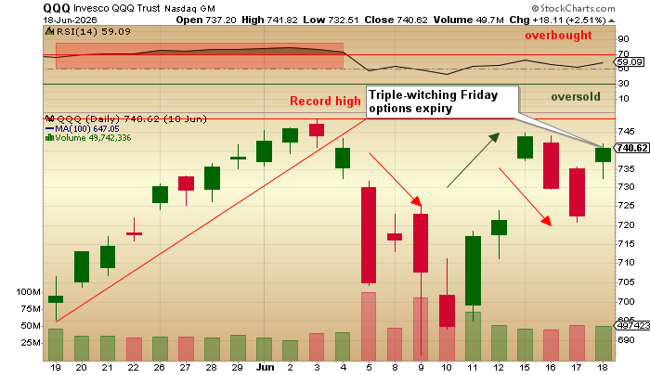
Stocks sold off hard on Wednesday and Thursday, only to bounce back on triple-witching Friday, but the market that "got it" immediately was gold (and silver) as the harsh words of the New Sheriff registered quickly and were translated by the precious metals players as "anti-inflation".
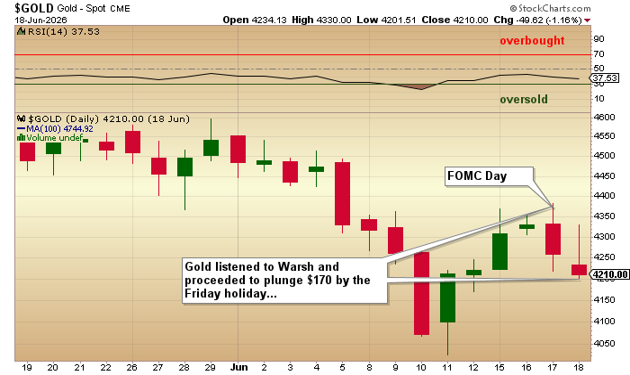
What gold and silver "heard" were these words from the new Fed Chairman: "So, when inflation surges — as it has done in recent years — grievous harm is done to our citizens, especially to the least well-off."
I will repeat that to all of the stockroaches out there — "especially to the least well-off". Anyone who cannot interpret that statement as being a cannonball fired directly across the bow of the U.S.S Wall Street is either illiterate or brainwashed. Those are not the words ever uttered by Messrs. Greenspan or Bernanke, Madame Yellen, and certainly not ex-Wall Street stock salesman Jerome Powell. What I heard last Wednesday was the end of a regime that started under Ronald Reagan and ended under Donald Trump. The Fed's role as "Cheerleader of Record" is no more.
In case one has been living in a cave on a mountaintop for the past forty years, Wall Street loves currency debasement. How many times have you heard me use an expression that I completely plagiarized from a co-worker back in 1979:
"Never underestimate the replacement power of equities within an inflationary spiral."
The greatest era of credit creation and currency debasement began under the Reagan Presidency, with people like Arthur Laffer promoting the now famous "Laffer Curve".
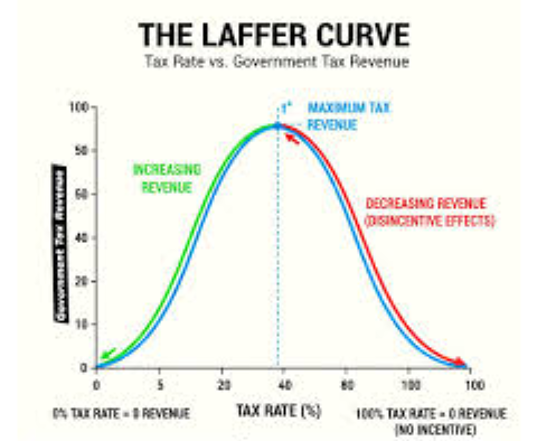
The concept famously gained popularity in 1974 after Laffer sketched the curve on a paper napkin during a meeting at a Washington, D.C. restaurant with Ford administration officials Dick Cheney and Donald Rumsfeld to argue against tax increases. It later became the foundation for the term "Reaganomics," in which increased military spending, along with huge personal and corporate tax cuts, began a forty-four-year era of ever-widening deficits. When Reaganomics first became popular during the 1980 Presidential campaign, the U.S. national debt was approximately $908 billion, with the Fed balance sheet totaling $171 billion.
With the appointment of Greenspan during Reagan's second term, the combination of deficit spending, tax cuts, and Fed interventions was augmented and accentuated throughout the 1990's, with the only balanced budget coming in 1999 under Bill Clinton.
As a result of profligate monetary and fiscal policies engaged by both sides of the aisle in Congress and every Fed Chairperson from Bernanke to Yellen and then Powell, the national debt has grown today to nearly $40 trillion, with the Fed balance sheet at $6.74 trillion. This perpetual compulsion by both politicians and bankers to avoid market meltdowns came after Reagan authorized the creation of "The Working Group on Capital Markets," which was catapulted into action after the Crash of '87 nearly crippled Wall Street indefinitely. That group was comprised of the following:
- The Secretary of the U.S. Treasury (who serves as the Chairman of the group)
- The Chairman of the Federal Reserve Board
- The Chair of the Securities and Exchange Commission (SEC)
- The Chair of the Commodity Futures Trading Commission (CFTC)
These financial market titans have been the overseers of the largest period of credit creation in global history, but the primary cheerleader for Wall Street has always been the Fed, because while the U.S. Treasury created the currency, the Fed has been the entity enabling the Treasury for the past forty-six years. At no time in that expanse of time have we heard any of the members mentioned above ever express primary commitment to "stabilizing prices" ahead of "maximum full employment" or "economic growth".
The last Fed chairman to do that was Paul Volcker, who singlehandedly crippled the global economy by refusing to let the banks borrow from the discount window at low rates, instead favoring letting them bid up borrowing costs, which he then matched with hikes in the Fed funds rate.
The 1981-1982 bear market was the result of the last Fed chairman, who refused to accommodate Wall Street, deciding instead to favor the average American citizen, primarily lower-income citizens with little or no safety net with which to ride out the inflationary storm.
Now, in 2026 with stocks at record highs, margin debt at record levels, the Buffett Indicator at higher levels than in 2001 or 2007, and with price-to-sales ratios at all-time highs, the world was introduced to the first Fed Chairman in forty-six years that has put Wall Street on notice that his Fed "will achieve price stability." — and he repeated it half a dozen times.
The Thursday triple witching hour option expiries allowed stocks to rally, but gold and silver miners steadfastly refused to comply by losing ground on both Wednesday and Thursday. While next week remains a critical test for all equity markets, my guess is that the metals are going to respond to oversold conditions and mount a rally while the S&P and NASDAQ are long overdue for a pullback.
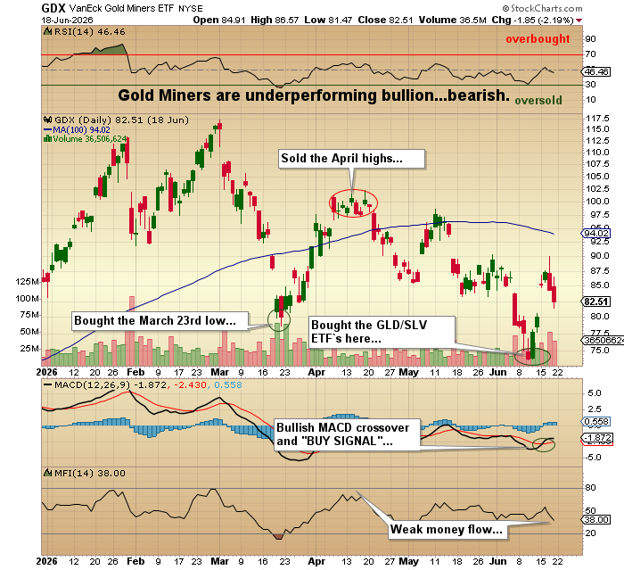
The great dilemma for me is what to do with the miners. An old Mantra I have followed for decades is that "Gold stocks lead gold bullion," and the same applies for silver and its related equities. The Rolls-Royce of the gold miners is undoubtedly Agnico Eagle Mines Ltd. (AEM:TSX; AEM:NYSE), which traded at $35 in September 2022 and traded at over $355 last March.
With gold bullion down approximately 25% since its January 29 peak, AEM is off over 35% in the same period. The VanEck Gold Miners ETF (GDX:US) is down 30%, which gives me a sense of dread because when combined with the relative outperformance of the GLD:US, the tape action reeks of "bear market idiosyncrasies". And for long-term gold and silver bulls, that is a direct conflict with everything I have ever believed regarding precious metals investment.
The problem I have is that everyone is reciting passages from the same hymn book.
Yes, the central banks are buying more into the current weakness. Yes, the currency debasement continues. Yes, the fundamental reasons for owning gold have not exactly changed, but that was the same narrative at the top in August 2020. However, it must be remembered that the lows did not arrive until September 2022. That was over twenty-five months of agony despite solid fundamentals. From the perspective of this writer, seventy-three years active, he does not particularly wish to spend the next two years waiting for the resurgence of speculative interest in the metals because by then, he may have forgotten not only where he left his car keys but where he loves and how to spell his last name.
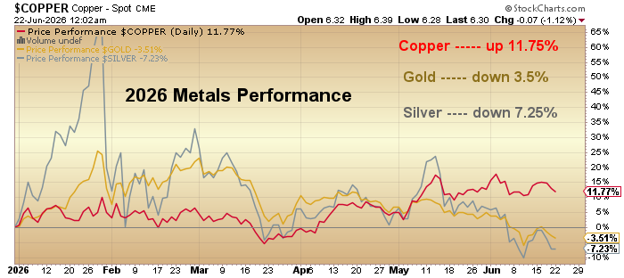
Make no mistake; the action in gold and silver is bearish. The tape feels "heavy"; the narrative has gotten old; and the gold bloggers are sounding increasingly desperate. Next week, the metals must decouple from stocks and bonds and recapture the tape. If not, it is going to be a very long summer for those holding the gold and silver miners.
However, unlike gold and silver, my top-rated metal since 2023 — copper — has been acting wonderfully since the peak in late January. Not only has it not taken out the March lows, but it has also put in two subsequent record highs since then and is still sitting comfortably in the $6.30 range, up 11.75% year-to-date and still attracting all kinds of speculative interest across the globe. There is no need to regurgitate the bullish narrative yet another time; copper reigns supreme in every aspect of the supply-demand metric.
There is no other metal that comes close to matching copper's unstoppable trend to insatiable demand, meeting irreversible near-term supply issues that will result in sharply higher, verging upon catastrophically higher prices for the one metal used in every aspect of life in the modern world. What Wall Street is going to discover by the end of the decade is that there could never have been a data-center buildout without a massive increase in the production of copper.
As mindboggling as the infatuation with all things related to "AI" is, I have a very tough time rationalizing the degree to which investors are ignoring the suppliers of the one metal that is critical to the ascent of the hyperscalers. The increase in copper usage as a result of the data-center buildout will not be a supply increase because there is no new supply coming on stream that comes within a country mile of meeting demand. What will happen is that anyone with near-term supply is going to be the object of panic buying, not so much by the average portfolio manager or retail investor, but more so by the users.
In fact, sovereign wealth funds may decide that copper producers represent strategic necessities to national security and buy entire companies for their nascent supply. This is why I choose to focus on junior copper developers with proven resources and, in some cases, near-term production start-up targets before the end of the decade. Subscribers know the names of the companies I like, so I will refrain from listing them in this missive.
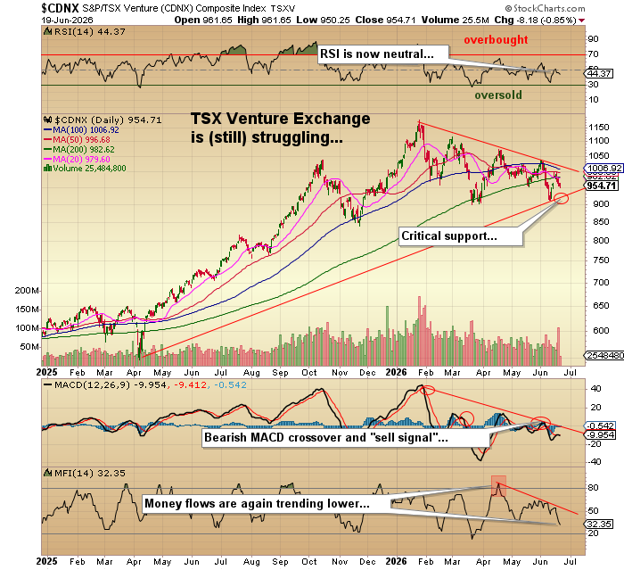
The S&P/TSV Venture Composite (CDNX:TSV) is in a clear downtrend off the January top in the metals, with a series of lower highs and lower lows dominating the landscape. Despite my obvious bias and glowering affection for the junior copper developers and explorers, they simply cannot fight the adverse conditions brought on by the overbearing supply issues surrounding the junior gold and silver stocks. Fundamentals matter not because the predominant narrative is that the junior Canadian miners are "dead money" until after Labor Day and possibly until after gold and silver make new all-time highs.
| Want to be the first to know about interesting Gold and Copper investment ideas? Sign up to receive the FREE Streetwise Reports' newsletter. | Subscribe |
Important Disclosures:
- As of the date of this article, officers, contractors, shareholders, and/or employees of Streetwise Reports LLC (including members of their household) own securities of Agnico Eagle Mines Ltd.
- Michael Ballanger: I, or members of my immediate household or family, own securities of: Fitzroy Minerals and Grafton Resources. My company has a financial relationship with: None. My company has purchased stocks mentioned in this article for my management clients: None. I determined which companies would be included in this article based on my research and understanding of the sector.
- Statements and opinions expressed are the opinions of the author and not of Streetwise Reports, Street Smart, or their officers. The author is wholly responsible for the accuracy of the statements. Streetwise Reports was not paid by the author to publish or syndicate this article. Streetwise Reports requires contributing authors to disclose any shareholdings in, or economic relationships with, companies that they write about. Any disclosures from the author can be found below. Streetwise Reports relies upon the authors to accurately provide this information and Streetwise Reports has no means of verifying its accuracy.
- This article does not constitute investment advice and is not a solicitation for any investment. Streetwise Reports does not render general or specific investment advice and the information on Streetwise Reports should not be considered a recommendation to buy or sell any security. Each reader is encouraged to consult with his or her personal financial adviser and perform their own comprehensive investment research. By opening this page, each reader accepts and agrees to Streetwise Reports' terms of use and full legal disclaimer. Streetwise Reports does not endorse or recommend the business, products, services or securities of any company.
For additional disclosures, please click here.
Michael Ballanger Disclosures
This letter makes no guarantee or warranty on the accuracy or completeness of the data provided. Nothing contained herein is intended or shall be deemed to be investment advice, implied or otherwise. This letter represents my views and replicates trades that I am making but nothing more than that. Always consult your registered advisor to assist you with your investments. I accept no liability for any loss arising from the use of the data contained on this letter. Options and junior mining stocks contain a high level of risk that may result in the loss of part or all invested capital and therefore are suitable for experienced and professional investors and traders only. One should be familiar with the risks involved in junior mining and options trading and we recommend consulting a financial adviser if you feel you do not understand the risks involved.