

Gold has been one of the best-performing assets of the decade, capturing investor attention as concerns over inflation, government debt, currency debasement, and geopolitical uncertainty intensified.
Yet while gold has dominated headlines, another metal may be quietly setting up for an equally important move.
Copper, the metal that powers modern civilization, sits at the center of nearly every major investment theme shaping the global economy. Artificial intelligence, data centers, electric vehicles, power grid expansion, renewable energy, defense spending, and critical mineral security all require enormous amounts of copper.
At the same time, the mining industry faces a growing challenge: it is simply not discovering enough new deposits to meet future demand.
When I combine the fundamental outlook with the long-term technical picture, I believe copper may be entering the early stages of a secular bull market that could last for years.
The Gold-to-Copper Ratio Is Flashing an Important Signal
One of the most interesting charts I follow is the Gold-to-Copper Ratio.
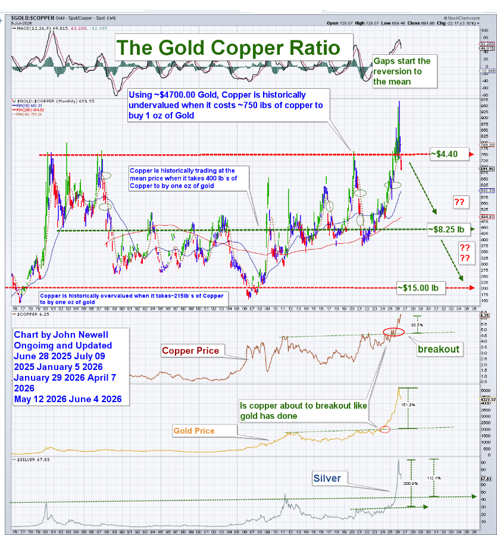
Rather than comparing two prices, the ratio measures how many pounds of copper it takes to purchase one ounce of gold.
Historically, the long-term average has been approximately 400 pounds of copper per ounce of gold.
Today, it takes roughly 700 pounds of copper to purchase one ounce of gold.
In simple terms, copper appears historically undervalued relative to gold.
The chart shows that periods of extreme divergence have historically been followed by mean reversion, where the ratio eventually moves back toward its long-term average. That adjustment can occur through weaker gold prices, stronger copper prices, or some combination of both.
Given the powerful supply and demand fundamentals emerging in the copper market, I believe the more likely outcome is that copper continues to play catch-up.
The chart also reveals what appears to be a massive multi-decade breakout pattern. If the ratio continues reverting toward historical norms, copper prices could have substantially more room to run than most investors currently appreciate.
The World Is Entering a Copper Demand Supercycle
Unlike previous commodity cycles driven largely by economic growth in a single region, today's copper market is being supported by multiple secular trends moving in the same direction.
Industry forecasts suggest global copper demand could increase from approximately 28 million tonnes annually today to more than 42 million tonnes by 2040.
Artificial intelligence alone is creating unprecedented demand for digital infrastructure. The world's largest technology companies are investing hundreds of billions of dollars in data centers that require enormous quantities of copper for power distribution, cooling systems, transformers, transmission networks, and backup power infrastructure.
Yet AI is only part of the story.
Electric vehicles require approximately four times more copper than traditional internal combustion vehicles. Renewable energy projects require massive amounts of copper wiring and transmission infrastructure. Aging electrical grids across North America and Europe require modernization, while rapidly developing economies such as India and parts of Africa continue expanding their infrastructure and industrial capacity.
Copper has quietly become one of the essential building blocks of the modern economy.
Why the Supply Crisis May Be Worse Than Most Investors Realize
Most investors understand that copper demand is rising.
What many fail to appreciate is how difficult it has become to find and develop new sources of supply.
The common assumption is that if copper prices rise high enough, the mining industry will simply produce more copper.
In reality, the problem is far more complex.
Veteran copper traders Sébastien Le Page and Nicolas Triantafillidis recently made an important observation: you cannot simply throw money at a copper shortage. Before a mine can be built, someone has to find the deposit, and that remains the most difficult part of the entire process.
The copper industry faces a remarkable challenge. It takes an average of approximately 17 years to move a major copper discovery from exploration through permitting, financing, construction, and ultimately into production.
Even if several world-class deposits were discovered tomorrow, they would likely not contribute meaningful supply until well into the next decade.
The problem is particularly evident in Chile, the world's largest copper-producing nation. Despite decades of exploration and investment, there has not been a major new copper discovery comparable to the country's giant deposits in nearly half a century.
This is occurring precisely as demand is accelerating.
As a result, the world may require the equivalent of one new million-tonne-per-year copper mine every year simply to satisfy projected demand growth.
Today, the industry is falling well short of that requirement.
One story illustrates the challenge perfectly.
A Chilean exploration team recently discovered a large copper deposit located just 22 kilometers from Escondida, the largest copper mine in the world. The discovery was made by a geologist who spent sixteen years working on the project before finally making the breakthrough.
Sixteen years of work for one discovery.
That reality highlights why higher prices alone cannot solve the coming supply problem.
Discoveries require time, expertise, perseverance, and often a considerable amount of luck.
Copper is approximately 99% recyclable, and recycling will certainly contribute to future supply, but even aggressive recycling growth is unlikely to offset the magnitude of projected demand increases over the coming decades.
Meanwhile, sophisticated investors and corporations are increasingly moving upstream into mining and critical mineral supply chains.
When companies such as Amazon invest directly into copper projects, when energy giants establish metals trading divisions, and when governments negotiate strategic mineral agreements, they are effectively acknowledging that future copper supply may become one of the world's most important economic and geopolitical challenges.
One statement captures the challenge better than any statistic:
"We have mined copper for roughly 10,000 years, and over the next two decades the world may need an amount comparable to everything humanity has mined before."
Whether that estimate proves precisely correct is almost beside the point.
The scale of future demand is enormous, while the pipeline of new discoveries remains surprisingly thin.
The Technical Charts Suggest Copper's Bull Market May Only Be Beginning
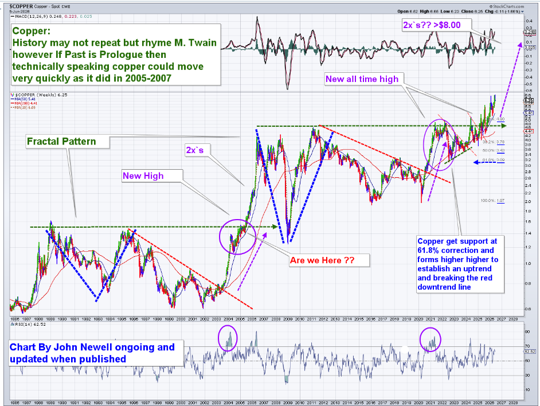
The long-term charts are beginning to confirm what the fundamentals have been suggesting.
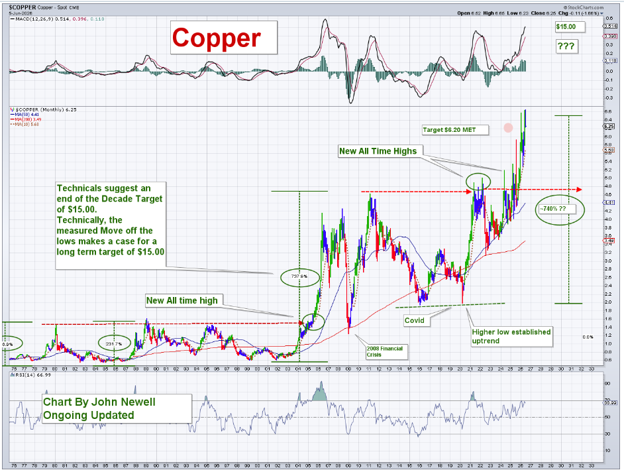
Copper has recently broken out to new all-time highs after spending more than a decade consolidating following the 2008 commodity supercycle.
From a technical perspective, this is highly significant.
Multi-year and multi-decade breakouts often signal the beginning of major secular bull markets rather than their conclusion.
One of the most interesting aspects of the current setup is its similarity to the powerful 2003-2007 copper bull market.
Copper corrected approximately 61.8% from its previous peak, successfully held support, broke a major downtrend line, and subsequently moved to new highs. This sequence closely resembles the pattern that preceded the last major acceleration phase.
If history continues to rhyme, copper could move substantially higher over the coming years.
My previously measured move target of approximately US$6.25 per pound has now been achieved.
The next long-term technical target points toward the possibility of US$15.00 per pound later this decade if the current secular breakout continues to unfold.
While that target may appear ambitious today, major commodity bull markets often seem unrealistic during their early stages.
Copper May Be Entering a Period of Outperformance vs the Broad Stock Market
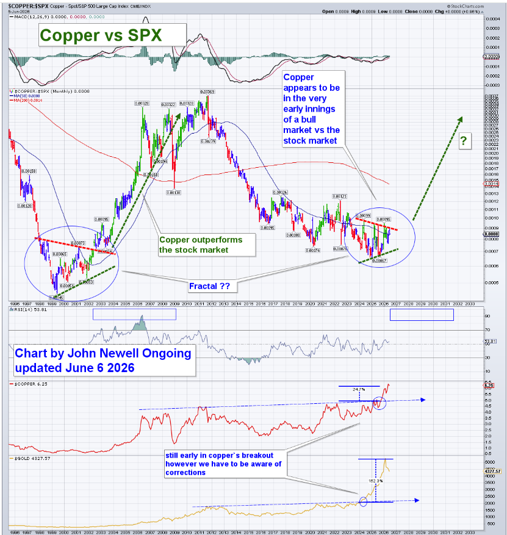
Another chart that has caught my attention compares copper to the S&P 500 Index.
Historically, there have been periods when commodities significantly outperformed financial assets and periods when the opposite was true. Since the 2011 commodity peak, investors have generally been rewarded for owning technology stocks and financial assets rather than hard assets such as copper.
That relationship may now be changing.
The Copper-to-S&P 500 Ratio appears to have completed a lengthy basing pattern similar to the one that developed between 1998 and 2003. Following that earlier base, copper dramatically outperformed the stock market during the commodity bull market that unfolded between 2003 and 2011.
Today, a remarkably similar pattern appears to be developing.
The ratio has begun establishing higher lows while momentum indicators are turning upward. Although still in its early stages, the chart suggests copper may be beginning a new period of relative strength versus the broader equity market.
If this fractal pattern continues to unfold, it could indicate that capital is gradually rotating from financial assets toward hard assets and commodities.
Historically, major commodity bull markets have often coincided with periods when investors sought exposure to tangible assets that benefit from inflation, infrastructure spending, resource scarcity, and economic expansion.
If copper outperforms the S&P 500 over the coming decade, copper producers, developers, and successful exploration companies could potentially generate returns that exceed those of the broader equity market.
The chart does not suggest that stocks are about to collapse. Rather, it suggests that copper may be entering a period where it becomes one of the market's leadership sectors.
When viewed alongside the copper breakout chart, the Gold-to-Copper Ratio, and the growing supply deficit story, the evidence continues to build that we may still be in the early innings of a major copper bull market.
Why Junior Copper Exploration Companies May Offer the Greatest Opportunity
The copper opportunity is no longer simply a bet on economic growth.
It is a bet on electrification, artificial intelligence, critical minerals, national security, and one of the largest infrastructure buildouts in human history.
The challenge is that while demand can be forecast with reasonable confidence, future supply cannot.
New copper deposits must first be discovered, then financed, permitted, and built.
That process can take decades.
This is why the role of junior exploration companies has never been more important.
Most major copper discoveries are made by junior explorers, not by major mining companies.
These entrepreneurial teams identify prospective districts, generate exploration targets, raise risk capital, and undertake the drilling programs that ultimately lead to new discoveries.
Virtually every major copper mine operating today was once a grassroots exploration project.
History also shows that successful discoveries often attract strategic investments, joint ventures, and eventual acquisition offers from larger producers seeking to replace reserves.
As copper deficits become increasingly apparent, competition for quality projects is likely to intensify.
As a technical analyst and long-time student of commodity cycles, I have learned that bull markets rarely reward all companies equally. Some succeed because they own large advanced-stage assets. Others create value through discovery. Still others benefit from strategic positioning in districts where major mining companies are actively looking to replace reserves.
The following companies represent several different ways investors can gain exposure to what I believe could become one of the defining commodity themes of the next decade.
Five Copper Companies Positioned to Benefit from a Copper Bull Market
McEwen Mining Inc.
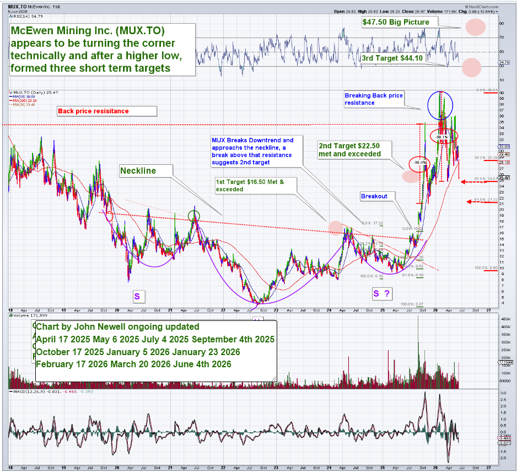
McEwen Inc. (MUX:TSX; MUX:NYSE ) offers investors something unique among copper investment opportunities. Unlike many junior exploration companies, it already generates revenue from producing gold and silver operations while maintaining substantial exposure to what could become one of the world's most important new copper mines.
The company's most significant growth asset is its ownership stake in McEwen Copper, the developer of the Los Azules Copper Project in San Juan Province, Argentina. Los Azules is widely recognized as one of the largest undeveloped copper projects in the world and has completed a feasibility study outlining a long-life operation capable of producing significant quantities of copper cathode.
For investors who believe copper prices could move substantially higher over the coming decade, McEwen Mining offers leveraged exposure to a potential Tier-1 copper asset while maintaining precious metals production that supports the company's valuation.
Technically, the stock appears to be undergoing a healthy correction following a significant advance. My original targets of CA$16.50 and CA$22.50 were achieved and exceeded. The shares recently approached my third target near CA$44.10 before entering a consolidation phase.
The current pullback appears to be testing key Fibonacci support levels after successfully breaking long-term resistance. If support holds and the uptrend resumes, I continue to see the potential for a longer-term target near CA$47.50.
Copper Giant Resources
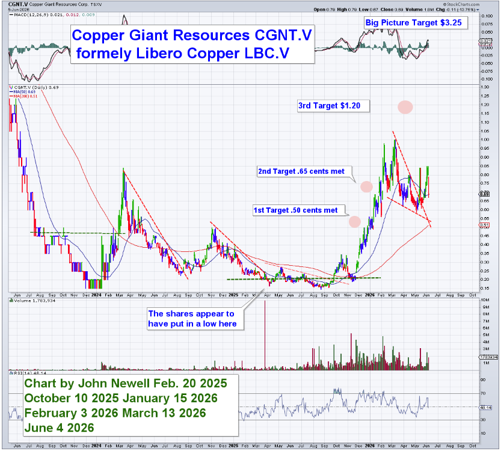
Copper Giant Resources Corp. (CGNT:TSXV; LBCMF:OTCQB), formerly Libero Copper, controls the Mocoa Copper-Molybdenum Project in Colombia, one of the largest undeveloped copper resources in the Americas.
Unlike many early-stage explorers, the company is advancing a known district-scale asset at a time when large copper discoveries are becoming increasingly rare. The involvement of mining financier Frank Giustra and an experienced management team adds further credibility to the story.
Technically, the stock appears to have completed a major bottoming process after a lengthy decline. My original targets of CA$0.50 and CA$0.65 have both been achieved. The shares are currently attempting to break out from a consolidation pattern with a third target of approximately CA$1.20.
Longer term, the chart suggests a potential big-picture target near CA$3.25.
Vizsla Copper
Vizsla Copper Corp. (VCU:TSXV; VCUFF:OTCQB) offers investors exposure to a portfolio of copper exploration projects in British Columbia, one of the world's premier mining jurisdictions.
The company benefits from strong technical expertise, a focused exploration strategy, and a land position that could become increasingly valuable as major mining companies search for new copper discoveries in safe jurisdictions.
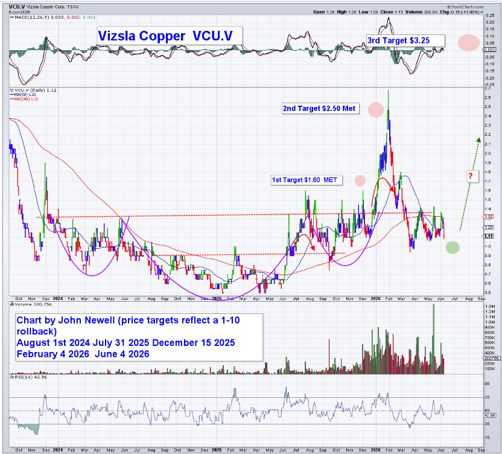
My previous targets of CA$1.60 and CA$2.50 were achieved before the shares entered a consolidation phase.
The stock now appears to be attempting to establish support near current levels. A successful breakout could target approximately CA$3.25 over time.
Pacific Booker Minerals
Pacific Booker Minerals (BKM:TSXV; PBMLF:OTCMKTS) owns the Morrison Copper-Gold Project in British Columbia, one of Canada's most advanced undeveloped copper-gold projects.
The project hosts a large, defined resource and has completed extensive engineering and economic studies, placing it much further along the development curve than most junior companies.
The company recently attracted industry attention following an unsolicited takeover proposal, highlighting growing interest in advanced-stage copper development projects.
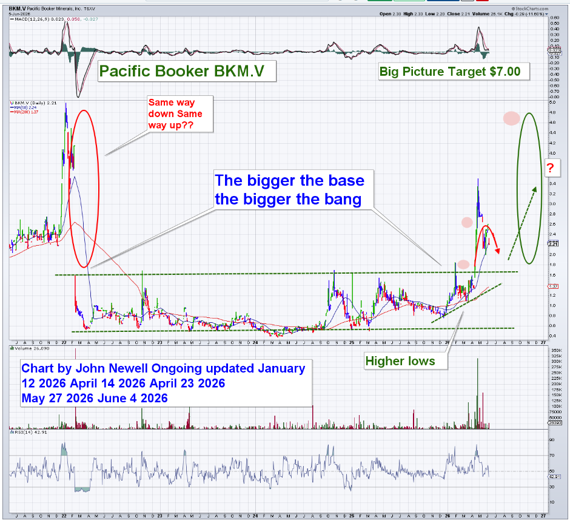
The chart is particularly interesting because of the massive base that has developed over several years.
As technicians often say, the bigger the base, the bigger the move.
Following a lengthy consolidation period and a series of higher lows, the shares appear to be preparing for another attempt at higher prices.
My long-term target remains approximately CA$7.00.
Kodiak Copper Corp.
Kodiak Copper Corp. (KDK:TSX.V) has emerged as one of the better-known copper exploration stories in British Columbia through its MPD Copper-Gold Project in the prolific Quesnel Trough.
One of Kodiak's greatest strengths is its combination of exploration success, strong technical leadership, and strategic backing from Teck Resources. Continued drilling has demonstrated the potential for multiple mineralized centers across a district-scale land package.
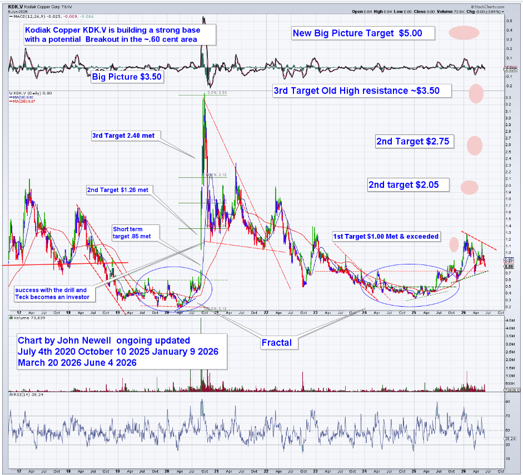
The current chart appears to be building a large fractal pattern similar to earlier periods that preceded substantial advances.
Following a lengthy consolidation, the shares may be setting up for another breakout cycle.
Longer term, I see potential targets of CA$2.75, CA$3.50, and possibly CA$5.00 should exploration success continue, and copper prices move higher.
Why These Five Companies?
I selected these five companies because they represent different ways to participate in a potential copper bull market.
McEwen Mining provides exposure to a producing precious metals company with ownership in the world-class Los Azules copper project. Copper Giant offers leverage to a giant, undeveloped resource in Colombia. Pacific Booker provides exposure to one of Canada's most advanced undeveloped copper-gold projects. Kodiak Copper represents a discovery-driven exploration story in the Quesnel Trough, while Vizsla Copper offers exposure to multiple exploration opportunities in British Columbia.
Together, they provide investors with exposure across the exploration, development, and future production spectrum of the copper industry.
Conclusion
The copper story is no longer simply about metal prices.
It is about electrifying the global economy, building the infrastructure required for artificial intelligence, modernizing power grids, securing critical mineral supply chains, and finding the deposits needed to support that future.
The challenge is that while demand can be forecast with reasonable confidence, supply cannot. New copper deposits must first be discovered, financed, permitted, and built. That process often takes decades.
For investors, this creates a rare opportunity.
The Gold-to-Copper Ratio suggests copper remains historically undervalued relative to gold. The Copper-to-S&P 500 Ratio suggests hard assets may be entering a period of outperformance relative to financial assets. Meanwhile, the underlying fundamentals point to growing supply deficits and increasing competition for new discoveries.
Copper itself may perform well, but history suggests that some of the greatest gains are often generated by the companies that discover and advance the next generation of world-class deposits.
If the charts are correct and the supply deficit develops as many analysts expect, we may still be in the early innings of one of the most important commodity bull markets of the 21st century.
| Want to be the first to know about interesting Copper and Base Metals investment ideas? Sign up to receive the FREE Streetwise Reports' newsletter. | Subscribe |
Important Disclosures:
- As of the date of this article, officers, contractors, shareholders, and/or employees of Streetwise Reports LLC (including members of their household) own securities of McEwen Inc. and Copper Giant Resources Corp.
- John Newell: I, or members of my immediate household or family, own securities of: None. My company has a financial relationship with: None. My company has purchased stocks mentioned in this article for my management clients: None. I determined which companies would be included in this article based on my research and understanding of the sector.
- Statements and opinions expressed are the opinions of the author and not of Streetwise Reports, Street Smart, or their officers. The author is wholly responsible for the accuracy of the statements. Streetwise Reports was not paid by the author to publish or syndicate this article. Streetwise Reports requires contributing authors to disclose any shareholdings in, or economic relationships with, companies that they write about. Any disclosures from the author can be found below. Streetwise Reports relies upon the authors to accurately provide this information and Streetwise Reports has no means of verifying its accuracy.
- This article does not constitute investment advice and is not a solicitation for any investment. Streetwise Reports does not render general or specific investment advice and the information on Streetwise Reports should not be considered a recommendation to buy or sell any security. Each reader is encouraged to consult with his or her personal financial adviser and perform their own comprehensive investment research. By opening this page, each reader accepts and agrees to Streetwise Reports' terms of use and full legal disclaimer. Streetwise Reports does not endorse or recommend the business, products, services or securities of any company.
For additional disclosures, please click here.
John Newell Disclaimer
As always it is important to note that investing in precious metals like silver carries risks, and market conditions can change violently with shock and awe tactics, that we have seen over the past 20 years. Before making any investment decisions, it's advisable consult with a financial advisor if needed. Also the practice of conducting thorough research and to consider your investment goals and risk tolerance.