



As I was doing my early-morning reading on Friday, I came across a report that made reference to Chinese Premier Xi in his address to the American delegation that included the President as well as several of America's "Titans of Industry". As I was poring through the report, the best word to describe my emotional state was "epiphany," defined as "a sudden moment of insight or realization when something becomes clear in a way it wasn't before". It was also a feeling that had eluded me for some sixty-four years, because the last time I felt this was in 1962 when our home room teacher ordered the entire class to crawl under our desks as soon as the fire alarm sounded. This was not a "fire drill", though. It was a "nuclear attack drill" as at the time, the West was heavily embroiled at the very peak of the Cold War with the Union of Soviet Socialist Republics (the "U.S.S.R").
During his address to the Americans, Premier Xi made mention of the "Thucydides Trap", to which the American president responded with a blank stare. This concept was named after the ancient Athenian historian Thucydides, who wrote that "It was the rise of Athens and the fear that this instilled in Sparta that made war inevitable," referring to the Peloponnesian War. When an emerging power (like Athens or, in this case, China) challenges a dominant power (like Sparta or, in this case, the U.S.), the resulting fear, tension, and strategic maneuvering make war highly likely.
Many podcasters and newsletter writers are too young to have experienced the sense of foreboding that a septuagenarian like me experienced when pictures of hydrogen bombs exploding over the Bikini Atoll in 1954 surfaced on daytime TV. Everyone was acutely aware of "tensions" between U.S. President Kennedy and Soviet Premier Khrushchev during the Cuban Missile Crisis of October 1962, but it was actually decades later that we learned how critically close they came to nuclear war. A last-minute order countermanded by a young Soviet naval officer allowed cooler heads to prevail, but no one in the mainstream media knew about it or reported it. The fact that Premier Xi made reference to Thucydides Trap is a public acknowledgment that he sees his nation, formerly a primary agrarian society of rice farmers and field workers, as being " in full and open competition" with the West. Xi sees China as the modern version of "rising Athens" trying to stay ahead of the ever-fearful Sparta-in-decline (the U.S.). The last time I saw a foreign leader openly challenging the West was that same former Soviet Premier Nikita Khrushchev banging his shoe on a desk in October 1960 during a meeting of the U.N. General Assembly in New York City. Such defiance was not treated kindly by the West, nor were Premier X's remarks this week.
The world did take notice, though, as the recent moonshot in Korean stocks abruptly reversed, closing down over 6% in what appeared to be merely a violent correction in an overheated market. Pundits shrugged it off as being "healthy" and "long overdue," but what followed later, when Western markets opened, was more of the same as the NASDAQ and the S&P 500 both gave back over 1% with the blistering Philadelphia Semiconductor Index ($SOX:US) losing over 3%.
The U.S. president preferred to differ with the negative reports circulating around the blogosphere on Thursday. He was quoted as saying, "We're going to have a fantastic future together," but if that were true, easing geopolitical tensions should have caused oil to sell off, but lo and behold, oil actually rose 3.62%, with the spot crude futures exceeding $105.50 at one point.
Also responding negatively to the event of the Summit was the U.S. bond market, where the yield on the U.S. 30-year Treasury Bond exploded up and through the all-important "Line-in-the-Sand" at 5%. I have been writing about this important level for the better part of a year, and with today's huge drop in the long bond price, the yield at noon on Friday had exploded to over 5.12%. If this were a stock, the CNBC Talking Heads would be blabbering all over the TV screen about the "powerful breakout" with the uptrend being "totally intact" and therefore a "strong buy". They are strangely silent today in their coverage of the fixed-income markets.
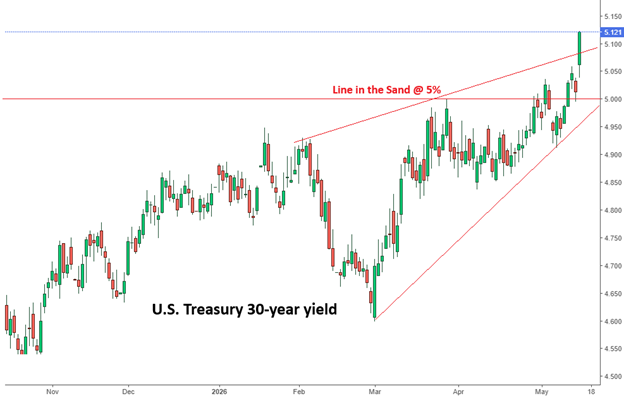
The difference in interest payments to holders of the 30-year bond between the March 2020 "Covid Crash" lows, just under 1%, and the current yield at 5.1202% on $40 trillion of debt is staggering. While not all government debt is constituted by the 30-year Treasury bond, if all of that debt were in long bonds, the annual interest cost in March 2020 would have been approximately US$396 billion, versus the U.S. Defense Budget in 2020 at $778 billion. Today, however, the annual interest expense would rise to US$2.048 trillion for a difference of US$1.652 trillion, which is about 60% higher than the estimated 2026 Defense Budget.
Passing this milestone does not necessarily infer a) an immediate fiscal crisis, b) imminent default, or c) a loss of reserve-currency status. However, there are negative repercussions related to a) long-term bond yields, b) inflationary expectations, c) currency sentiment, and d) politics related to "fiscal reform". Of course, the U.S. is a master class in "kicking the can down the road".
As long as the equity markets continue to rise, politicians are content to raise the debt ceiling each and every year into infinity.
Returning to the China-U.S. Summit, the significance of Premier Xi's reference to the Thucydides Trap is not so much that he openly admitted that he and Trump are adversaries, but more in the manner that the western media chose to ignore it.
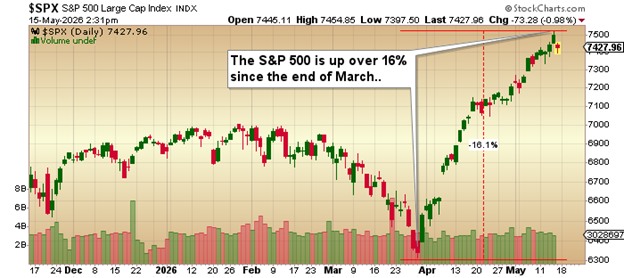
With the S&P 500 up over 16% in the past six weeks, the level of complacency is literally unprecedented, especially when the majority of stocks found in the S&P 500 index are trading below their 50-dma lines. Only 43.93% of stocks found in that index have been able to exceed their 50-dma lines, and what this infers is that the rally has been confined to a relatively small group of (primarily) technology issues, with specific attention being paid to the semiconductors, which are up over 69% since March 30th. In fact, the only other period in which the semiconductors did better was during the March 2000 "blow-off top" that led to the dot.com crash and meltdown.
No one cares about oil over $100, long rates over 5%, stocks with narrow leadership, or a Chinese premier alluding to the potential for armed conflict with the West. They have all been
trained to expect that the Fed and/or the Treasury will move to rescue stocks at every turn, regardless of cost, and they may in fact be right as long as their leader uses the "record stock prices" as a personal benchmark for the execution of office.
Metals
Metal prices had a decent week, with the standout being copper, that is, until Friday, when the combination of the strong USD and rising oil took gold down 2.78%, copper down 4.91%, but poor silver got hammered, closing down 10.15% on the day.
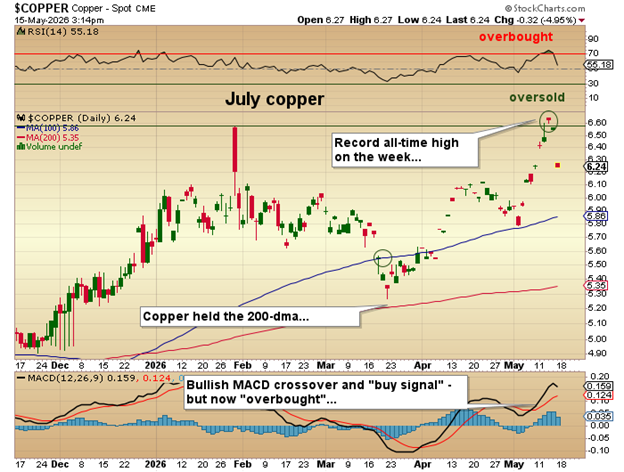
For the week, June gold was down 3.3%, July silver was down 4.82%, but July copper eked out a modest .62% gain after hitting an all-time high at $6.716/lb. on Wednesday. Copper remains the standout performer in the metals for the past few weeks due to severe supply constraints and a surge in speculative demand linked to artificial intelligence infrastructure. Thanks largely to the disruptions in the Strait of Hormuz, there has been a critical disruption in the supply of sulfuric acid, which is essential for copper production. Also weighing in is the Chinese export ban expected to last until next December. The problems at Freeport-McMoRan Inc.'s (FCX:NYSE) Grasberg Mine continue, while smelter squeezes have caused processing fees to plunge to record lows, forcing output reductions just as global demand is hitting its peak.
On the demand side, "AI" and data center buildouts, overall global electrification, and an export boom of copper-intensive clean-tech products from China are all contributing to boosting demand. You cannot rule out tariff "front-running" where traders have been hoarding copper to avoid the impact of future White House actions, and lastly, copper prices have "shrugged off" the Iran-US war uncertainty, with investors shifting capital into physical assets like copper as a hedge against geopolitical risk. That was until the Summit ended and the bond market decided to act up. And until the dollar started to spike.
And yields. And so on. And so forth…
The metals reacted exactly as free markets should react. Sellers came in and re-priced the outlook for industrial demand for copper and safe-haven demand for gold and silver all based upon a dismal outlook for global trade with Xi and Trump staring across the table at one another. Stocks finally got the memo and went out with a loss on the Friday session but because of these bizarro markets, for the week, the Dow was flat while the S%P 500 was up .12% and the NASDAQ was up 1.5-2.0%. The move to record highs in copper is a premonition of better days ahead for the red metal and all of the major producers and junior developers as well. As for stocks, well, stay very much alert because they can remain irrational far longer than we can remain solvent (thanks to Mr. Keynes).
Fitzroy Minerals
The only real news of significance for the week was a strikingly good intercept of copper mineralization by Fitzroy Minerals Inc. (FTZ:TSX.V; FTZFF:OTCQB)at their Buen Retiro project in Chile. The company reported that "Drill hole BRT-DDH059 returned 78.0 m @ 1.70% Cu from 58.0 m, including 40.0 m @ 3.02% Cu from 92.0 meters."
This sent the stock up 27% on Thursday. Despite Friday's pullback, it was up approximately 22% for the week, driven by strong copper drill results and continued advancement of its Chilean projects. For a junior explorer, that is an exceptionally strong weekly performance and indicates the market is assigning increasing value to the Buen Retiro discovery.
As I wrote in February, after the PDAC event in early March, the junior explorers and developers tend to move into minor funks with only event-driven moves triggering demand. The juniors tend to grab a bid in mid-late August in anticipation of the return of the mining speculators from summer holidays, including cottages, travel, and back-to-school expenses that tend to distract investors away from the juniors.
This is why I like to focus on the companies that include exploration drilling in their activities, because sticking with just the producers leaves you totally vulnerable to major market and commodity price volatility. It is clear from the chart posted below that selling in the late winter was the appropriate move, as we have seen a series of lower highs and lower lows since then. The TSXV needs to buck that trend and begin to take out the late-February and mid-April highs while staying above the March lows. The late-January high coincided with the blow-off top in the metals in late-January, so the juniors will undoubtedly need cooperation from metal prices before taking a run at the 1,177 level last touched on January 26.
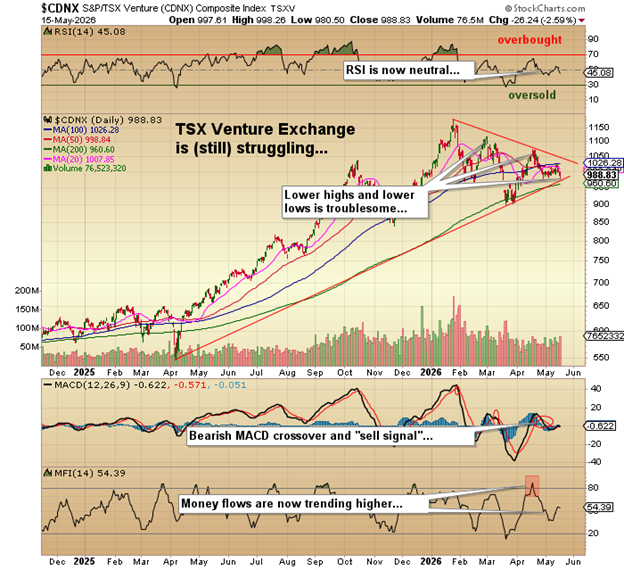
All in all, we are rapidly moving toward the arrival of summer, a period of time at least in North America where trading volumes (and liquidity) recede but if the basket of juniors one holds contains well-funded, active juniors able to generate value-adding events such as drill results, revised resource estimates, preliminary economic assessments, or full or pre-feasibility studies, then the doldrums of summer may not be a factor. All companies held in the GGMA portfolios are going to be "event-driven" all year long with full treasuries and active programs.
Whenever I am speaking to a CEO of a junior miner, I like to remind them of the words of the most successful mining entrepreneur of all time, Robert Friedland, who said: "Promoting a stock is like making a movie. You've got to have stars, props, and a good script".
Pretty simple stuff, but few use it…
| Want to be the first to know about interesting Silver, Gold and Copper investment ideas? Sign up to receive the FREE Streetwise Reports' newsletter. | Subscribe |
Important Disclosures:
- As of the date of this article, officers, contractors, shareholders, and/or employees of Streetwise Reports LLC (including members of their household) own securities of Fitzroy Minerals Inc.
- Michael Ballanger: I, or members of my immediate household or family, own securities of: Freeport-McMoRan and Fitzroy Minerals Inc. My company has a financial relationship with: None. My company has purchased stocks mentioned in this article for my management clients: None. I determined which companies would be included in this article based on my research and understanding of the sector.
- Statements and opinions expressed are the opinions of the author and not of Streetwise Reports, Street Smart, or their officers. The author is wholly responsible for the accuracy of the statements. Streetwise Reports was not paid by the author to publish or syndicate this article. Streetwise Reports requires contributing authors to disclose any shareholdings in, or economic relationships with, companies that they write about. Any disclosures from the author can be found below. Streetwise Reports relies upon the authors to accurately provide this information and Streetwise Reports has no means of verifying its accuracy.
- This article does not constitute investment advice and is not a solicitation for any investment. Streetwise Reports does not render general or specific investment advice and the information on Streetwise Reports should not be considered a recommendation to buy or sell any security. Each reader is encouraged to consult with his or her personal financial adviser and perform their own comprehensive investment research. By opening this page, each reader accepts and agrees to Streetwise Reports' terms of use and full legal disclaimer. Streetwise Reports does not endorse or recommend the business, products, services or securities of any company.
For additional disclosures, please click here.
Michael Ballanger Disclosures
This letter makes no guarantee or warranty on the accuracy or completeness of the data provided. Nothing contained herein is intended or shall be deemed to be investment advice, implied or otherwise. This letter represents my views and replicates trades that I am making but nothing more than that. Always consult your registered advisor to assist you with your investments. I accept no liability for any loss arising from the use of the data contained on this letter. Options and junior mining stocks contain a high level of risk that may result in the loss of part or all invested capital and therefore are suitable for experienced and professional investors and traders only. One should be familiar with the risks involved in junior mining and options trading and we recommend consulting a financial adviser if you feel you do not understand the risks involved.