

Overlooked for years, Egypt's mining sector is drawing strong interest from investors after it has undergone sweeping legal and organizational reforms, according to a report by Sherine Samir for Egypt Oil & Gas Group in July 2025.
"Investor appetite intensified since 2020 following changes to the 2014 mining law, which eliminated the requirement for companies to enter into 50–50 joint ventures with the government," Samir wrote. "Egypt also replaced its production-sharing model with a royalty and tax-based system — a shift long advocated by global mining players."
For the moment, one of the biggest public players is South African company AngloGold Ashanti Ltd. (AU:NYSE; ANG:JSE; AGG:ASX; AGD:LSE), which successfully completed its acquisition of Centamin in late 2024, incorporating the Sukari mine into its portfolio, which has since achieved record gold production and is now classified as a Tier 1 asset, significantly contributing to the group's overall production, according to a Simply Wall St. piece published by Yahoo! Finance on March 18.
The company has also completed its corporate migration to London and transitioned its primary listing to the NYSE.
These strategic changes, including the integration of Centamin and the high output from Sukari, have notably repositioned AngloGold Ashanti within the global gold mining sector, the article said.
Current evaluations from Simply Wall St. suggested that the company's shares are trading about 24% below analyst expectations, with a consensus target of US$126.43, and are flagged as trading 22.2% below the estimated fair value. However, a recent 30-day return shows a decline of approximately 12.4%, contrasting with longer-term gains, indicating potential concerns about recent momentum.
In 2025, the company reported a 16% increase in gold production year-over-year, significantly bolstered by the full-year contribution from Sukari, reported Sreeja Deb for Zacks in an article published by Yahoo! Finance on March 17.
The Sukari mine itself produced a record 500,000 ounces of gold, marking a 4% increase from the previous year despite facing challenges with lower head grades in the fourth quarter, Deb said. This production boost was primarily due to enhanced ore throughput and improved equipment availability and utilization.
Financially, the Sukari mine generated an adjusted EBITDA of US$1.3 billion in 2025, with total cash costs at US$783 per ounce and all-in sustaining costs at US$1,094 per ounce. The mine also reported a free cash flow of US$475 million and a record cash flow of US$2.9 billion for the year.
As of December 31, 2025, the gold mineral reserves at the Sukari mine stood at 2.36 Moz, with measured and indicated mineral resources at 1.86 Moz and inferred mineral resources at 0.58 Moz, the Zacks piece noted.
According to a March 27 updated research flash email by Joe Reagor for Roth Capital Markets, the company announced the results of a preliminary feasibility study (PFS) for its Arthur project in Nevada, which demonstrated strong economic potential, the analyst noted. The PFS revealed an NPV of US$3.4 billion at a gold price of US$3,500 per ounce and projected an average annual production of 500,000 ounces of gold over an initial nine-year mine life. Based on these results, the valuation of the project was increased from US$750 million to US$1.36 billion, representing 40% of the PFS NPV.
 Streetwise Ownership Overview*
AngloGold Ashanti Ltd. (AU:NYSE; ANG:JSE; AGG:ASX; AGD:LSE)
Despite the positive outcomes from the PFS, the recent decline in gold prices led to a revision of the price target for AngloGold Ashanti from US$122 to US$103, aligning with a more conservative long-term gold price forecast of US$3,600 per ounce. This adjustment reflects a shift from evaluating based on current high gold prices to a reliance on forecasted prices. However, the firm maintained its Buy rating, citing the company's potential for strong cash flow and return of capital through dividends, even if gold were to stabilize at the forecasted price level.
Chief Executive Officer Alberto Calderon highlighted the strategic importance of the Arthur Gold Project in a release on March 26, noting its role in establishing a world-class, long-life production platform in the U.S.
"With average annual production of approximately 500,000 ounces in its initial phase, with some years projected to be well in excess of that, the project delivers immediate scale in a premier mining jurisdiction," Calderon said. "This is just the beginning. With a world-class orebody and a disciplined capital approach, we have a clear roadmap to growth and long-term shareholder value."
According to StockAnalysis.com on April 7, among five reported analysts, the average rating for AU stock was "Buy." The average 12-month stock price target was US$102.2, which was an increase of 2.61% from the time of writing.
1Less than 1% of the company is owned by strategic entities like insiders, management, and holding companies. About 82% is held by institutions. The rest is retail.
Top shareholders include Public Investment Corp. Ltd. with 15.67%, The Vanguard Group Inc. with 4.54%, Van Eck Associates Corp. with 3.72%, MandG Investment Managers (Pty) Ltd. with 3.26%, and Ninety One SA Pty Ltd. with 3.16%.
Its market cap is US$51.25 billion with 505 million shares outstanding. It trades in a 52-week range of US$31.91 and US$129.14.
A New Key Player in the Belt
Private company Red Sea Resources, which is actively exploring the untapped potential of Egypt's last unexplored greenstone belt, is positioning itself as a key player in the region with exclusive exploration licenses, according to its investor presentation and website.
Despite Egypt's long history of surface gold prospecting and artisanal mining dating back to Roman times, modern exploration has been minimal due to previous governmental restrictions, leaving many surface anomalies untested. However, recent deregulations in neighboring countries within the Arabian Nubian Shield have led to significant gold discoveries, suggesting similar potential in Egypt, the Vancouver-based company said.
In 2021, Red Sea Resources secured three prime properties totaling 753 km² in an international bid that included major mining companies like Barrick, B2Gold, and Centamin. These properties are located within the Arabian-Nubian Shield, known for its rich mineral deposits. The company's strategic acquisitions were driven by over two years of detailed reconnaissance and are believed to be well-positioned for significant discoveries, given the geological similarities to other prolific greenstone belts, Red Sea said.
One of the standout properties is the Luxor Project, situated just west of the Sukari Gold Mine, which is Egypt's first commercial gold mine, on the same geological structure. This proximity and similar geological setting suggest that Luxor could mirror Sukari's success, where AngloGold Ashanti's mining operation has become a hallmark of the region. The Oasis and Rah Projects also show promising high-grade mineralization at the surface, ready for further exploration and drilling.
The Oasis Project, near Shalateen in the South-Eastern Desert, spans 185 km² and features significant geological structures conducive to gold deposits. The Rah Project, located west of Hurghada, covers 244 km² and has already yielded high-grade gold, silver, copper, zinc, and lead from preliminary samples. Both areas are set for detailed exploration plans, including mapping, sampling, and drilling, to further delineate and prioritize targets.
Pasofino Gold Ltd. (VEIN:TSX.V; EFRGF:OTCQB; N07:FSE) President, Chief Executive Officer, and Director Brett Richards, who is a shareholder, told Streetwise Reports that "there are only a handful of good quality projects, run by good dedicated people, out there in under-explored jurisdictions."
"Red Sea Resources is just that company, as a private (with a go-public plan for 2026) explorer in Egypt with activities underway on the three license areas." Richards said. "The assets are well located, both geologically and strategically, including around AngloGold's Sukari gold mine, and they have a management team with proven multiple successes in Africa. We love the project for many compelling reasons and will continue to build our position through the IPO and through the market when it is free trading."
Positive Shifts in Egyptian Mining Landscape
In a recent video presentation from March, the company discussed several key developments and plans for Red Sea Resources. Vice President of Business Development and Communications, Adrian O'Brien, focused on the recent positive shifts in Egypt's mining landscape, including the appointment of a new mining minister and the restructuring of mining laws to encourage foreign investment, which now mandates a flat 15% Egyptian ownership across all mining companies.
O'Brien detailed the company's proactive steps in addressing the challenges at their Luxor property, particularly the issue of illegal mining. He noted the government's initiative to fund a task force to clear these illegal operations, which paves the way for more efficient exploration activities. "This is super exciting," he said, indicating the potential for smoother operations moving forward.
O'Brien said the company has raised significant funding to advance exploration on its key targets: Oasis, Raw, and Luxor. He shared their aggressive exploration strategy, which includes planning for an Initial Public Offering (IPO) in 2026.
He said Red Sea Resources is currently conducting a financing round, which is expected to be the last one before the IPO, priced at 40 cents per unit, with each unit including a half warrant exercisable at CA$1.
O'Brien emphasized the strategic importance of their projects within the Arabian-Nubian Shield, noting the historical under-exploration of the area and the significant potential for discovering large-scale gold deposits similar to the nearby Sukari Gold Mine.
A Young Greenstone Belt
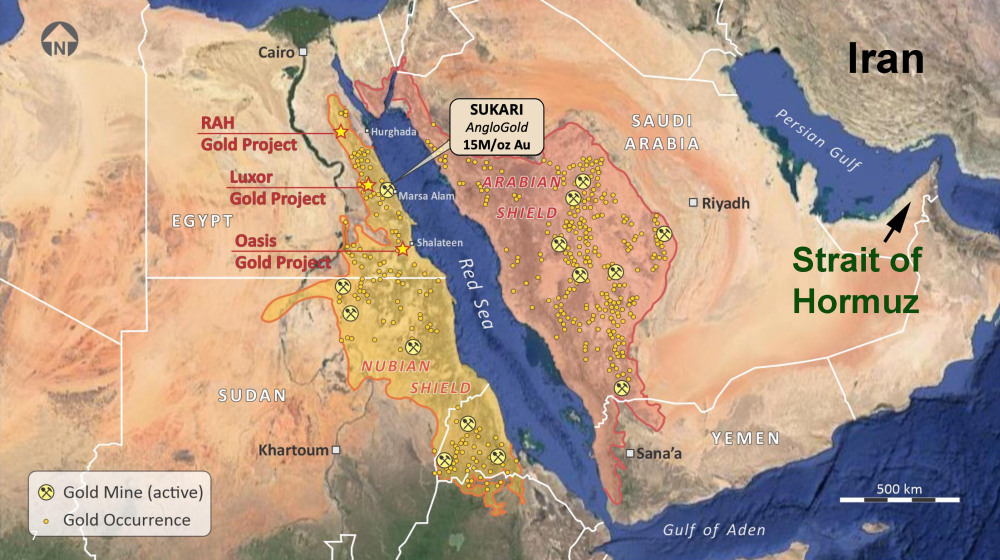
The Arabian-Nubian Shield (ANS) is a region of Precambrian crystalline rocks, primarily Neoproterozoic in age, located along the flanks of the Red Sea and known as one of the world's youngest Greenstone Belts. This geological area spans multiple countries, including parts of Israel, Jordan, Egypt, Saudi Arabia, Sudan, Eritrea, Ethiopia, Yemen, and Somalia. The northern sections of the ANS are visible within the Sahara and Arabian Deserts, while the southern parts are found in the Ethiopian Highlands, the Asir province of Arabia, and the Yemen Highlands.
Historically, the ANS is notable for being one of the earliest sites of geological exploration by humans, particularly by the ancient Egyptians who mined gold from the region's rocks, especially in Egypt and northeastern Sudan. Gold, known for its ease of working and resistance to tarnishing, was the primary metal extracted. The oldest preserved geological map, the Turin papyrus from 1150 BCE, details the locations of gold deposits in Eastern Egypt. Additionally, the region has seen new gold discoveries in modern times in Sudan, Eritrea, and Saudi Arabia.
"The Arabian-Nubian Shield is poised to become the next big mining destination, involving the economies of Egypt, Ethiopia, Saudi Arabia, and Sudan and holding copious deposits of materials deemed 'strategically significant' across the globe," according to a report by global professional services firm Marsh in 2023. "At almost 3 million square kilometers, the Arabian-Nubian Shield constitutes one of the world's largest Precambrian rock formations. It stretches across nine countries from the eastern Nile basin to the Saudi highlands, including the whole maritime area leading to the Suez Canal."
Greenstone belts, named for their characteristic green color, are significant geological formations known for containing valuable mineral deposits such as silver, copper, and zinc, but they are particularly renowned for their abundant gold reserves. These belts, most commonly of Archean age, often host some of the world's largest and most productive gold mines.
Exploration Updates
Recent exploration updates from Red Sea's three major projects have yielded significant findings. In September 2025, preliminary diamond drilling was completed at the Oasis project at the King targets (Ramses and Tut), revealing high-grade gold mineralization across a 1.4-kilometer strike length, the company reported in its investor presentation. Notable intercepts included 1.5 meters at 29 grams per tonne (g/t) gold, which included a segment of 0.5 meters at 86.3 g/t gold. Another significant result from hole OAS25-009 in the intrusive unit showed gold over a 51-meter length, including 3.6 meters at 3.1 g/t and 7.6 meters at 1.7 g/t. Additionally, new discoveries at the Khufu and Seti targets have produced grab samples with gold up to 176.5 g/t.
At the RAH Project, the first drill campaign was completed in January and involved 1,788 meters drilled over 16 holes, testing mineralization along a 900-meter strike length and 500 meters of dip. Early highlights include 3.1 meters at 5.57 g/t gold and 4.6 g/t silver, including a segment of 0.7 meters at 24.5 g/t gold and 74.0 g/t silver. Results are still being finalized, with a Phase II drill program planned for 2026. The project's geochemical footprint is expanding, with new anomalies in the north and south showing elevated levels of precious and base metals.
The WAM Target at the Luxor Project shares geological similarities with the nearby 15-Moz (million-ounce) Sukari deposit, including the same host rock, structural characteristics, vein origins, alteration patterns, and metal associations. The mineralized footprint at WAM spans 3.5 kilometers by 2 kilometers. Channel sampling at this site has highlighted significant gold concentrations, including 1 meter at 215.1 g/t and 10 meters at 2.3 g/t.
The company said drilling activities have recommenced across all three properties in February 2026 as part of an ongoing exploration program aimed at further delineating and understanding the potential of these significant mineral deposits.
Upcoming catalysts for the ongoing exploration projects include anticipation of continued drill results from the 2026 drilling programs at Oasis and RAH, with results still pending from the January 2026 RAH campaign, and the planned IPO after the exploration program. There is also the potential for resource estimation work as more drilling data becomes available.
"We're doing this financing to ensure that all the pieces are in place," O'Brien said during the video presentation. "The day that Luxor gets cleared, we pull the pin and we go."
Gold Down, But Not Out
Gold prices saw an 8.3% increase in the first quarter of 2026, despite a significant drop of 11.5% in March, closing the month at US$4,672, according to Dan McEvoy writing for Money Weekly on April 2.
This decline was largely due to investors selling off gold for liquidity amidst the outbreak of conflict in Iran, despite gold's reputation as a safe haven during crises. The price of gold had reached an all-time high of US$5,600 on January 29, 2026, following a strong performance in 2025, which was the best year for gold since 1979. According to Jason Hollands, managing director at Bestinvest, even traditionally stable markets like gold felt the impact of the last month's negative trends. Dan Coatsworth, head of markets at AJ Bell, noted that gold's liquidity makes it a common sell-off asset in troubled times.
The recent conflict has unexpectedly strengthened the dollar due to the U.S.'s status as a net oil exporter, which contrasts with gold's typical benefit from a weaker dollar, McEvoy noted. This situation is compounded by hawkish central bank policies; both the Bank of England and the Federal Reserve held interest rates steady recently, with the Fed anticipating only one rate cut this year. Susannah Streeter, chief investment strategist at Wealth Club, explained that rising yields on government bonds make gold less appealing since it does not offer interest.
Despite the recent underwhelming performance of gold since the onset of the Iran conflict, analysts at UBS still project a significant rise in its value, predicting it could reach as high as US$6,200 per ounce by the end of 2026, according to Ernest Hoffman of Kitco News on March 16. In a recent analysis, UBS experts pointed out that gold has struggled to surpass the US$5,200 mark since the conflict began, a stark contrast to its 65% surge last year amid similar geopolitical tensions and economic factors like lower real interest rates and growing debt concerns.
The analysts observed that gold's recent behavior aligns with historical patterns observed during major conflicts, where initial spikes in value are often followed by declines as investors shift towards liquidity and other assets like energy, Hoffman noted. They cited examples from past conflicts, noting significant initial increases during the Russia-Ukraine conflict in 2022 and the Gulf and Iraq Wars, followed by notable declines as each situation stabilized and interest rates rose.
UBS remains optimistic about gold's prospects, maintaining its forecast for a 20% increase in its price in 2026. The firm argues that gold serves as a broader hedge against the indirect effects of conflicts, such as monetary risks including currency devaluation, rising deficits, and economic slowdowns, rather than direct impacts from wartime events, Hoffman said.
While acknowledging the current challenges posed by higher energy prices and inflation concerns, which have strengthened the U.S. dollar and fueled fears of interest rate hikes — both negative for gold prices — the analysts believe that central banks will carefully manage inflation risks without resorting to abrupt rate increases. This careful management, they suggest, will support a bullish outlook for gold in the near future.
Egypt's Mining Sector
Egypt's mining sector is increasingly seen as a pivotal element in the country's economic diversification efforts, showcasing a sophisticated approach that integrates environmental standards, technological advancements, and international partnerships, reported Muflih Hidayat for Discovery Alert on April 7.
"The convergence of environmental regulations, technological advancement, and supply chain diversification has created conditions favoring nations that can adapt their mining frameworks to international competitiveness standards," Hidayat wrote. "This systemic shift toward value-added production and downstream processing represents more than regulatory reform; it signals fundamental changes in how emerging economies position themselves within global resource networks."
The nation's Strategic Mining Sector Development Framework reflects this advanced economic planning, focusing on enhancing the entire value chain while staying competitive on the international stage, the article said. This approach is in line with regional trends towards more sophisticated resource sectors that maximize local content. Recent policy initiatives have been particularly focused on aligning with global sustainability standards, such as the Carbon Border Adjustment Mechanism (CBAM), to ensure competitiveness in European and global markets.
At the Prospectors and Developers Association of Canada Convention (PDAC) held in Toronto from March 1–4, representatives from international companies investing in Egypt's mining sector engaged in discussions with a delegation from Egypt's Ministry of Petroleum and Mineral Resources, according to a report by Doaa Ashraf for Egypt Oil & Gas Group on March 9. Red Sea Resources President and Director of Exploration Darin Labrenz presented on the company's exploration activities.
Titled "Spotlight on Egypt," the session was organized in collaboration with MineAfrica and the Canada-Africa Chamber of Business, emphasizing Egypt's geological potential, especially in the Arabian-Nubian Shield.
Yasser Ramadan, Chairman of the Mineral Resources and Mining Industries Authority (MRMIA), highlighted Egypt's mining investment advantages, including its diverse mineral resources, modernized legislation, strategic location, and digital transformation initiatives aimed at streamlining procedures and enhancing the business environment. Patrick Barnes from Wood Mackenzie discussed Egypt's significant, yet untapped, potential in gold and critical minerals, noting that recent reforms are attracting international interest.
During the session, representatives from major mining companies shared their experiences and insights. Stewart Bailey from AngloGold Ashanti talked about the positive investment climate in Egypt and the importance of sustainability in mining operations.
Labrenz noted that areas within the Arabian-Nubian Shield remain largely underexplored, offering promising opportunities for discoveries, the article said.
| Want to be the first to know about interesting Gold investment ideas? Sign up to receive the FREE Streetwise Reports' newsletter. | Subscribe |
Important Disclosures:
- As of the date of this article, officers, contractors, shareholders, and/or employees of Streetwise Reports LLC (including members of their household) own securities of Red Sea Resources and Pasofino Gold Ltd..
- Steve Sobek wrote this article for Streetwise Reports LLC and provides services to Streetwise Reports as an employee.
- This article does not constitute investment advice and is not a solicitation for any investment. Streetwise Reports does not render general or specific investment advice and the information on Streetwise Reports should not be considered a recommendation to buy or sell any security. Each reader is encouraged to consult with his or her personal financial adviser and perform their own comprehensive investment research. By opening this page, each reader accepts and agrees to Streetwise Reports' terms of use and full legal disclaimer. Streetwise Reports does not endorse or recommend the business, products, services or securities of any company.
For additional disclosures, please click here.
1. Ownership and Share Structure Information
The information listed above was updated on the date this article was published and was compiled from information from the company and various other data providers.