

Undoubtedly, anyone over the age of 60 has had the opportunity to witness some truly remarkable sporting events, and within those events, some truly remarkable athletes. There have been memorable playoff series, like the World Series, and also memorable championship contests, like the Super Bowl or the World Cup Final. For Canadians, everything revolved around hockey and the Stanley Cup until golfer Mike Weir won the 2003 Masters Golf Tournament 2003. I asked the artificial intelligence wizard on Google Chrome to list the Top Ten Athletes of All-Time, and here is what I got:
- Michael Jordan (Basketball) Often cited as the greatest basketball player ever and the top athlete of the 20th century by ESPN, known for his unprecedented success with the Chicago Bulls, global icon status, and fierce competitiveness.
- Muhammad Ali (Boxing) Regarded by many as the greatest sportsperson of all time, known not only for his heavyweight boxing championships and iconic fights but also for his significant cultural and social impact outside the ring.
- Babe Ruth (Baseball) A transformative figure who changed baseball from a game of singles to a power-hitting spectacle, he was decades ahead of his time in hitting home runs and remains the consensus greatest baseball player ever.
- Pelé (Soccer) A three-time World Cup winner, he is the most important player in the history of soccer and a global icon who helped popularize the sport worldwide and set the benchmark for future generations.
- Wayne Gretzky (Ice Hockey) Held an astonishing 61 NHL records, including career goals, assists, and points, earning the nickname "The Great One" for his offensive dominance and fundamental change to how the game was played.
- Michael Phelps (Swimming) The most decorated Olympian of all time, with a record 28 Olympic medals, including 23 gold. His dominance in the pool over several Olympic cycles is unparalleled in his sport.
- Serena Williams (Tennis) Widely considered the greatest female tennis player ever, she won 23 major singles titles and dominated the sport for two decades, transcending the game with her power and athleticism.
- LeBron James (Basketball) The NBA's all-time leading scorer, he is recognized for his extraordinary sustained excellence, versatility, and success across multiple teams, still competing at an elite level well into his late 30s.
- Usain Bolt (Track and Field) The "fastest man in the world," he is the only sprinter to win Olympic 100m and 200m titles at three consecutive Olympics and holds world records that still stand.
- Tom Brady (American Football) Considered the greatest NFL player of all time, he has won more Super Bowls (seven) than any single NFL franchise, known for his longevity, leadership, and performance under pressure.
(Other athletes frequently mentioned in these discussions include Lionel Messi, Roger Federer, Tiger Woods, and Simone Biles.)
Personally, I would have put Muhammad Ali ahead of Michael Jordan, but that is my own personal bias surfacing, because as young boys, my older brother Donnie and I followed his career from the time he won Olympic gold under the moniker of Cassius Clay in 1960. I worshipped Ali over the many hurdles he overcame and how he absolutely dominated the heavyweight division in the late 1960s and 1970s until the U.S. government decided to strip him of his title and of a number of his prime fighting years, after which he returned to the ring and regained the champion's crown two more times. In all the years that I competed against bigger, stronger, and faster opponents, I grew to fiercely admire those great athletes whose claims to fame were an accomplishment, a record-breaking game, race, or event that separates them from the run-of-the-mill excellence that typifies performance. I played on the famous "riots in Quebec City" St. Catharines Blackhawks alongside Hall-of Famer Marcel Dionne in my rookie year in the OHL Junior "A" in 1970-71 and in doing so, sat in awe of the best hockey player I ever had the pleasure of watching play. Sure, I watched all the great players, but from the stands, but never from the vantage point of being on the ice with one. Big difference. The astounding thing about Marcel was that he was only 5 8" tall, but he weighed in at 190 lbs. and could hit a golf ball 300 yards in his sleep. Powerful man.
Whether it was Babe Ruth pointing to the bleachers and then knocking a ball into them or the Yankees' Reggie Jackson's three homers in Game Six of the 1977 World Series or Rocket Richard's five-goal game back in 1944 against the Toronto Maple Leafs, there is only one event that stands out. It is the one competitive event that resonates in my septuagenarian memory banks and which I suspect will never be replaced. And it isn't even a human that owns the rank as "the greatest".
Standing one full notch ahead of Muhammad Ali is the greatest horse to ever win a Triple Crown event (1st place finishes in the Kentucky Derby, the Preakness, and the Belmont Stakes) by way of his 1973 victory in the Belmont Stakes.
That horse was, of course, Secretariat.
Foaled at The Meadow in Virginia, Secretariat, nicknamed "Big Red," was owned by Penny Chenery of Meadow Stable, trained by Lucien Laurin, and primarily ridden by Nova Scotian jockey Ron Turcotte. Over a career that lasted two seasons, Secretariat raced for 16 months, competing in 21 races with a record of 16 first-place finishes, three second-place, and one third-place finish. He was named Horse of the Year as both a two-year-old and a three-year-old. Amazingly, in 1973, Secretariat won the Kentucky Derby, the Preakness Stakes, and the Belmont Stakes, setting a record time in all three races. I was seated in a pub at Woodbine Racetrack in northwest Toronto on June 9th, 1973, ready for the running of the Belmont with a number of high school mates, never for a moment expecting to witness what remains for me the greatest athletic feat in world history.
"Big Red" had a rivalry with another thoroughbred called "Sham," a dark bay-coloured "stalker" that preferred to run just behind the leaders until late in the race when he would sneak ahead in one final burst of speed. Over his career, Sham broke a number of track records and amassed an impressive win-place-show record. By post time, although Secretariat was favoured, many of the pundits questioned whether the added track length would be an issue. Out of the starting gate, both Secretariat and Sham traded leads until around the three-quarter mile point when Big Red decided to throw on the afterburners.
What happened in the seconds that passed after that was something that I shall never forget. By the end of the race, he won by an astonishing 31 lengths and set a world record for a 1.5-mile dirt track of 2:24, a record that still stands today.
"Still stands today" — 52 years later.
Now, a sidebar to the story that day was that I was losing my shirt all afternoon at Woodbine as the winners were all odds-on favourites, where the payout was meagre, and the winnings were feeble. I slipped into the "off-track" betting parlour and threw my last five bucks down on an exactor where "I wheeled "Big Red" against the field. Now, that is where you bet one horse to win and add other horses to place (come in second), but you cover all the place positions with the field. Since Twice a Prince placed and was a long shot (17-1), the Secretariat-Twice a Prince exactor paid out $110.50 on a $5.00 bet, allowing me to buy a round (or five) of drinks for "the boys," making the 1973 Belmont one of my most beloved memories.
2025 Performance
When I look at the year 2025 and think of the performance of the U.S. stock markets, I think of the 1973 Belmont Stakes. With particular attention to the S&P 500, the novelty of a culture-changing advance in technology called "artificial intelligence" has captured the fancies and the pocketbooks of an entirely new generation of investor — younger, more aggressive, and immune to the governorship caused by risk — to the point where records have been falling since April 7's "Liberation Day" explosion.
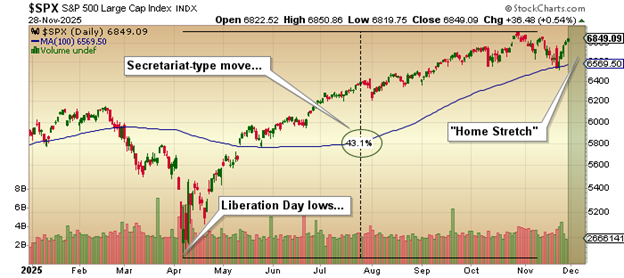
From the start of 2025 until Liberation Day, the bull was Secretariat and the bear was Sham as they battled each other for the lead but once Trump scrapped the Department of Government Efficiency and decided to delay all tariffs, Wall Street threw on its afterburners and soared ahead of the rest of the field, leaving Sham to finish out-of-the-money and dead last and that will most certainly be the story for the 2025 performance summary if December goes out as robustly as did November.
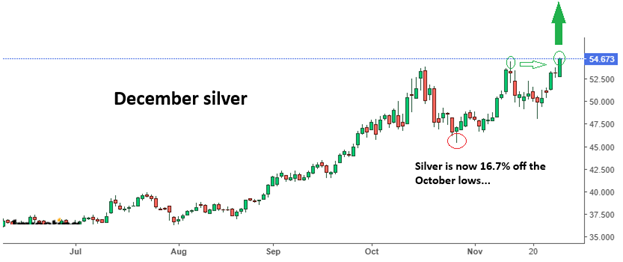
If there was one asset that exhibited Secretariat-style performance for the month of November, it was a blistering thoroughbred called "December silver." Just as Secretariat broke records in all three legs of the Triple Crown event, silver exploded out of the gate and traded well up and through the old high of $54.415, closing up 6.55% for the session and at the highest monthly close ever.
The Hunt Brothers from Texas must be looking down from that drill rig in the sky, smiling broadly with middle fingers on both hands extended forcefully in the immediate direction of the bullion bank behemoths, the regulators, and the coneheads at the CME that govern margin rates. They are most certainly rejoicing because if you are a commercial hedger, you had better have enough inventory (silver ounces) to deposit at the Crimex vaults lest you hear the haunting lilt "he who sells what isn't his'n, must deliver or go to prison!"
My inbox was absolutely inundated with finger-wagging, "tsk-tsk"-type "I-told-you-so" lecturing verging on jeering because of my decision to call the top of the gold market during the week of October 13-20 with my actual "SELL" decision on Friday the 17, when gold executed a picture-perfect "outside key reversal day," one of the most powerful technical patterns that exists.
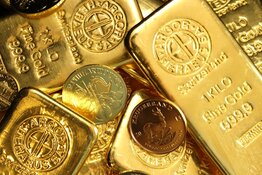
At the risk of sounding "catty," it should be known that the only precious metal asset to hit higher levels than those seen on October 17 is silver. At the risk of sounding even more "catty," I own large positions in two junior silver explorer-developers as well as my beloved physical bars that live in my basement right next to my wine collection and immediately to the left of my Remington double-pump.
My hedges were mostly gold and the junior gold miner ETF's with a sidebar position in the SLVD:US, where I am offside by a little under 20% despite a 17% advance in silver of the October lows. My larger position in the ProShares UltraShort Gold 2X's Shares (ARCA) ETF (GLL:US) is still onside, but that is only because I bought it as gold was peaking at $4,400 in what a lesser man might describe as a "stroke of genius" but which I will only describe as a "stroke of BS luck."
I decided to take a "wait-and-see" approach to the precious metals after listening to a barrage of silver bugs all taking victory laps and thumbing their noses at the crypto-junkies because of the gaping disparity between Bitcoin and December silver. If I were a trader on the floor of the old Vancouver Stock Exchange, I would "swear" that someone is executing a "ghost switch" – laying off Crypto to buy Silver — and doing a terrible job of disguising it. I have little doubt that one or some of the crypto "whales" have dumped massive positions in Bitcoin, leaving the true believers wondering whether they will be seen as vindicated visionaries or babbling bagholders by year's end. As a person who has held his silver for over twenty years and has a book value of $8.00 per ounce, I will be the first person to tell the silver and gold gang that, since its inception in and around January of 2009, Bitcoin has crushed gold and silver. There is not even a sliver of a case for silver or gold versus Bitcoin in that time frame. I own zero crypto only because, at my age, remembering where I left the car keys is tough enough, let alone trying to understand what a "blockchain" is. In fact, the first time I heard the phrase "blockchain," all I could think about was a way to lift an engine out of a car.
I think that the reason crypto spars with silver is that they both tend to be dominated by a younger breed of predominantly male investors, and having gone through that phase of life as a younger man, I recall only too well the impact that elevated testosterone levels have on male behaviour. There is nothing more hilarious than observing the combative idiosyncrasies of younger male investors, where every tick in a stock becomes a schoolyard challenge at recess.
The chatrooms light up and the messages are ALL IN CAPS with !!!!!!! punctuating every post while the entire exercise is to get the last word (post) in before you shut off the computer. Bitcoin is simply a barometer for overall market risk, while silver is a barometer for overall precious metals sentiment, neither of which tends to endear you to the opposite sex. I need to see silver outperforming gold and the precious metals miners for this to be a new upleg in the entire complex. As for Bitcoin, I see it as being in one of the typical corrections that are largely exacerbated by way of its relatively short history. The kiddies like to bet on it and tend to ride it when it is hot, no different than "wheeling Big Red" 52 years ago, when testosterone governed my every thought. However, that was then, and this is now.
Fitzroy Minerals
I have had a great many queries on Fitzroy Minerals Inc. (FTZ:TSX.V; FTZFF:OTCQB), arguably my largest holding and top pick for 2025 and beyond, just as copper ranks higher than both silver and gold for fiscal 2025 and beyond. I have yet to observe any "hard asset" with the fundamentals so rigidly in place for the red metal and as much as I have been a staunch believer in the ultimate repricing of gold as a means of collateralizing the gargantuan debt monster lurking below the surface of wave after wave of "American Exceptionalism," gold does not have the universal demand elasticity as does copper.
Silver, as much as I love the way it looks and feels, there is no shortage of silver, despite what the silver bugs would suggest. There might be a shortage of silver in the $45-65 range, but silver at north of $75 will cause a forced mobilization of the hundreds of millions of ounces currently under "care and maintenance" at the dozens upon dozens of base metal mines around the globe.
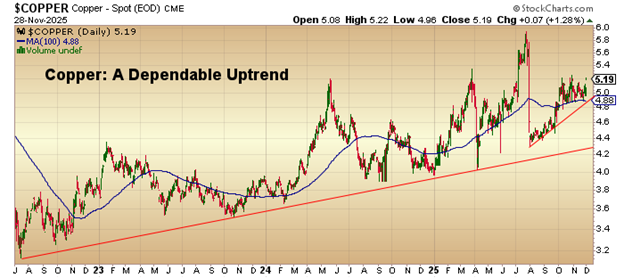
Copper is going to be in huge demand, and that will occur with or without the Fed's 2% inflation target and without the Fed's "maximum full employment" target. The chart shown above is not the type of chart that triggers chatroom battles or water-cooler debates; it is the type of chart that finds people like David Tepper or Warren Buffett discussing over brandies or Coke Classic. It is an extremely boring chart for the young and reckless, but a very exciting chart for the old and wise. You have all read my words about charts that have trendlines moving up at 45° angles in what I call "gradual" inclines, and what happens to my price expectations when the rate of incline moves from 45° to 90°, moving in effect to "vertical." Copper is in the "gradual" phase, and while the shares are slowly starting to gain favour amongst the bigger players, it is soon to move to a steeper rate of incline as dwindling supply and burgeoning demand come to bear on price.
Influencers on "X," and "Instagram," and "Facebook" constantly refer to the "severe silver shortage" and throw up targets of $200, $300, $500 per ounce while failing to address the notion that at those prices, silver better have found a new application in transmitting electricity, oil, or natural gas. Otherwise, every silver serving tray, candlestick, spoon, and fork will be up on eBay or Kijiji looking for a bid — any bid — in order to monetize the stuff grandad kept hidden in his closet. Such is not the case for copper. I am overweight, that boring red metal that will never be classified as a "cult asset" like Bitcoin or gold and silver. I like it because it is used everywhere on the planet and required on every continent by every race, creed, and colour that aspires for a clean method of heating their home and cooking their food and removing waste through pipes, wires, and cathodes.
As followers of this publication know all too well, I am normally early in deals that I choose, and usually to a fault. I was buying Aftermath Silver Ltd. (AAG:TSX.V; AAGFF:OTCQX; FLM1:FRA) in 2019 through a purchase of the private placement units at $0.085 long before anyone was aware of the Peruvian Berenguela Project and subsequent move to $1.70 by January 2021. I was buying Getchell Gold Corp. (GTCH:CSE; GGLDF:OTCQB) in the $0.10 level in 2020 after the Covid Crash took everything down to "shell pricing levels". I was buying Fitzroy Minerals Inc. (then Norseman Silver) at $0.035 in late 2023 before a new management team was installed. I am always "early" because I hate being "late" and it is far worse to be "late" than "early."
The upcoming copper cycle will make the gold and silver cycles look like corn and soybeans because it will be driven by total global demand by people in need, not of currency protection but of air conditioning, plumbing, and cell phones. These are the people of the largely agrarian Third World who are moving from bicycles to scooters to Mercedes, which will demand a geometric increase in the use of copper. India, Indonesia, and China will need billions of pounds of copper wiring in order to meet the living standards of the West. Therein lies my fascination and obsession with copper.
Owning copper is your 1973 Belmont Stakes moment; bet big on "Big Red."
| Want to be the first to know about interesting Silver, Gold and Copper investment ideas? Sign up to receive the FREE Streetwise Reports' newsletter. | Subscribe |
Important Disclosures:
- As of the date of this article, officers, contractors, shareholders, and/or employees of Streetwise Reports LLC (including members of their household) own securities of Fitzroy Minerals and Getchell Gold.
- Michael Ballanger: I, or members of my immediate household or family, own securities of: All. My company has a financial relationship with: None. My company has purchased stocks mentioned in this article for my management clients: None. I determined which companies would be included in this article based on my research and understanding of the sector.
- Statements and opinions expressed are the opinions of the author and not of Streetwise Reports, Street Smart, or their officers. The author is wholly responsible for the accuracy of the statements. Streetwise Reports was not paid by the author to publish or syndicate this article. Streetwise Reports requires contributing authors to disclose any shareholdings in, or economic relationships with, companies that they write about. Any disclosures from the author can be found below. Streetwise Reports relies upon the authors to accurately provide this information and Streetwise Reports has no means of verifying its accuracy.
- This article does not constitute investment advice and is not a solicitation for any investment. Streetwise Reports does not render general or specific investment advice and the information on Streetwise Reports should not be considered a recommendation to buy or sell any security. Each reader is encouraged to consult with his or her personal financial adviser and perform their own comprehensive investment research. By opening this page, each reader accepts and agrees to Streetwise Reports' terms of use and full legal disclaimer. Streetwise Reports does not endorse or recommend the business, products, services or securities of any company.
For additional disclosures, please click here.
Michael Ballanger Disclosures
This letter makes no guarantee or warranty on the accuracy or completeness of the data provided. Nothing contained herein is intended or shall be deemed to be investment advice, implied or otherwise. This letter represents my views and replicates trades that I am making but nothing more than that. Always consult your registered advisor to assist you with your investments. I accept no liability for any loss arising from the use of the data contained on this letter. Options and junior mining stocks contain a high level of risk that may result in the loss of part or all invested capital and therefore are suitable for experienced and professional investors and traders only. One should be familiar with the risks involved in junior mining and options trading and we recommend consulting a financial adviser if you feel you do not understand the risks involved.