

As economists focus on keeping the GDP number positive to maintain the statistical recovery myth, another crisis is brewing in the world of crucial resources. And competition is most evident in the production of REEs.
About 124,000 metric tons (mt) of REEs were produced in 2009, with worldwide demand during this period estimated at 134,000mt—the difference made up from existing stockpiles. By 2012, global demand is expected to reach 180,000mt; and mining operations can't meet demand in the near term.
The Congressional Research Service explored the situation in a late-July report.
Unfortunately, there isn't much actual competition because China produces 97% of REEs worldwide, which puts the U.S. in a precarious position.
Critical to the discussion is the fact that 97% of REE production is currently controlled by China, where internal demand is rising and interest in exporting REEs is falling as China's leaders look to take advantage of their country's market dominance.
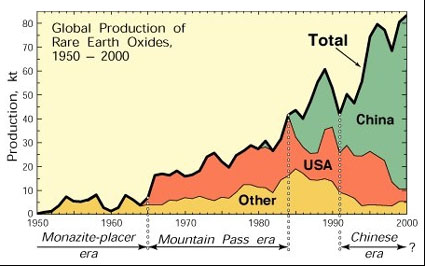
REEs are moderately abundant in the earth's crust, some more so than lead, gold and platinum. However, REEs are not concentrated enough to make them easily exploitable economically. Once self-reliant in domestically produced REEs, the U.S., over the past 15 years, has become 100% reliant on imports, primarily from China.
There is no REE mine production in the U.S. U.S.-based Molycorp operates a separation plant at Mountain Pass, CA, and sells the REE concentrates and refined products from previously mined aboveground stocks.
What can we do to solve REE crisis? We have three choices:
About 124,000 metric tons (mt) of REEs were produced in 2009, with worldwide demand during this period estimated at 134,000mt—the difference made up from existing stockpiles. By 2012, global demand is expected to reach 180,000mt; and mining operations can't meet demand in the near term.
The Congressional Research Service explored the situation in a late-July report.
Unfortunately, there isn't much actual competition because China produces 97% of REEs worldwide, which puts the U.S. in a precarious position.
Critical to the discussion is the fact that 97% of REE production is currently controlled by China, where internal demand is rising and interest in exporting REEs is falling as China's leaders look to take advantage of their country's market dominance.
REEs are moderately abundant in the earth's crust, some more so than lead, gold and platinum. However, REEs are not concentrated enough to make them easily exploitable economically. Once self-reliant in domestically produced REEs, the U.S., over the past 15 years, has become 100% reliant on imports, primarily from China.
There is no REE mine production in the U.S. U.S.-based Molycorp operates a separation plant at Mountain Pass, CA, and sells the REE concentrates and refined products from previously mined aboveground stocks.
What can we do to solve REE crisis? We have three choices:
- Find REE substitutes or redesign processes/products that don't require them
- Find new economically viable REE reserves, preferably in the U.S. or a friendly country (e.g., Australia).
- Invade China